
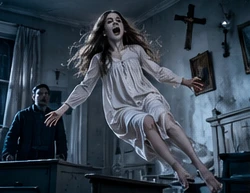

A Dark Page narrative inspired by a historical account or enduring legend. The scenes are literary reconstructions, not eyewitness transcripts.
The first sound was small enough to dismiss. In a north London home, where children slept behind thin doors and the ordinary noises of the street filtered through the windows, a knock came from a place where nobody stood. Another followed. The family listened. The house, which had always been a shelter, began to feel like something that was listening in return.
It was 1977, and the Hodgson family lived in Enfield. The children told their mother about movements and noises that frightened them. Furniture seemed to shift. Objects appeared in unexpected places. When the disturbances continued, neighbours and then investigators entered the story. Every visitor brought a new pair of eyes, but also a new interpretation of what those eyes were seeing.
The most famous scenes gathered around Janet, an eleven-year-old girl. Witnesses described strange voices and episodes that seemed impossible to reconcile with an ordinary childhood. Cameras clicked; tape recorders rolled. A child’s bedroom became an unlikely theatre in which adults tried to decide whether they were observing mischief, distress, something unknown or a mixture of all three.
Imagine the exhaustion of a family living under that attention. In daylight, the room still contained its familiar bed, toys and walls. At night, the smallest creak could summon everyone to the landing. A photograph might preserve a fraction of a second, yet it could not capture what happened immediately before or after. A recording might preserve a voice without explaining where it came from.
Some investigators became convinced that they had witnessed extraordinary phenomena. Others challenged the accounts, and some incidents were acknowledged as tricks. The argument followed the story into books, documentaries and dramatisations. But the image that endures is quieter than the most sensational headline: a mother looking down a dark corridor, wondering whether the next sound will come from her children or from the house itself.
The Enfield story remains an account of a reported haunting, not an established supernatural event. Its enduring power comes from the uncertainty. The house is ordinary. The people are recognisable. And the question that opens the story is the same one that closes it: when something knocks in the dark, how do we know who—or what—is on the other side?
Further reading: The Bell Witch · The Vallecas Case.




[…] reading: The Enfield Poltergeist · The Bell […]