
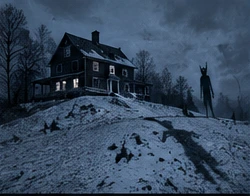

A literary retelling of a reported event or enduring legend. Atmospheric scenes are reconstructed, not eyewitness transcripts.
In Amherst, Nova Scotia, a small household begins to attract an unusual number of visitors. They arrive because of sounds from rooms that should be quiet and objects said to move without a visible hand. Soon the story is larger than the house itself.
At its centre is Esther Cox, a young woman whose experiences became the subject of a nineteenth-century account popularised by Walter Hubbell. Reports describe knocks, threatening words and episodes that witnesses struggled to explain. Each new incident drew another observer.
Picture a visitor seated beside a lamp, determined to remain calm. The house creaks. Someone points towards the ceiling. A sharp noise interrupts the conversation. The observer reaches for a notebook, trying to turn a fleeting moment into a reliable record.
The household’s private life becomes increasingly public. Curiosity brings strangers to the door; strangers bring their expectations. Esther is asked to occupy two roles at once: a frightened person living through an unsettling time and the central figure in a spectacle that other people have come to witness.
The accounts belong to an era fascinated by spiritualism and extraordinary manifestations. Their dramatic details are not equivalent to independently verified proof of a poltergeist. Yet the social scene they describe is compelling: an entire town trying to decide what to believe about a single house.
Long after the visitors leave, the Amherst legend remains. It is a story about unseen forces, but also about the very visible weight of attention placed upon someone whose experiences have become public property.
Further reading: The Enfield Poltergeist · The Bell Witch.




[…] reading: The Great Amherst Mystery · The Enfield […]