


← Back to Lost Treasures & Ancient Maps
In July 2009, Terry Herbert took his metal detector into a Staffordshire field with the permission of its owner, Fred Johnson. Beneath the ploughsoil lay fragments of gold and garnet that had once caught the light on the weapons of Anglo-Saxon warriors. The iron blades were largely absent. What survived were the parts that had made those weapons worth looking at.
The Staffordshire Hoard is the largest collection of Anglo-Saxon gold and silver metalwork yet discovered. Its contents have forced historians to look again at warfare, skilled labour and the wealth of early medieval England. They also pose a question that no amount of gold can answer on its own: why did someone put it all in the ground?
A field in the old kingdom of Mercia
Herbert reported the discovery, and archaeologists investigated the site near Hammerwich. The field lay within the territory of early medieval Mercia, near the old Roman road of Watling Street. The hoard contains thousands of fragments representing roughly 700 objects. Historic England’s research summary puts the metals at about four kilograms of gold and 1.7 kilograms of silver. The fragments tell two stories at once: how the objects were made, and what happened when they were taken apart.
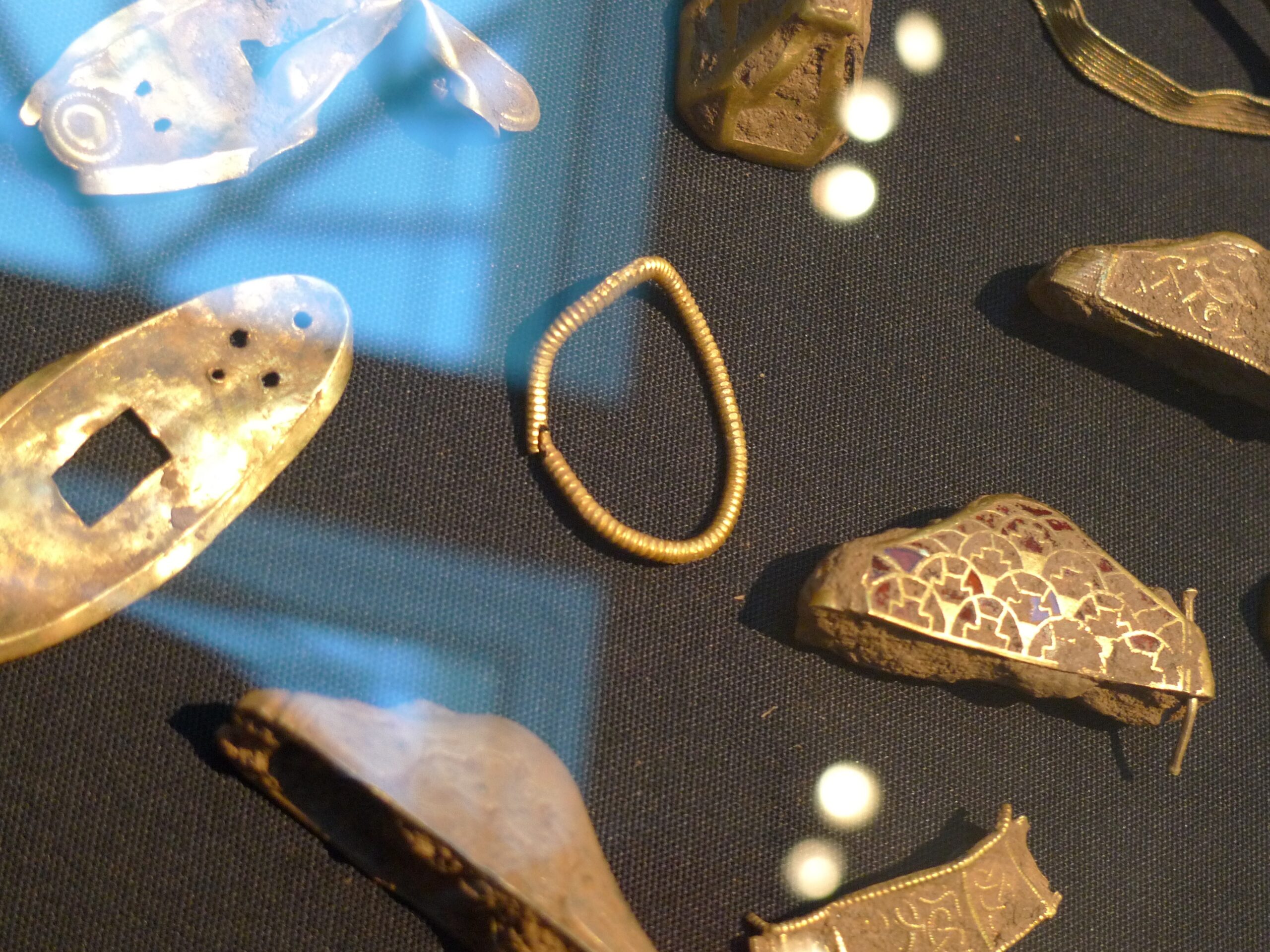
Sword pommels, hilt fittings and pieces of a helmet make up much of the collection. The concentration of richly decorated war gear suggests a world in which the appearance of a weapon mattered. A hilt visible at a gathering or on the battlefield could mark its owner’s standing. A gold cross among the finds complicates the picture. The people who valued these objects lived through the spread of Christianity, and the collection brings devotional imagery into close company with arms.
What the goldsmith saw
Look closely at a garnet fitting and the metal almost disappears into the pattern. The craftsperson divided the surface into tiny cells, shaped red stones to fit them and set the stones into place. In some pieces, patterned foil beneath the garnets catches the light and sends it back through the stone. Elsewhere, fine gold wire forms interlaced designs and small animal shapes. These details were made for hands and eyes at close quarters, even when the finished weapon was meant to impress at a distance.
Research into early medieval garnets points to sources as far away as South Asia for some stones. A stone’s geological origin can suggest a chain of trade and reuse. It cannot tell us every port, workshop or owner it passed through. The goldsmith working in England may never have known where the stone began its journey.
Why bury it?
The hoard was probably buried in the seventh century. Some fittings had been stripped from the objects they once decorated, and some pieces had been bent or broken. That makes it tempting to imagine the spoils of warfare gathered together, a stock of precious metal awaiting reworking, or a deposit made for a purpose we no longer recognise. Each possibility accounts for part of what survived. None identifies the person who dug the hole or explains why the collection was left there.
From a £3.285 million valuation to two museums
The find was declared treasure under the Treasure Act 1996. In November 2009, the Treasure Valuation Committee valued it at £3.285 million. In this case the reward was divided equally between Herbert and Johnson, about £1.64 million apiece.
Birmingham and Stoke-on-Trent worked together to acquire the collection. The Art Fund led a public appeal, and a £1.285 million grant from the National Heritage Memorial Fund closed the funding gap. The West Midlands kept the hoard together for research, conservation and public display. Today, its care is shared by Birmingham Museums and The Potteries Museum & Art Gallery in Stoke-on-Trent.
The first signal in the field led to an object small enough to hold in a hand. The discovery’s lasting value lies in what researchers can see when those small things are studied together: a goldsmith’s choices, a warrior’s status and the traces of a decision made in Mercia more than thirteen centuries ago.





[…] reading: The Staffordshire Hoard · The Lost Library of Ivan the […]
[…] Further reading: The Piri Reis Map · The Staffordshire Hoard. […]
[…] Read the complete article: The Staffordshire Hoard: A Treasure Hidden in Plain Earth → […]
[…] reading: The Staffordshire Hoard · The Nazca […]
[…] reading: The Staffordshire Hoard · The Lost Amber […]