

A Dark Page narrative inspired by a historical account or enduring legend. The scenes are literary reconstructions, not eyewitness transcripts.
The farmhouse seemed to have acquired a second inhabitant, one who never opened a door and never appeared at the table. At first, there were noises: knocks in the walls, scratches in places too narrow for anyone to stand. The family waited for the sounds to stop. Instead, the story says, they grew bolder.
The Bell Witch legend belongs to Tennessee’s early nineteenth-century folklore. John Bell, his daughter Betsy and the family home became the centre of a narrative about an unseen presence that seemed to know their habits and private fears. Later tellings gave the entity a voice, a temper and an almost human delight in tormenting its hosts.
Imagine sitting beside a lamp while a visitor asks the darkness a question. Everyone falls silent. A creak comes from above. Someone insists that the reply was unmistakable; another hears only the house settling. By the next morning the disagreement has become part of the story, and by the next week the story has travelled to another town.
The tale eventually acquired darker claims about John Bell’s death and famous visitors. Such episodes are difficult to establish from contemporary records; much of the familiar account was written down long after the events it describes. Folklore, however, does not need a courtroom verdict to survive. It needs a place, a name and listeners willing to imagine the scene.
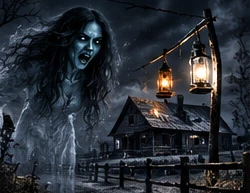
The Bell home in the legend is frightening precisely because it remains domestic. The fields outside are ordinary, the family routines familiar, and the threat seems to speak from the same walls that ought to provide protection. There is no distant castle and no forbidden ruin, only a household in which the invisible has become impossible to ignore.
Whether read as a haunting or as an example of how communities preserve fear, the Bell Witch is a story about the fragile boundary between home and the unknown. The most unsettling detail is not the voice itself. It is the possibility that the voice has been listening all along.
Further reading: The Great Amherst Mystery · The Enfield Poltergeist.



