
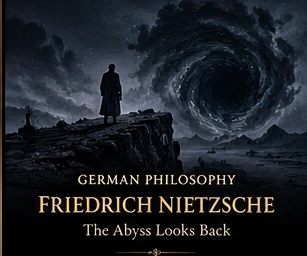

There is a particular kind of fear that begins not when we encounter something strange, but when the strange begins to resemble us. Friedrich Nietzsche’s famous image of gazing into an abyss endures because it reverses the direction of inquiry. We imagine ourselves as observers: detached, rational, safely standing at the edge. Yet sustained attention changes the observer. The question is no longer simply what lies below. It is what prolonged contact with darkness does to the person looking down.
When a Question Changes Its Questioner
We encounter this reversal whenever we investigate cruelty, obsession, corruption or despair. At first, we search for explanations outside ourselves. Then a more unsettling thought arrives: the impulses we study may exist, in lesser or disguised forms, within us. Nietzsche’s image is not a supernatural warning that a chasm has eyes. It is a literary and philosophical warning about the moral and psychological costs of attention.
Consider a detective who spends years understanding a killer, or a scholar who studies propaganda until every conversation begins to sound like manipulation. Knowledge is necessary, but immersion is not neutral. A mind can become shaped by the patterns it repeatedly rehearses. That is the abyss’s most credible power.
The Mystery Is the Mirror
We often travel toward the unknown hoping to discover an answer. Sometimes the journey instead reveals the architecture of our own fear. Why do certain mysteries fascinate us more than others? Why do we look again at the thing that disturbs us? The abyss may be less a destination than a mirror held at an uncomfortable angle.
Perhaps the most courageous response is neither to avert our eyes nor to surrender to darkness, but to keep asking what the act of looking is making of us. The final mystery is not whether the abyss looks back. It is whether we recognize the face that answers.
Further reading: German thought and meaning · Dostoevsky and human nature.




[…] Further reading: Schopenhauer, Nietzsche and Goethe · Nietzsche and the abyss. […]
[…] Further reading: Poe and the uncertain world · Nietzsche and the abyss. […]