

On 21 August 1986, a lake in Cameroon released an invisible danger. The catastrophe revealed a natural process few people had imagined—and inspired an extraordinary effort to prevent its return.
Nothing on the Surface
There is something disarming about a lake. Its surface offers a simple promise: what we can see is what is there. The water reflects the hills, the sky, the slow passage of clouds. A traveller looking across Lake Nyos in northwestern Cameroon might have seen a beautiful crater lake enclosed by green slopes. What the surface could not reveal was an immense store of gas dissolved in the deep water.
On the evening of 21 August 1986, that hidden reservoir was released. A cloud of carbon dioxide moved out from the lake and into surrounding valleys. The gas was colourless, and its lethal effect was suffocation rather than fire or poison in the familiar sense. Approximately 1,700 to 1,800 people died, along with thousands of animals. Estimates differ slightly among scientific and institutional accounts; the scale of the tragedy does not. Villages near the lake were devastated by a disaster that seemed, at first, almost impossible to explain.
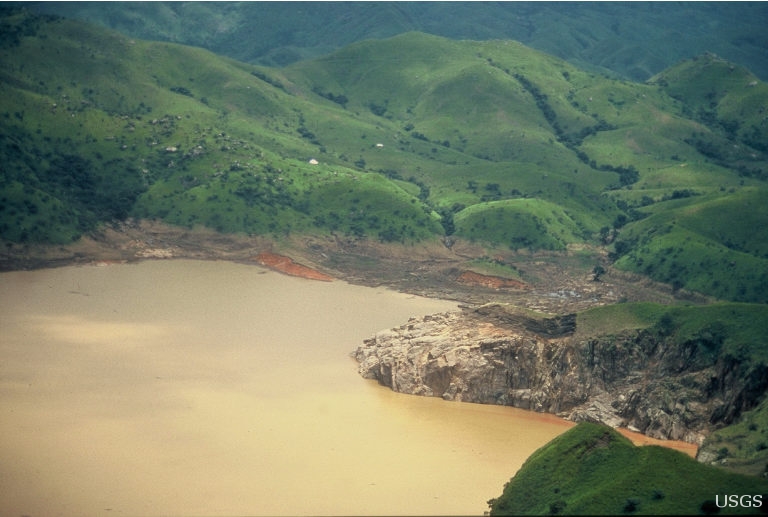
The Volcano That Did Not Need to Erupt
Lake Nyos occupies a volcanic crater in the Oku Volcanic Field. Carbon dioxide of deep geological origin enters the lake through groundwater. In ordinary conditions, gas can escape from surface water into the atmosphere. But deep water under pressure can hold large quantities of dissolved carbon dioxide. If the lake remains strongly layered, the gas-rich water at depth may stay isolated from the surface for long periods.
Think of a sealed bottle of sparkling water. While the pressure is high, much of the gas remains dissolved. When pressure falls, bubbles form and expand. At Nyos, the analogy is useful but incomplete: the lake was not a bottle someone opened, and its enormous volume made the consequences radically different. Once gas-rich water began rising, falling pressure allowed more carbon dioxide to come out of solution. That could drive further upward movement and rapid gas release—a process scientists call a limnic eruption.
The gas then spread through the lower landscape. Carbon dioxide is denser than ordinary air under comparable conditions, so a sufficiently concentrated cloud can collect in low-lying places and displace breathable air. People and animals exposed to such an atmosphere may lose consciousness without the visible warning associated with smoke or flames.
What Set It Off?
Knowing how the catastrophe unfolded is not the same as knowing precisely what initiated it. Scientists have investigated possible triggers, including disturbance of the water column and changes in gas-rich water entering the lake. The initiating event remains a subject of scientific discussion. It would be misleading to present a landslide, an earthquake or a sudden volcanic explosion as an established single cause.
Geochemical investigations after the disaster found strong evidence that the carbon dioxide was linked to deep geological sources. The decisive danger was not a conventional eruption of lava, but the sudden release of gas that had accumulated invisibly in the lake. The distinction matters: it turns an apparently supernatural tale into a comprehensible, if rare, natural hazard.
A Warning Two Years Earlier
Nyos was not the first Cameroonian lake to produce a deadly gas release. In 1984, Lake Monoun experienced a smaller event that killed 37 people, according to the U.S. Geological Survey. Seen together, the two disasters showed that a lake could store dangerous quantities of gas and release them with catastrophic results. This was a geological threat that did not announce itself with the familiar spectacle of a volcano.
The lesson was also human. A rare hazard is easy to overlook when it does not fit the hazards a community has learned to recognise. After Nyos, scientists, engineers and local authorities faced an urgent question: could the invisible reservoir be emptied gradually, before it emptied itself again?
The Fountain Built to Prevent Another Night
The answer was a remarkable piece of engineering: pipes reaching into the gas-rich depths. As deep water rises in a pipe, pressure drops and carbon dioxide escapes, helping propel the flow upward. The resulting fountain is striking, but its purpose is not spectacle. It allows dissolved gas to be removed in a controlled manner.
A degassing installation began operating at Lake Nyos in 2001, and additional pipes were installed in 2011. In a 2020 scientific paper, researchers reported major progress in reducing the lake’s stored gas and described how continued controlled discharge could balance its natural carbon dioxide recharge. That research supports the value of long-term mitigation; it does not justify claiming that the lake can never again pose a risk or that monitoring is unnecessary.
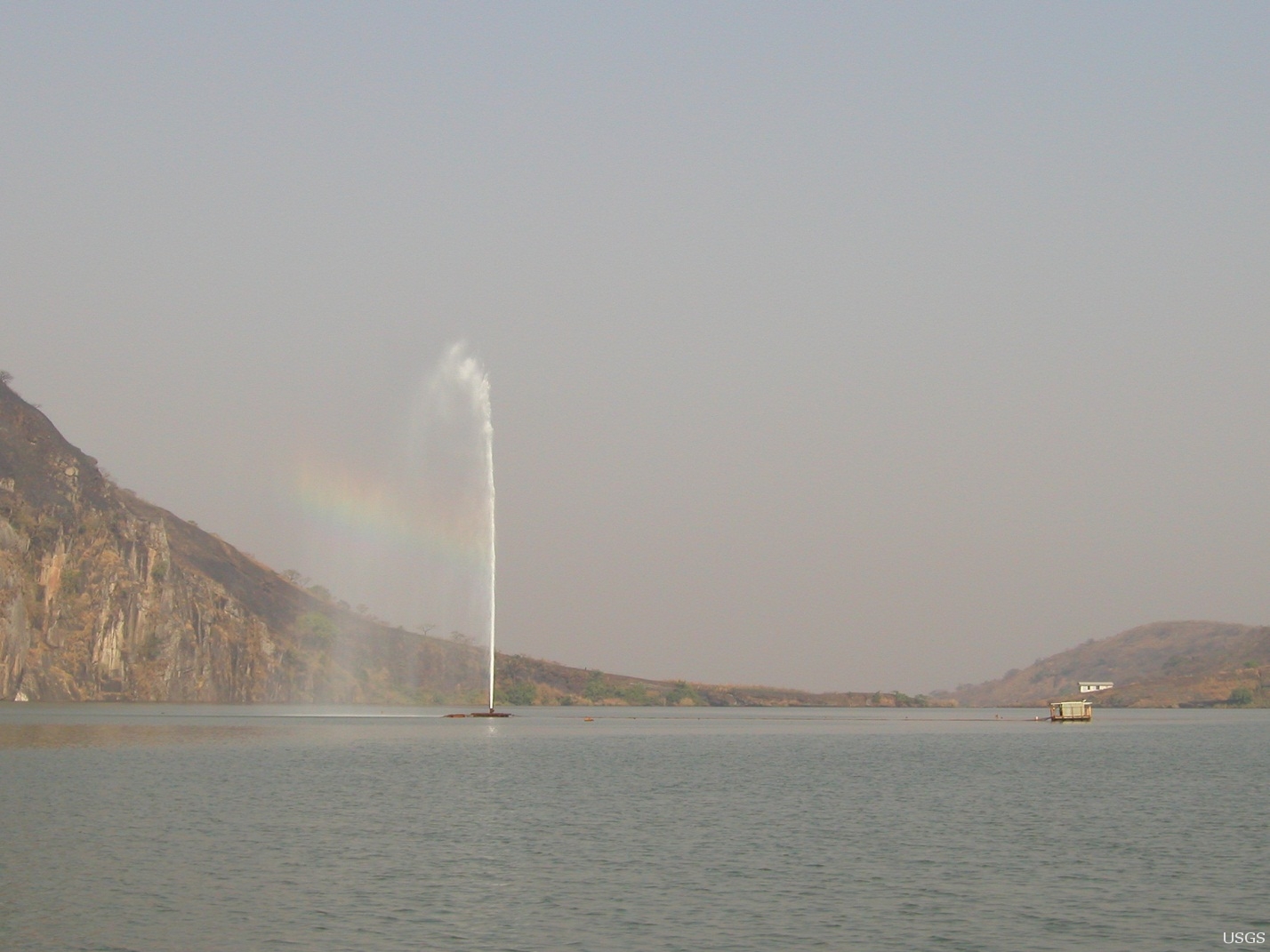
The Mystery Was Real. The Explanation Matters.
Some dark stories invite us to choose between disbelief and the supernatural. Lake Nyos offers a third possibility: an event so extraordinary that it seems invented, yet documented by field investigations, satellite observations and engineering studies. Its explanation does not make it less haunting. It makes the lives lost, and the work of prevention, more important.
The lake’s terrible lesson is not that nature is malicious. It is that familiar appearances can conceal unfamiliar physics. Beneath a peaceful surface, pressure and chemistry may be writing a story nobody can read until scientists learn its language. At Nyos, the task of reading that story came too late for thousands of families. The work that followed was an attempt to ensure that it would not come too late again.
Evidence and Further Reading
- U.S. Geological Survey (1987): scientific investigation of the 21 August 1986 disaster
- NASA Earth Observatory (2015): Lake Nyos, Cameroon
- U.S. Geological Survey: degassing fountain, explanation and public-domain image
- U.S. Geological Survey: historical photograph, Jack Lockwood, public domain
- Halbwachs, Sabroux and Kayser (2020): research on the Lake Nyos degassing programme
- Kusakabe and Ohsumi (1987): geochemical investigation of the gas release
Related environmental disasters: Explore London’s Great Smog and the aftermath of Mount Tambora.
Editorial note: This is a documented natural disaster, not evidence of a paranormal event. Death tolls are approximate and vary by source. The initial trigger of the gas release is not presented as definitively established. Both photographs are from the U.S. Geological Survey and are identified by that agency as public domain.




[…] environmental disasters: Read about the Lake Nyos gas disaster and the year without a […]
[…] Related natural disasters: Explore the Great Smog of London and the Lake Nyos disaster. […]