

DARK PAGE • DARK HISTORY / THE JOURNAL
The Summer the Sun Forgot
The volcano that dimmed the world—and helped give Gothic literature one of its most enduring nightmares.
Imagine opening your door in June and finding winter waiting on the threshold. The fields are planted, the calendar insists it is summer, and yet frost returns like a visitor who has forgotten how to leave. Far away, a poet watches a darkened lake. A young writer sits indoors and begins to imagine a creature assembled from the dead. Neither the farmer nor the writer can see the cause of the strange season. It lies on an island thousands of miles away, in the remains of a mountain that has already exploded.
The year is 1816. Later generations will remember it as the Year Without a Summer. The phrase sounds like a fairy tale, but its consequences were painfully real: failed harvests, rising food prices, disrupted livelihoods and hunger across parts of the Northern Hemisphere. The disaster also left a curious literary afterimage. In the stormy gloom near Lake Geneva, the idea that would become Frankenstein began to take shape.
A Mountain Breaks, a Sky Changes
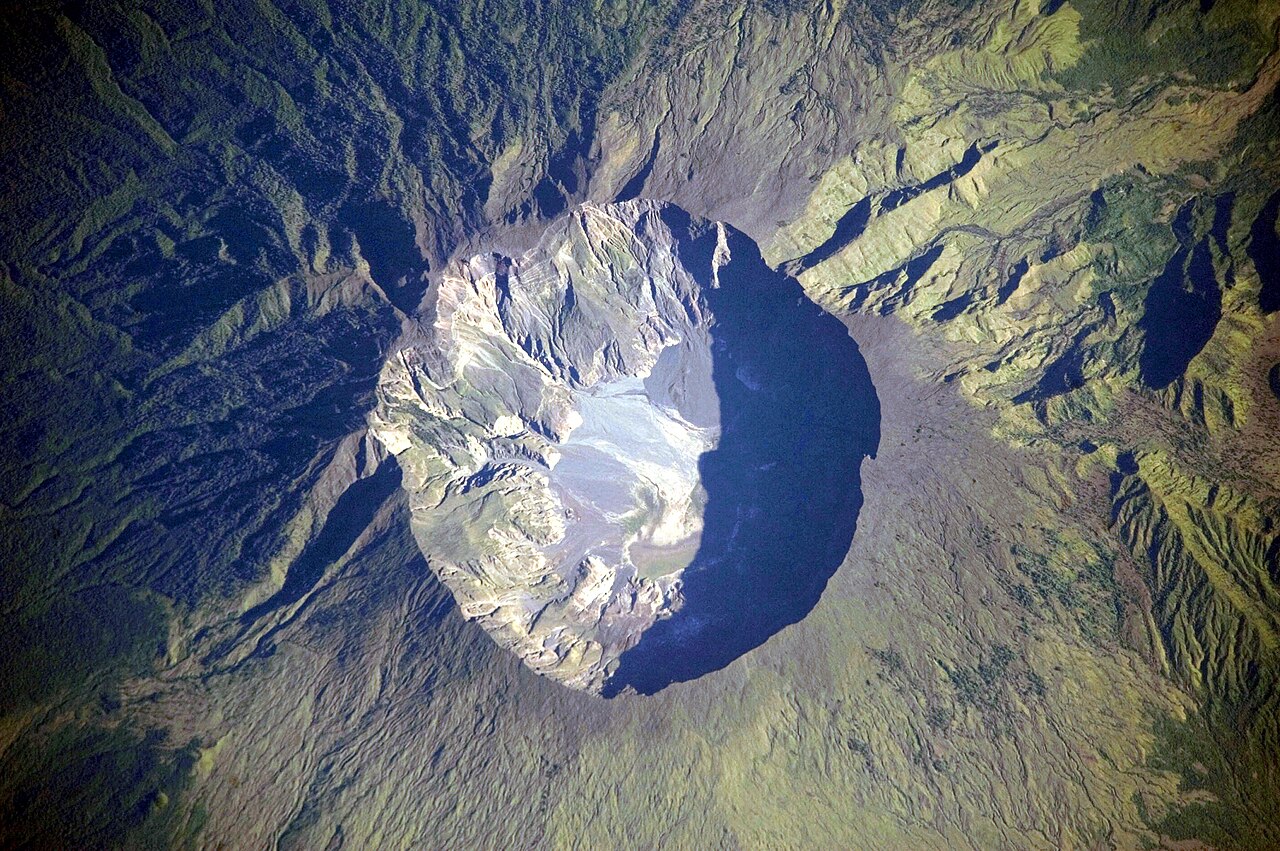
On 10 April 1815, Mount Tambora on the Indonesian island of Sumbawa entered its catastrophic eruptive phase. The blast tore away much of the mountain’s summit, leaving the immense caldera visible in modern satellite and astronaut photographs. The eruption devastated nearby communities; many people died in its immediate violence, and many more suffered as food supplies collapsed and disease spread. Scientific reviews describe it as one of the most consequential volcanic events in recorded history.
But Tambora’s reach did not end where the ash fell. Sulphur dioxide released high into the atmosphere was transformed into tiny sulphate aerosol particles. These particles scattered incoming sunlight and altered the planet’s energy balance. A volcano does not need to throw a permanent curtain over the sun to disturb a harvest: a relatively modest change in average temperature, arriving at the wrong moment in the growing season, can have enormous human consequences.
Researchers reconstruct the eruption’s climatic effects through several independent kinds of evidence: early thermometer observations, tree rings, ice-core chemistry and climate models. One scientific review estimates Northern Hemisphere and tropical cooling of roughly 0.4–0.8°C relative to preceding decades. The exact magnitude varies by region and by method. The cold was not identical everywhere, and the world did not literally lose every warm day. The historical name describes the severity of an extraordinary season, not a planet frozen solid.
Frost in the Fields, Fear at the Table
In parts of northeastern North America, late frosts and unusual summer snow struck crops already struggling through a short growing season. Across sections of Europe, cold, persistent rain and damaged harvests helped drive hardship and food-price increases. Farmers could not simply wait for the weather to become normal: seed, livestock feed, credit and the next winter’s provisions were all connected to a single fragile harvest.
These details matter because the disaster is often told as a spectacle—a volcano, a dark sky, a sensational temperature number. Its most enduring consequences were quieter. Families counted what remained in the grain store. Traders watched prices climb. People migrated, improvised or went hungry. A change in atmospheric chemistry became a crisis of ordinary human life.
Scientists also caution against reducing every unusual event of the 1810s to Tambora alone. The period was already climatically unsettled; research identifies an earlier major eruption around 1809, and background climate variability shaped the regional response. Tambora was a major driver of the extraordinary conditions of 1816, but historical weather is never a single-cause machine.
The Dark House Beside the Lake
That summer, a small circle of writers and friends gathered near Lake Geneva. Among them were Mary Godwin—later Mary Shelley—Percy Bysshe Shelley, Lord Byron, Claire Clairmont and John Polidori. Storms and gloomy weather kept them indoors. Byron proposed a ghost-story challenge. In that atmosphere of confinement, conversation and speculation, Mary began the idea that became Frankenstein; or, The Modern Prometheus.
The story is often simplified into a charming formula: a volcano created a monster. The real chain is more interesting. Tambora contributed to the abnormal weather; the weather helped shape the conditions of a literary gathering; and the gathering became one moment in a much larger process of imagination, reading and intellectual debate. Mary Shelley also drew on contemporary questions about electricity, life, responsibility and the limits of scientific ambition. The weather did not write her novel. She did.
Polidori’s experience at the same gathering would help produce The Vampyre, another influential work of Gothic literature. Thus a season of environmental disruption entered cultural memory not only through accounts of hunger and cold, but also through fictional beings that still inhabit our screens and books. The connection is striking precisely because it does not require supernatural intervention.
The Evidence Left Behind
Today, the mountain’s missing summit is visible from space. Sulphate signals in polar ice provide another kind of record, preserved where human witnesses could never have travelled in 1816. Climate simulations test how volcanic aerosols might have altered temperature and rainfall. Historical diaries and agricultural records tell us what those changes meant at ground level. No single archive is sufficient; together, they build a compelling account.
It is tempting to imagine the planet as an immense stage on which every tragedy has a clear villain. Tambora offers a more unsettling lesson. The Earth is connected by systems that ignore borders and intentions. A chemical plume above one island can influence weather over distant continents. A failed harvest can alter a family’s future. A storm can keep a writer indoors long enough for an unforgettable question to emerge: what happens when human beings create life but refuse responsibility for it?
There was no spell over the summer of 1816. There was a volcano, a changing atmosphere, a vulnerable food system and a world trying to understand what had happened. That is what makes the story extraordinary. The darkness was real—and so were the people who lived through it.
Evidence & Further Reading
U.S. National Park Service — 1816: The Year Without Summer
Raible et al. (2016) — Tambora 1815 as a test case for high-impact volcanic eruptions
Kandlbauer et al. (2013) — Climate and carbon cycle response to the Tambora eruption
British Library — Mary Shelley’s Frankenstein and the 1816 gathering
NASA astronaut image: Mount Tambora caldera (public domain)
Editorial note: The atmospheric opening is a literary reconstruction, not a quotation from a named eyewitness. Historical and scientific claims are distinguished from interpretation.
Related natural disasters: Explore the Great Smog of London and the Lake Nyos disaster.





[…] Related environmental disasters: Explore London’s Great Smog and the aftermath of Mount Tambora. […]