

Dark History / Science & Society — A true story of the five days when the air became an enemy, and the political reckoning that followed.
When the City Lost Its Edges
There are disasters that announce themselves with a noise. A wall gives way. A river rises. A mountain opens. London’s disaster of December 1952 entered without a single defining sound. It arrived as a familiar visitor: fog. A city accustomed to winter mist had no reason to imagine that the air itself might become the instrument of a catastrophe. The streets did not collapse; the buildings remained standing. What disappeared was the space between them. By the time the weather changed, thousands of people had died, and the city had been forced to confront something it had long mistaken for an ordinary feature of urban life.
The Great Smog lasted from 5 to 9 December 1952. It was not simply a natural fog that happened to be unusually dense. Cold, still weather coincided with smoke from coal fires and other combustion sources. The atmosphere held the pollution near the ground instead of allowing it to disperse. Visibility in places fell to only a few metres. Vehicles struggled, movement slowed, and even indoor spaces could not be entirely sealed from the polluted air. The disaster’s most disturbing feature was its familiarity: Londoners had known smoky fog for generations, but this time an everyday inconvenience had become a public-health emergency.
A City Heated by Coal
To understand the smog, imagine the city before the modern language of air-quality alerts. Coal was not an exotic industrial substance. It warmed rooms, fed power stations and powered a landscape of furnaces and chimneys. During cold weather, countless households had practical reasons to keep fires burning. Each individual flame seemed small; together they formed a vast, continuous emission. Soot and sulphur dioxide entered an atmosphere already holding moisture, while industrial activity contributed further pollution. The familiar term “pea-souper” made the spectacle sound almost picturesque. Yet the colour and thickness were signs of material suspended in the air people were breathing.
A high-pressure weather system, with little wind and a stable layer of air, helped trap emissions close to the surface. This is the crucial distinction between the weather and the disaster. The weather created the conditions, but the fuel burned across the city supplied much of the poison. Fog did not invent the pollution; it revealed the dangerous scale of what had already become normal. The Royal Meteorological Society describes the combination of cold anticyclonic weather, coal combustion and unusually persistent smoky fog.
The Unseen Casualties
There is a temptation, when writing about a historical catastrophe, to invent a single dramatic witness and allow that person to speak for everyone. The more faithful story is less theatrical. The effects were spread across homes, hospitals and streets. Breathing became difficult for many people, especially those already vulnerable to respiratory illness. The very young, older people and those with existing health problems faced particular danger. A person might not have seen a falling building or a visible flame; the harm came with each breath, and the full toll was not obvious from the street.
Contemporary estimates associated roughly 4,000 excess deaths with the episode and its immediate aftermath. Later studies suggested that the wider mortality burden may have been much higher, with figures of up to approximately 12,000 often cited. These numbers should not be presented as two equally precise headcounts. They reflect different methods and periods of analysis: an early estimate of excess mortality versus later attempts to assess a broader aftermath. The Greater London Authority refers to more than 4,000 deaths, while the Royal Meteorological Society notes later estimates reaching 12,000. Precision matters most when the subject is human life.
What the Fog Revealed
One of the cruelest paradoxes of the Great Smog is that its danger was produced by the ordinary machinery of keeping a city alive. Warmth, electricity, work and domestic comfort depended heavily on fuels that, under particular conditions, made the air hazardous. The episode exposed a weakness in the idea that environmental damage must be spectacular before it becomes urgent. The pollutants were not strangers invading London. They were the accumulated consequences of everyday decisions, technologies and habits, made lethal by an atmospheric trap.
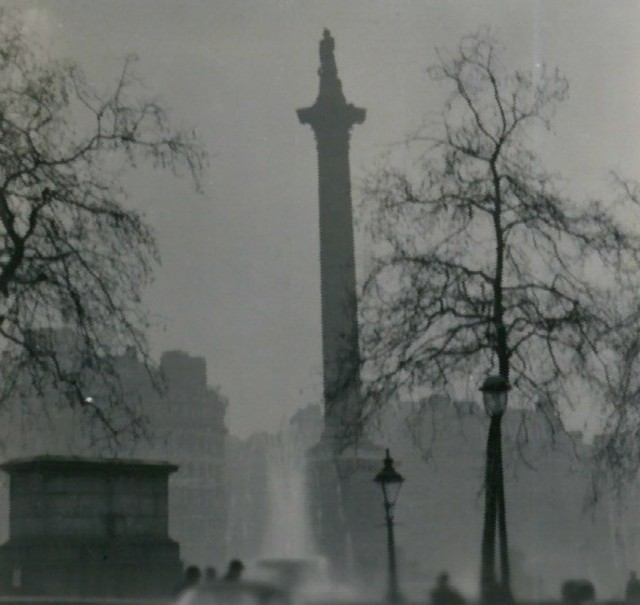
The disaster also changed the meaning of evidence. An obscured skyline is visible; the relationship between pollution and premature death requires measurement, comparison and sustained public-health analysis. Counting deaths above expected levels, examining respiratory illness and tracing the conditions of exposure were essential to understanding what had happened. A photograph could show Nelson’s Column fading into grey, but no photograph could show the whole burden borne by people whose illnesses worsened after the streets became visible again.
The Law That Followed the Silence
In 1956, Parliament passed the Clean Air Act, a landmark in Britain’s response to urban smoke pollution. It supported smoke-control measures and helped shift heating practices away from the most polluting forms of coal combustion. The legislation was not a magical ending. Changing fuels, equipment, buildings and industrial practices took time, and subsequent air-pollution episodes still occurred. But the political principle was profound: a problem long accepted as the price of city life could instead be treated as preventable harm requiring collective action.
The Act’s significance has been recognised in later parliamentary discussion and air-quality assessments. A House of Commons Environmental Audit Committee report explicitly linked the 1952 deaths to the 1956 legislation. Decades later, a 2022 City Hall review examined how much worse London’s air might have been without the Clean Air Acts. Such modelling is a counterfactual estimate, not a record of events that actually occurred, but it shows why the law remains central to the history of public health.
The Difference Between Darkness and Danger
London did not escape every form of air pollution when coal smoke declined. Modern cities face different mixtures of emissions, including pollution associated with traffic. Nor is every winter mist a threat. The lesson of 1952 is not to fear the appearance of fog; it is to understand the invisible substances that can accompany it. Air can be transparent and harmful, or opaque without being comparably toxic. The visible darkness was the warning, not the complete explanation.
Historical memory often gives catastrophe a dramatic image. For the Great Smog, it is the outline of a monument struggling to exist through a grey curtain. But the deeper image is a city learning that what it had accepted as atmosphere was partly a political and technological choice. The fog eventually lifted. Its questions remained: Who bears the cost of a city’s comfort? When does a familiar danger become unacceptable? And how many lives must be counted before the air is treated as something everyone has a right to breathe safely?
The most haunting thing about December 1952 is not that London vanished. It is that London had been living with the ingredients of its own disappearance for years.
Sources and verification
- Royal Meteorological Society, “65 years since the Great Smog” (5 December 2017) — weather, dates, health effects and later mortality estimates.
- Greater London Authority, “Seventy years on from the Great Smog” (5 December 2022) — contemporary official assessment and policy legacy.
- House of Commons Environmental Audit Committee, Air Quality Follow-up Report (2011) — historical death estimate and Clean Air Act.
- Wikimedia Commons: N T Stobbs, “Nelson’s Column during the Great Smog of 1952” — image provenance and CC BY-SA 2.0 licence.
Related environmental disasters: Read about the Lake Nyos gas disaster and the year without a summer.
Editorial note: This is original historical nonfiction. No dialogue or individual eyewitness scenes have been invented. Death estimates are presented with their methodological uncertainty. The historical photograph is used without modification.





[…] natural disasters: Explore the Great Smog of London and the Lake Nyos […]
[…] environmental disasters: Explore London’s Great Smog and the aftermath of Mount […]