


Dark Page | Wonder & Curiosity
The Other Side of the Quantum Threat
What if the machine feared for breaking tomorrow’s digital locks also helped humanity understand matter, discover medicines, and build cleaner technologies? Q-Day names the potential moment when a sufficiently capable fault-tolerant quantum computer can break important forms of today’s public-key cryptography. But there is another story: a quantum dawn, not a scheduled event or established scientific milestone, but a metaphor for the discoveries quantum technologies might enable. The first question is not whether a machine will become omniscient. It is whether we can learn to calculate with the very physical rules that govern the smallest constituents of nature.
A Computer That Does Not Think Like Us
Ordinary computers process bits, each representing zero or one. Quantum processors manipulate qubits, whose behavior can involve superposition, entanglement, and interference. That does not mean a quantum computer consciously thinks like the universe, tests every answer at once, or outperforms classical computers on every task. Its promise is more precise: certain mathematical and physical problems may admit powerful quantum methods. The difficult part is engineering enough reliable, error-corrected qubits and demonstrating an advantage that matters outside a laboratory. What happens when we can model a complex quantum system without having to approximate away so much of its behavior?
Medicine: Reading the Chemistry of Disease
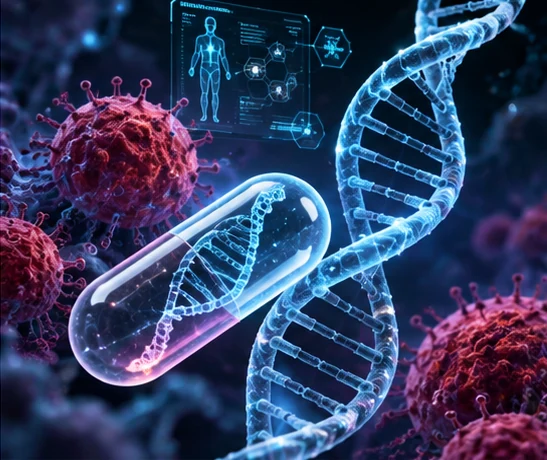
Disease unfolds through intricate interactions among proteins, molecules, cells, and organs. Researchers already use classical simulations, artificial intelligence, and experiments to discover drugs, but some molecular calculations remain exceptionally difficult. Quantum simulation could eventually help characterize selected chemical reactions, molecular energies, and candidate compounds more accurately. Imagine researchers narrowing a vast field of possible medicines before committing to costly laboratory studies. Could better molecular models uncover new approaches to resistant infections or help explain difficult steps in neurodegenerative disease? Possibly. Yet a molecular calculation cannot establish whether a treatment is safe or effective in a human body. Clinical trials, biological complexity, manufacturing, and equitable access remain indispensable. The remarkable prospect is not instant immortality; it is a deeper scientific map of where to search.
Energy: Designing What Nature Has Not Handed Us
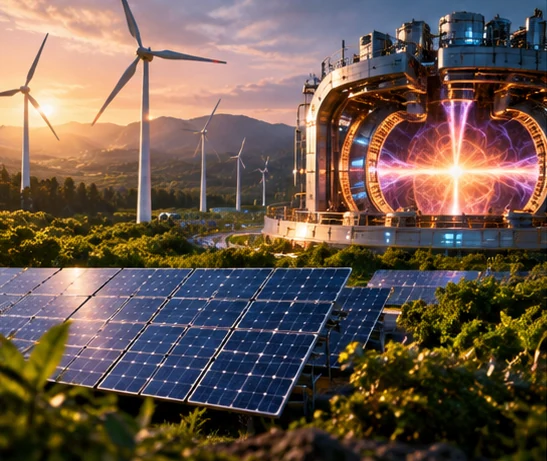
The clean-energy transition depends not only on power generation but also on materials: catalysts, battery electrodes, electrolytes, membranes, and devices that survive harsh conditions. Their behavior is ultimately rooted in quantum physics. Better simulations might help scientists investigate more abundant battery materials, improved catalysts, or compounds that capture carbon dioxide more efficiently. Could that make storage cheaper, industrial chemistry cleaner, or some energy technologies easier to scale? Perhaps—but no quantum algorithm alone can guarantee a battery that charges instantly, reverse climate change, or deliver limitless electricity. Engineering, resources, policy, and deployment still decide what reaches the world. Fusion offers a similar lesson: quantum methods might assist research into relevant materials and processes, but controlling plasma and building viable reactors remain distinct challenges.
Food: A Secret Hidden in an Enzyme
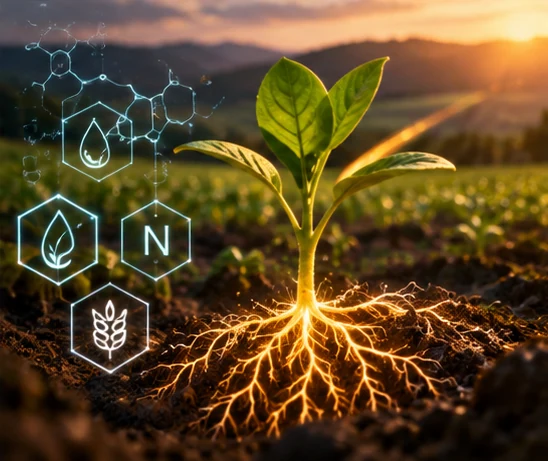
Modern agriculture relies heavily on nitrogen fertilizers, and industrial ammonia production consumes substantial energy. Yet some microorganisms fix atmospheric nitrogen using an extraordinary enzyme called nitrogenase. Its complex metal-containing active site raises difficult questions in quantum chemistry. If researchers can model its reaction pathways more faithfully, might they discover catalysts that make useful nitrogen compounds with less energy? That would be a meaningful advance. But ending hunger requires far more than efficient fertilizer: food distribution, affordability, water, land, conflict, and climate all matter. The deeper mystery is how biological chemistry performs transformations that industry still struggles to imitate.
New Materials: An Unwritten Periodic Future
Humanity has transformed civilization by learning to combine atoms into materials with unfamiliar properties. Quantum computing may one day help researchers investigate strongly interacting electrons, exotic magnetic phases, and candidate superconductors. Could it reveal a useful material that conventional simulations routinely miss? Could it accelerate the search for devices that waste less energy or sense the world with unprecedented precision? Those are research questions, not promised inventions. Even a theoretically remarkable material must be stable, manufacturable, affordable, and safe. Nature supplies the laws; discovering a practical design is still our responsibility.
Cities, Trade, and the Limits of Optimization
Transportation networks, supply chains, and power systems involve enormous optimization problems. Researchers are investigating whether particular quantum algorithms or hybrid methods can improve specific tasks. No general quantum shortcut has been established for every route, schedule, or traffic network. Still, the possibility invites an intriguing question: could future computing tools reduce wasted journeys, help coordinate emergency services, or make complex logistics more resilient? The answer will depend on measurable performance, real-world data, and human decisions. An efficient city is not automatically a just city. Who sets the objectives that its algorithms optimize?
The Paradox of Quantum Security
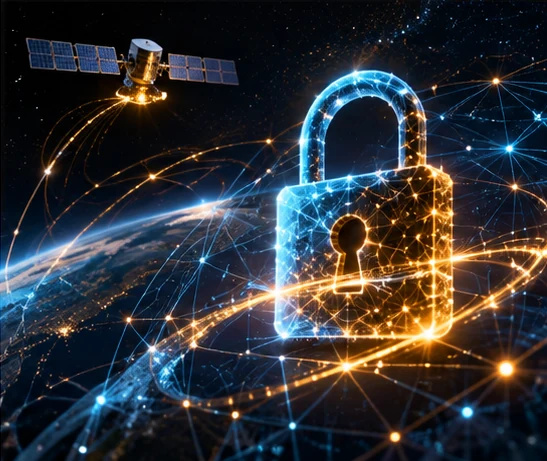
Quantum computing threatens some familiar cryptographic assumptions, yet quantum physics also supports new communication techniques. Quantum key distribution, or QKD, uses carefully prepared quantum states to help legitimate parties detect certain forms of interception during key establishment. Satellite and fiber experiments have demonstrated important capabilities. But QKD does not make an entire internet unhackable: endpoints, authentication, implementation flaws, and infrastructure remain vulnerable. Meanwhile, post-quantum cryptography offers new algorithms designed to run on conventional networks while resisting known quantum attacks. A safer future may require layered defenses rather than one miraculous lock. If we build stronger protections, who will enjoy them—and who might be excluded?
Quantum Computing Meets Artificial Intelligence
Artificial intelligence can help identify patterns, propose molecules, and guide experiments. Quantum processors might eventually assist selected scientific computations. Their combination is an active research area, but sweeping claims that quantum computing will automatically create conscious or vastly superior AI are unsupported. The more credible possibility is a research loop: models suggest hypotheses, simulations evaluate them, laboratories test them, and results refine the next questions. If machines become powerful collaborators in discovery, what will remain uniquely human? Choosing the problems worth solving, questioning the evidence, and deciding how discoveries should be used.
Who Holds the Key?

The most consequential quantum breakthrough might arrive not as a spectacular announcement but as a quiet technical advantage held by a small number of institutions. Advanced processors, specialist talent, cryogenic equipment, and research infrastructure are expensive. Will the benefits reach public hospitals, smaller laboratories, and lower-income countries, or become concentrated behind proprietary systems? And if a state acquires cryptographically relevant quantum capabilities before others are prepared, what happens to trust? Quantum progress is therefore a question of governance as much as engineering.
The Dawn Is a Question, Not a Guarantee
The quantum future will not necessarily abolish disease, hunger, energy scarcity, or cybercrime. The hardware remains difficult, and many proposed applications have yet to demonstrate practical superiority. Yet dismissing the field would overlook a profound possibility: building computers that use quantum effects to investigate quantum nature. Each successful scientific instrument expands what we can ask, not merely what we can answer. Q-Day asks whether our digital locks can survive new knowledge. Quantum dawn asks what we might build with that knowledge. Perhaps the ultimate revelation will be that the universe has not handed us a master key at all—only the means to discover how many doors we have never noticed.
Editorial note: This article explores research possibilities, not guaranteed outcomes or a predicted timetable.
Further reading: The Higgs Boson · Gravitational Waves.



