

DARK PAGE · THE AGE OF WONDER
The Night Spacetime Shuddered: When Two Black Holes Collided
Some questions grow stranger as we learn more.
A Signal Almost Too Small to Imagine
On 14 September 2015, two detectors in the United States registered a fleeting pattern: a rising oscillation that lasted only a fraction of a second. The change in the instruments was extraordinarily tiny, yet the signal carried news from far beyond our galaxy. Two black holes had spiralled together and merged. The universe had sent a message without using light.
Einstein’s Unsettling Prediction
General relativity describes gravity as the geometry of spacetime. When massive objects accelerate in certain ways, they can generate ripples that travel outward at the speed of light. Einstein’s theory predicted gravitational waves a century before instruments could detect them directly. The prediction was not that space makes an ordinary noise, but that distances themselves can change by minuscule amounts as a wave passes.
The Two Watchmen
The Laser Interferometer Gravitational-Wave Observatory, or LIGO, uses long perpendicular arms and exquisitely precise laser measurements. Its two widely separated detectors help distinguish a genuine cosmic signal from local disturbances. The first detection was announced in February 2016, following months of analysis. It opened an observational window that astronomy had never possessed before.
A Collision Without a Photograph
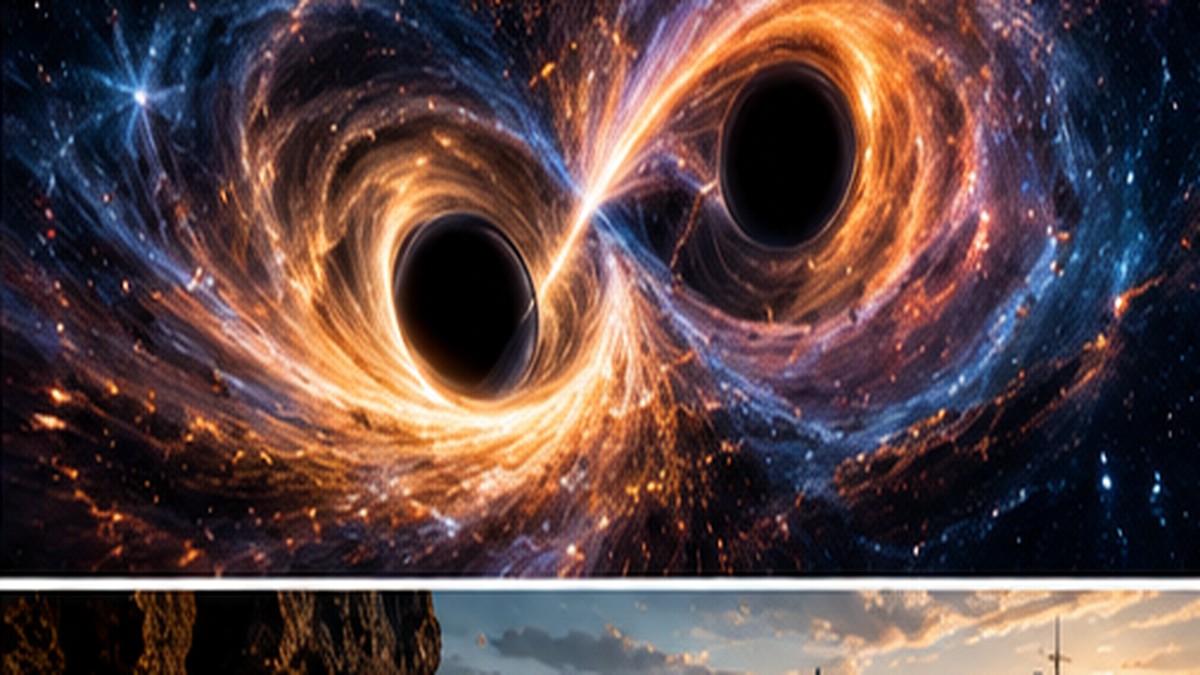
Black holes emit no light from within their event horizons, but their motion can shake spacetime. From the form of a gravitational-wave signal, researchers can estimate properties of the merging objects. The 2015 event demonstrated that stellar-mass black holes can form binary systems and merge. It was an encounter inferred from a physical trace, not a conventional picture taken by a telescope.
The Sound That Was Not Sound
Scientists sometimes convert gravitational-wave data into audio. The resulting chirp can be heard by human ears, but it is a translation of measured variations, not sound travelling through empty space. The distinction makes the achievement more remarkable. We built instruments capable of reading changes in the fabric of the universe and then found a way to make the data audible.
What Else Is Hiding in the Dark?
Later gravitational-wave observations included mergers involving neutron stars, and pulsar timing collaborations have reported evidence consistent with a low-frequency gravitational-wave background. Different detectors are sensitive to different frequencies and cosmic sources. Each new observing method expands the range of events we may be able to study.
The Final Tremor
For most of history, people learned about the heavens through light. Now we can investigate some of its most violent events through the movement of spacetime itself. How many stories have passed through Earth unnoticed because we had not yet invented a way to listen?
Editorial note: This feature separates established findings from interpretation, speculation and personal belief.
Further reading: Beyond the Last Star · The Higgs Boson.




[…] the science behind the story: Read how scientists detected gravitational waves, then discover Leo’s adventure near a black […]