

A literary retelling of a reported event or enduring legend. Atmospheric scenes are reconstructed, not eyewitness transcripts.
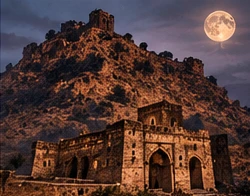
At the edge of Rajasthan’s hills, the ruins of Bhangarh rise beneath an enormous sky. Walls mark the outlines of buildings whose inhabitants have long vanished. In daylight, visitors walk through the remains of markets and courtyards. As evening approaches, shadows gather beneath the arches.
The approach to the fort is part of its spell. The visitor passes stone gateways and broken structures, then looks towards the surrounding hills. Once, the site was a settlement with ordinary concerns: trade, worship, water, work and families. A ruined street can conceal more lives than a ghost story ever tells. The legends borrow that vanished energy and turn it into a single dramatic catastrophe.
In one popular version, a magician becomes obsessed with Princess Ratnavati and attempts to enchant her. His scheme is discovered, and a curse follows. The tale has the shape of a moral fable, complete with forbidden desire and retribution. Its details are part of local folklore, not a documented explanation for the site’s historical decline.
As the light changes, the same stones seem to alter their meaning. A doorway that framed a courtyard in the afternoon becomes a black opening. A bird taking flight may sound like footsteps. None of these sensations proves a haunting; each shows why ruined architecture is such fertile ground for the imagination. Bhangarh remains compelling because its history and its legend are both present, but they should not be mistaken for the same thing.
The fort has become inseparable from stories of a curse. One familiar legend tells of a princess and a sorcerer whose desire was answered with disaster. The details vary between storytellers, but the outcome is always a place abandoned to silence.
Imagine a traveller standing at the end of an old street. Wind moves through an empty doorway, and for a moment the sound resembles distant conversation. The mind fills the ruins with shopkeepers, footsteps and the metallic echo of a sword. The traveller turns, but there is nobody there.
Restrictions on entering the site after dark are often repeated as if they were official confirmation of a haunting. They are not. Rules governing historic sites may serve safety, preservation and visitor-management purposes.
The stones remain important historical remains regardless of the legends. Yet folklore supplies something archaeology alone cannot: an imagined voice for the people whose lives once animated the streets.
Bhangarh’s power comes from that double vision. One sees a real ruin and, behind it, a second city made of stories. When the last light leaves the walls, it is the imagined city that seems to wake.
Further reading: The Hollywood Roosevelt Hotel · The Vallecas Case.




[…] reading: Bhangarh Fort · The Vallecas […]