
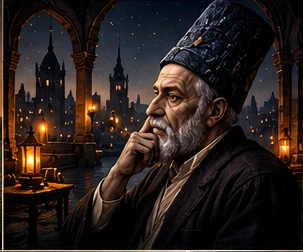

Mirza Ghalib’s poetry repeatedly returns to the difficulty of knowing what is real. His imagination is filled with mirrors, dreams, longing and worlds that seem to dissolve as soon as the mind reaches for certainty. In one celebrated couplet, existence itself becomes a trap woven from thought. The image is not merely pessimistic. It is intellectually mischievous: what if the world that appears most solid is also the world we misunderstand most completely?
Reality and Its Witness
We live surrounded by things we assume are obvious: a room, a face, a name, a memory. Yet experience reaches us through perception, interpretation and language. The same event can become triumph in one memory and tragedy in another. The same silence may feel peaceful to one person and unbearable to someone else.
Ghalib’s poetic universe thrives in that uncertainty. He does not need to prove that the physical world is imaginary. Instead, he shows how deeply the mind participates in the world it claims simply to observe. The net is made of meanings, expectations and desires; we may become entangled without noticing when we entered.
A Mystery Without a Final Key
Modern readers sometimes compare such verse with scientific theories about reality. Those comparisons may be imaginative, but a poetic metaphor is not evidence for a physics hypothesis. Ghalib’s real power lies elsewhere: he can make a familiar word suddenly feel like an unanswered question.
What does it mean to exist? Is the self the one who experiences the world, or also the one who invents its meanings? The poem does not close the investigation. It leaves the reader standing inside it. Perhaps that is why Ghalib remains so contemporary: his mysteries have not grown old because they were never meant to be solved once and for all.
Further reading: Rumi and the self · Omar Khayyam and impermanence.



