
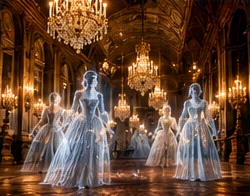

A literary retelling of a reported event or enduring legend. Atmospheric scenes are reconstructed, not eyewitness transcripts.
An afternoon at Versailles begins with the promise of an ordinary excursion. Two visitors follow the paths through the grounds, searching for a particular building and enjoying the order of the gardens. Then the atmosphere seems to change. The paths feel unfamiliar, and the world appears to grow strangely still.
The visitors did not describe a sudden flash or a machine. Their mystery was subtler: the texture of an afternoon. The paths seemed less welcoming; the people they passed appeared absorbed in a world with its own rules. A man they encountered seemed oddly out of place, and the women later struggled to reconcile the route they remembered with the grounds as they knew them. These are details of a reported experience, not evidence that the clock actually reversed.
The account became especially fascinating because its narrators were educated women who tried to reconstruct their impressions carefully. Yet careful recollection is not the same as a recording. Memories can change as people discuss them, read historical descriptions and return to a place with new expectations. The passage of time may make an uncertain detail feel sharper rather than more reliable.
At the Petit Trianon, history is already close to the surface. Buildings, gardens and the name of Marie Antoinette invite visitors to imagine lives interrupted by revolution. Perhaps the most powerful element of the time-slip tale is this collision between a physical landscape and the past it seems to contain. The garden never answers the women. It simply remains, waiting for the next visitor to take the same path.
In 1901 Charlotte Anne Moberly and Eleanor Jourdain visited the Petit Trianon. They later described figures dressed in clothing that seemed to belong to an earlier century and a sense that they had wandered into a different moment in history. Their account would eventually appear in a book titled An Adventure.
Imagine the women walking slowly past a figure who does not seem to notice them. The sunlight falls across a wall, yet the scene feels oddly theatrical, as though the visitors have entered a performance without knowing where the stage begins. A woman sits nearby, absorbed in her own activity. Only afterwards does the possibility of Marie Antoinette enter the retelling.
When the travellers compare their memories, the experience becomes more complicated. Details that seemed insignificant on the day take on new meaning. They return to maps and historical descriptions, trying to find a route through the uncertainty.
Later critics suggest misunderstandings, altered memories and the possibility of people in historical costume. None of these possibilities has the drama of a journey into the past, but the story’s evidence does not establish that time travel occurred.
The mystery lives in the gap between an experience and its explanation. A garden is a place where the past is deliberately preserved. At Versailles, two visitors felt, for a moment, that preservation had become something far stranger.
Further reading: The Chronovisor · Memento Mori.




[…] reading: The Versailles Time Slip · The Voynich […]