

Dark Page Kids | Little Explorers | Ages 7–12 | Science-inspired fantasy
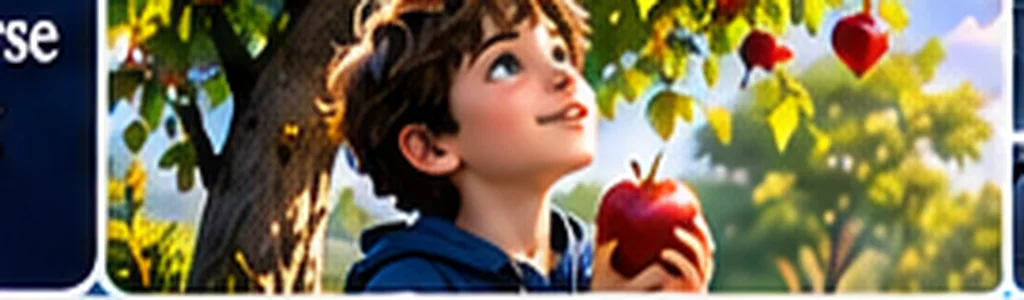
Ten-year-old Oliver sat beneath the apple tree in his garden, reading a book, when a ripe red apple broke free from its branch and fell beside his shoes.
He picked it up and smiled. “Newton’s apple!” he said. “Gravity makes things fall.” But then a new question tugged at him: If gravity can pull an apple down, can it also send a message across the stars?
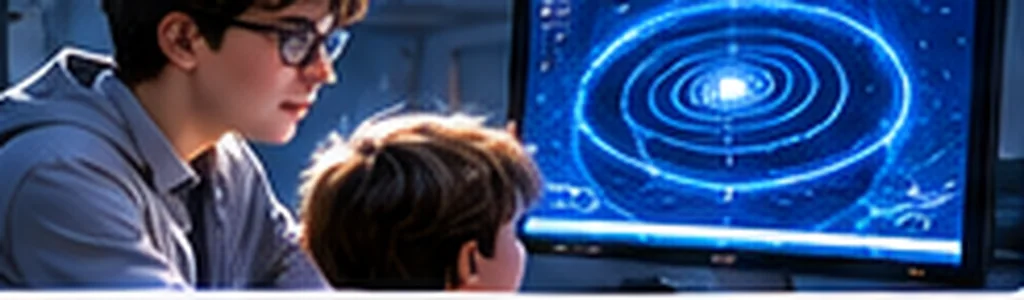
That evening, Oliver’s older sister, a university astronomy student, called him to her computer. On the screen, two enormous black holes circled one another, spiralling closer until they merged. Rings spread outward across an animated grid, like ripples on a pond.
“Those are gravitational waves,” she explained. “Einstein predicted them more than a century ago. Scientists first detected them directly in 2015, and announced the discovery in 2016. They are tiny stretches and squeezes of spacetime, travelling at the speed of light.”
“Spacetime?” Oliver repeated.
“Think of space and time as part of the same great fabric,” she said. “The picture is only a model, not a real cloth floating in space. And gravity isn’t a magnet. Very massive objects change the geometry of spacetime. When objects such as black holes accelerate around each other, they can send ripples through it.”
“So the universe has a secret pond?” Oliver whispered.
“Not literally. But that is a wonderful way to imagine it.”
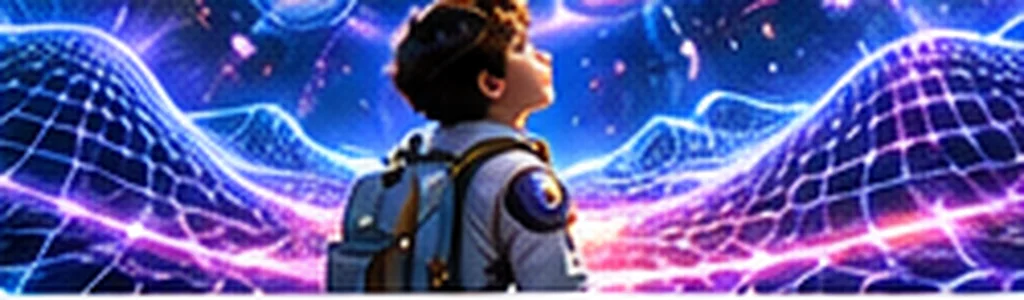
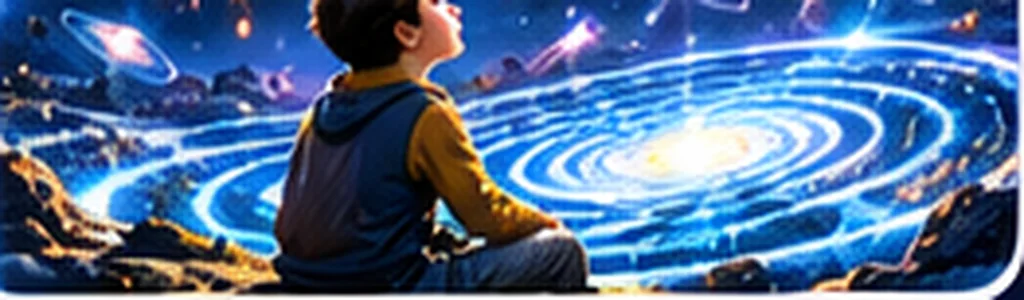
That night Oliver dreamed he was floating through a place called the Gravity Garden. There were no walls, no ground and no air. Instead, luminous silver threads curved around distant stars. When two dark giants whirled together far away, golden rings travelled across the garden. In his dream he could see and hear the ripples, although real gravitational waves are invisible and cannot be heard directly by human ears.
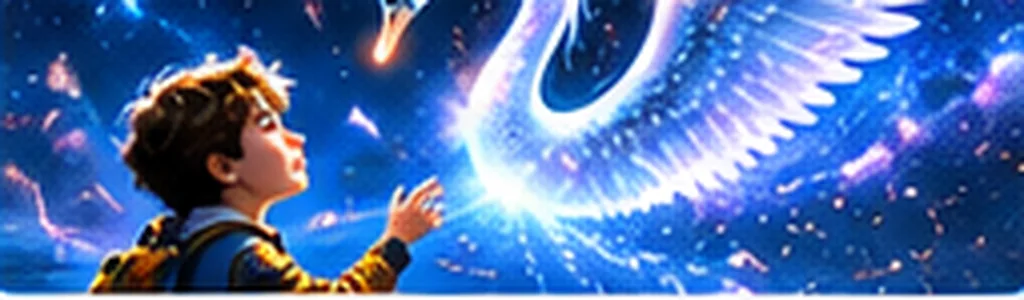
A magnificent blue swan appeared on the shining rings. Its wings were edged with starlight, and every feather seemed to hold a tiny galaxy.
“Welcome, young question-keeper,” said the Cosmic Swan. “What brings you to the garden between the stars?”
“An apple,” Oliver replied, feeling rather foolish.
The swan laughed gently. “A small beginning for a very large question.”
Oliver watched a wave pass beneath him. “If these ripples come from black holes that collided long ago, does that mean they carry news from the past?”
“Yes,” said the swan. “Because they take time to reach Earth, scientists can study events that happened millions or even billions of years ago. Instruments called interferometers measure changes far smaller than an atom. They turn those measurements into signals scientists can study—and sometimes into sounds we can listen to.”
“Could we surf on a gravitational wave?” Oliver asked, stretching out his arms like a surfer.
“That is a magnificent dream,” the swan answered. “But the waves that reach Earth are extraordinarily faint. They do not behave like ocean waves that can lift a surfboard. Your scientists have no known way to ride them.”
Oliver thought for a moment. “Then could we listen all the way back to the first morning of the universe?”
The silver garden grew quiet.
“That,” the swan said softly, “is a question scientists are still exploring. Some hope that ancient gravitational waves may preserve clues from the universe’s earliest moments. None has yet given us a complete picture of the beginning. A good question is not the same as a proven answer.”
Oliver smiled. He liked that. It meant the mystery was still alive.
“Then I have another question,” he said. “If the universe has been sending messages for billions of years, how many are passing through us right now without our knowing?”
The swan spread its wings. The garden filled with light—not because Oliver had solved the universe, but because he had found another doorway into it.
Morning sunlight woke him. The apple tree rustled outside his window. A second apple dropped onto the grass.
Oliver picked up his notebook and wrote: What can the universe tell us without using light?
Then he drew a swan, a pair of black holes, and a little apple in the corner of the page.
The Science Behind the Wonder
Gravitational waves are ripples in spacetime predicted by Albert Einstein’s general theory of relativity. The first direct detection was made by LIGO in September 2015 from merging black holes. These waves are not visible glowing threads, and they cannot be surfed like water waves. Researchers hope future observations may reveal more about distant cosmic events and perhaps the very early universe.
Try This: Ripples in a Bowl
Fill a shallow bowl with water and gently tap the surface. Watch the circles spread outward. This is an analogy for travelling ripples, not an experiment that creates gravitational waves. Real gravitational waves are changes in spacetime itself.
Wonder Questions for Young Explorers
- How can a ripple in spacetime tell us about an event long ago?
- Why is a water wave only an analogy for a gravitational wave?
- What would you ask the Cosmic Swan?
Explore the science behind the story: Read how scientists detected gravitational waves, then discover Leo’s adventure near a black hole.




[…] exploring: Discover Oliver’s adventure with gravitational waves and Ethan and Mei’s mystery of vanished […]
[…] Continue exploring: Read Lily’s journey beyond the black hole and Oliver’s adventure with gravitational waves. […]
[…] The Invisible Swings of the Universe →The Mountain That Answered Questions → […]
[…] Discover another mystery: Explore Jack’s minute that never passed and Oliver’s exploration of spacetime. […]