

Dark Page | Dark History / The Unbelievable | Historical investigation
In August 1835, the Moon was no longer a silent object above New York. According to the morning newspaper, it had forests, beaches, animals and a civilisation of winged human beings. The most astonishing discovery in astronomy had arrived in six instalments. There was just one problem: none of it had happened.
The first extraordinary morning
On 25 August 1835, readers of the New York Sun encountered the beginning of a report that appeared to come from the frontier of science. The story invoked Sir John Herschel, an astronomer whose real work was already impressive. Herschel had travelled to the Cape of Good Hope to observe the southern sky. That authentic journey supplied the hoax with its foundation: a genuine scientist, a genuine expedition, and a distant place from which news would travel slowly.
The supposed account appeared under the authority of an Edinburgh Journal of Science supplement and a writer named Dr Andrew Grant, presented as a companion to Herschel. Grant was fictional. The journal named in the report had ceased publication. Yet these details were not decorations. They were the machinery that made an impossible story resemble a scientific dispatch.
At first, the imagined discoveries were almost plausible to an excited nineteenth-century reader: lunar landscapes, strange geological formations, suggestions of vegetation. Then the newspaper opened the doors of its invented world. There were bison-like animals, one-horned creatures and beavers that moved upright. The fourth instalment, on 28 August, presented the sensation that would outlive the rest: human-shaped beings with wings like bats.
The telescope that could not exist
The report described a spectacular optical instrument capable of resolving tiny details across the distance between Earth and the Moon. Its technical language sounded authoritative. Its promise was irresistible: the heavens had become a landscape one might inspect as closely as a garden. The deception worked partly because the real age of astronomy was already expanding the imaginable. Readers knew that instruments were improving. The false report simply carried that improvement beyond physical reality.
Today, the distinction is clearer. A telescope does not make distant detail arbitrarily visible merely by increasing magnification; resolving power and the behaviour of light impose limits. And the Moon itself is not a hidden tropical world. Spacecraft measurements reveal an extremely tenuous lunar exosphere, vastly unlike the dense atmosphere that supports terrestrial forests, rivers and flying animals. This is not evidence that every question about extraterrestrial life is settled. It is evidence that the specific Moon described in the Sun was fiction.
When illustrations became evidence
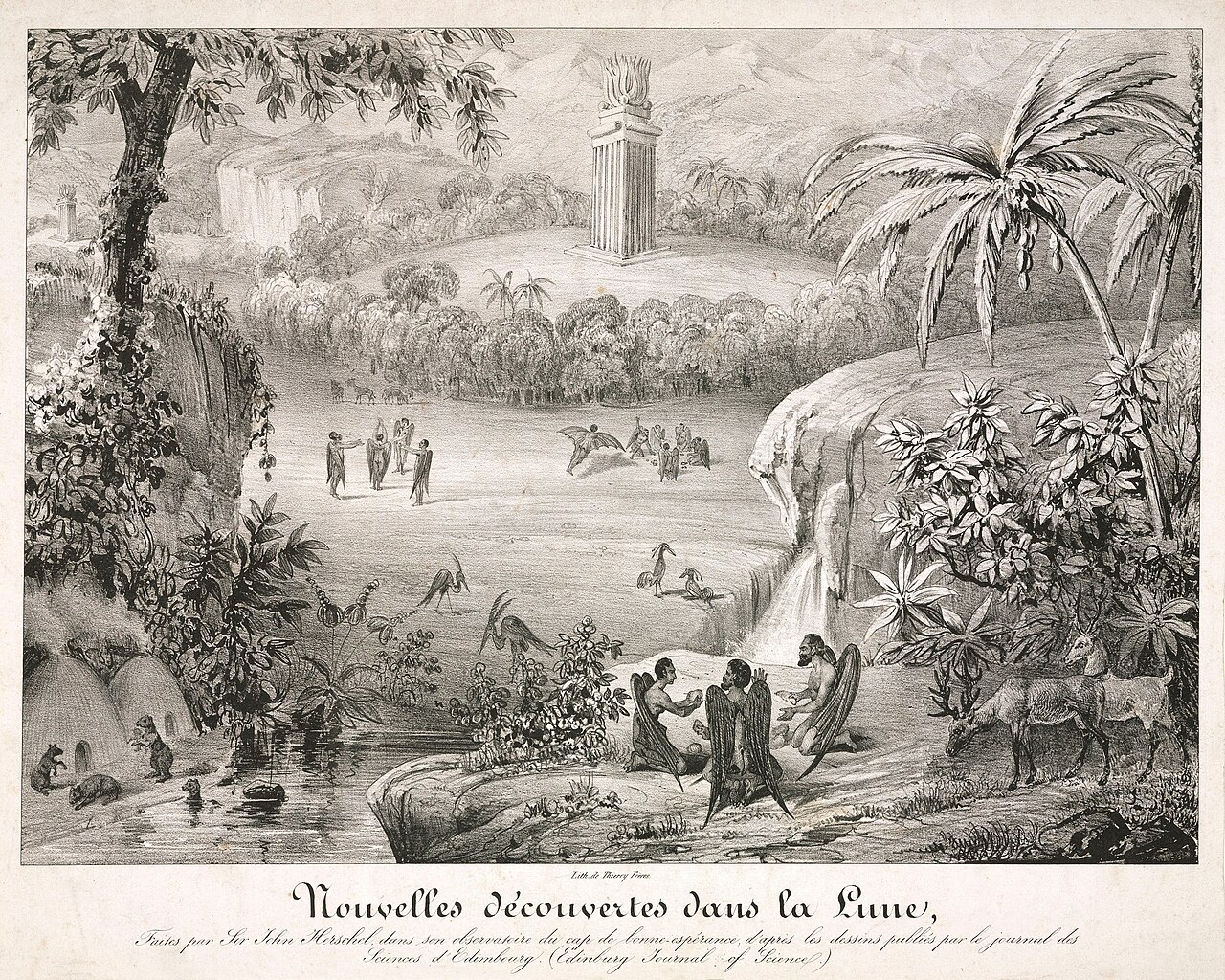
The hoax did not remain confined to columns of print. Its imagined creatures appeared in illustrations and in editions published beyond the United States. Pictures gave the invented landscape an afterlife. A reader could look at a winged lunar figure, its body carefully rendered, and feel that the image confirmed what the words had claimed. But the direction of evidence was reversed: the image was made from the story, not from a telescope.
The historical lithograph reproduced here is a record of nineteenth-century imagination, not a record of life on the Moon. Its value lies precisely in that distinction. It shows what people were invited to believe, and how persuasive an invented visual world could become.
Did everyone believe it?
The familiar retelling says that an entire city swallowed the tale without question. The historical record is more complicated. As the Library of Congress notes, some newspapers were sceptical while the series was still running. By 29 August, rival publications were openly questioning the report. Others repeated it, sometimes with enthusiasm and sometimes with reservations. Belief and disbelief helped carry the same story across the press.
That matters. A successful hoax does not require every reader to be fooled. It needs enough uncertainty, fascination and argument to keep the story moving. In 1835, the debate itself became part of the spectacle. Readers wanted the next instalment whether they expected another discovery or the unmasking of a trick.
The author behind the impossible discovery
Richard Adams Locke, a journalist associated with the Sun, is generally identified by historians as the writer. He later acknowledged his role and described a satirical intention. The target included grand claims about inhabited worlds made with more confidence than evidence. But satire disguised as a scientific announcement can escape its author’s control. Some readers saw comedy. Others saw revelation.
The episode also brushed against the literary world. Edgar Allan Poe had published his own fictional lunar voyage earlier in 1835 and later accused Locke of borrowing from it. The dispute reminds us that the hoax occupied a porous border between literature, entertainment, journalism and the language of science. The boundaries were not always marked for the reader.
The real discovery was about us
Nearly two centuries later, the winged people have vanished from the Moon, but the method remains familiar. A recognisable expert gives a story authority. Technical vocabulary supplies the appearance of precision. A dramatic picture makes the claim memorable. Repetition turns an extraordinary assertion into something that seems widely confirmed. The human desire to encounter a universe stranger than the one we know does the rest.
Wonder itself is not the enemy. It is one of the reasons people study the sky. The problem begins when wonder is asked to stand in for evidence. The true Moon—scarred by impacts, shaped by ancient geology and surrounded by a nearly empty exosphere—is extraordinary without imaginary forests or winged citizens. Its real mysteries do not need a counterfeit telescope.
In 1835, a newspaper briefly populated the heavens with creatures of its own invention. What survived was something more enduring than the fantasy: a warning about how easily the appearance of knowledge can be mistaken for knowledge itself.
Research and image credits
- Library of Congress, Stephanie Hall, “Belief, Legend, and the Great Moon Hoax” (26 August 2014): contemporary reactions, authorship and the spread of the hoax.
- Smithsonian Magazine, Sarah Zielinski, “The Great Moon Hoax Was Simply a Sign of Its Time” (2 July 2015): the six-part story, scientific culture and later illustrations.
- Library of Congress, 1835 lunar creatures lithograph catalogue: contemporary visual material and catalogued historical context.
- NASA Science, “The Moon’s Atmosphere”: present-day evidence on the lunar exosphere.
- Historical illustration: Nouvelles découvertes dans la Lune, lithograph by Thierry Frères, circa 1835. Wikimedia Commons source and public-domain status. The illustration depicts the hoax’s imagined lunar world, not a real astronomical observation.
Editorial note: This article investigates a documented nineteenth-century newspaper fabrication. No lunar animals or winged human inhabitants were discovered by Herschel.
Further reading: Evidence Before Sensation · The Russian Sleep Experiment: Fact Check.




