

Birth Stories — Part Twenty | Everything Has a Beginning. Every Beginning Has a Story.
What existed before the universe? When did time begin? How large is everything? These are not merely questions about distant galaxies. They are questions about the ground beneath every human life. Each breath, every ocean, every star, and every thought belongs to the same cosmic history. Science has reconstructed much of that history with remarkable precision. At its earliest edge, however, the story still opens onto questions we cannot yet answer.
The Beginning We Can Describe
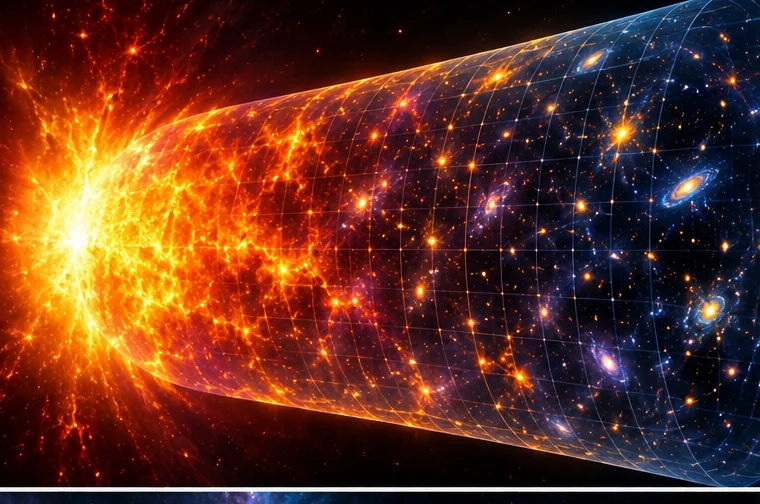
The observable universe has been expanding and cooling for approximately 13.8 billion years. The Big Bang model describes its evolution from an extremely hot, dense early state. It does not describe an ordinary explosion of matter into an already empty space. Space itself expands, increasing the distances between widely separated galaxies. Nor does the evidence establish that all reality was once literally a point smaller than an atom. Our equations become incomplete when extrapolated to the very earliest conditions.
Did time itself begin? Was there a prior phase? Could the universe be part of a larger reality? Scientists and philosophers explore these possibilities, but no established observation has settled them. Saying that there was definitely ‘nothing’ before the Big Bang would turn an open question into an unsupported certainty.
The Clue in the Light of Galaxies
In the early twentieth century, astronomers learned that the spectra of many distant galaxies are shifted toward longer, redder wavelengths. Vesto Slipher made crucial early measurements, and Georges Lemaître connected expanding-universe ideas with astronomical observations. In 1929 Edwin Hubble published the distance–velocity relationship that became a cornerstone of observational cosmology. In general, more distant galaxies recede faster as space expands, though nearby galaxies can move toward us under local gravity.
This redshift is not simply the color of a galaxy turning visibly red. It is a measurable stretching of the wavelengths of light. Rewind cosmic expansion in a mathematical model and the universe becomes hotter and denser. That insight made it possible to ask what traces of the early universe might still survive.
The First Fractions of a Second
Some cosmological models propose a brief episode of extraordinarily rapid expansion called inflation. Inflation can help explain why the universe appears nearly uniform on large scales and why its spatial geometry is close to flat. But its physical cause, exact timing and detailed mechanism have not been established. Numbers specifying a single precise first fraction of a second should therefore be treated cautiously.
In the very early universe, energy and particles interacted in conditions far beyond those of everyday experience. As expansion continued, temperatures fell. Quarks became bound into protons and neutrons. Within the first few minutes, primordial nucleosynthesis produced the nuclei of light elements, chiefly hydrogen and helium, with small quantities of lithium. These were nuclei, not yet the neutral atoms familiar to us. Much later, electrons could join nuclei without being immediately stripped away by energetic radiation.
The Oldest Light We Can See
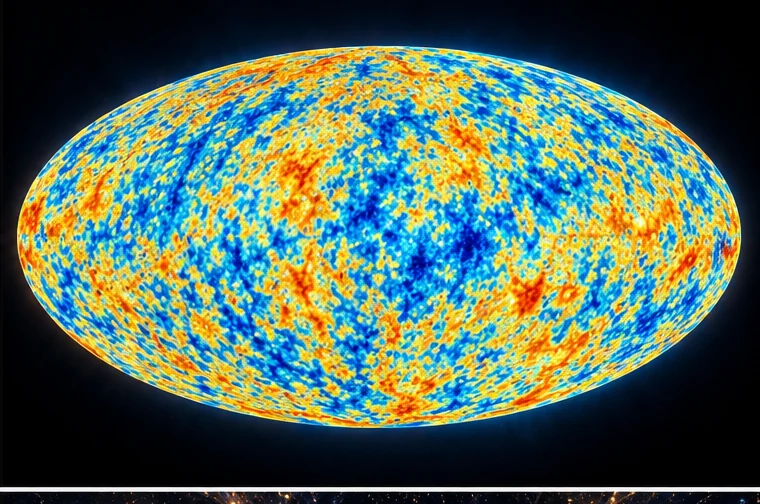
Roughly 380,000 years after the beginning of cosmic expansion, the universe had cooled enough for neutral atoms to form in abundance. Light could then travel much more freely through space. The ancient radiation left from that era has been stretched by cosmic expansion into microwaves: the cosmic microwave background, or CMB.
Arno Penzias and Robert Wilson discovered this background radiation in 1965, building on theoretical work by earlier cosmologists. Their discovery provided powerful evidence for the hot Big Bang model and earned them a share of the 1978 Nobel Prize in Physics. Later missions such as COBE, WMAP and Planck measured tiny temperature variations in the CMB. Those minute patterns help scientists reconstruct the universe’s early composition, geometry and the seeds of later cosmic structure. The CMB is often called the afterglow of the Big Bang, but it is not sound and not a photograph of the absolute first instant.
The Long Darkness and the First Stars
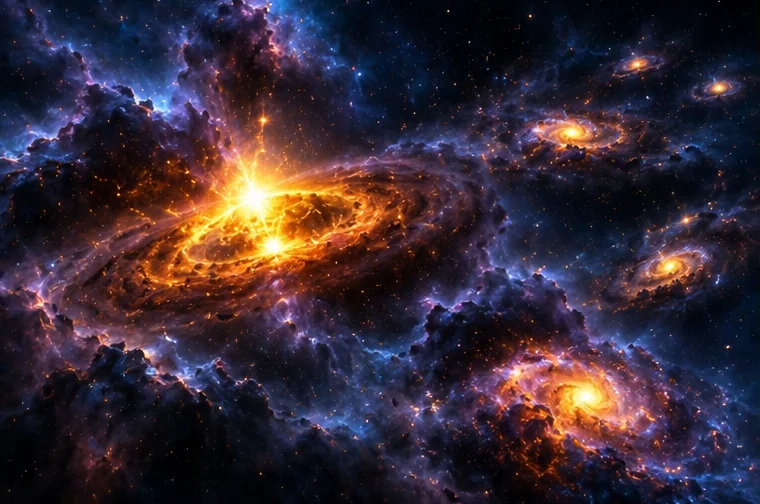
After the CMB was released, there were no stars illuminating the cosmos. Gravity slowly amplified small density differences in the gas and dark matter. The first stars likely formed within the first few hundred million years, although their exact emergence remains under investigation. They were not necessarily like the Sun. Some may have been massive, short-lived and extraordinarily luminous.
Stars became furnaces of cosmic change. Hydrogen fusion built helium, and later generations of stars formed heavier elements through successive nuclear reactions. Exploding stars and other energetic events scattered newly forged elements into interstellar space. Carbon in living cells, oxygen in water and calcium in bones are connected to this long stellar history. Some heavy elements, including much of the universe’s gold, are linked to violent processes such as neutron-star mergers. The phrase ‘we are made of stardust’ is poetry with a strong scientific foundation—though hydrogen in our bodies largely traces back to the early universe itself.
Galaxies: Cities of Stars
Gas, stars, dark matter and gravity assembled into galaxies, which grew through star formation, interactions and mergers. Our galaxy, the Milky Way, contains perhaps hundreds of billions of stars, though estimates vary. Its bright stellar disk spans roughly one hundred thousand light-years. One light-year is a distance, not a time: about 9.46 trillion kilometres, the distance light travels in a year.
At the Milky Way’s center lies Sagittarius A*, a supermassive black hole with a mass of about four million Suns. In 2022 the Event Horizon Telescope collaboration released an image of the bright emission surrounding it. In 2019 the same collaboration had revealed the first such image, of the black hole at the center of galaxy M87. These images do not show light escaping from inside an event horizon. They reveal radiation from hot material near a region where gravity is extreme.
How many galaxies exist? There is no single securely counted total for the entire universe. Estimates for the observable universe vary with observational limits and assumptions about faint, unseen galaxies. The often repeated figure of two trillion is a model-based estimate, not a census, and the universe beyond our observable horizon may be far larger—or even spatially infinite. The observable universe itself is roughly 92 billion light-years across today, despite its age being only about 13.8 billion years, because space expanded while the light traveled.
Our Sun, Our Earth, Our Moon
The Sun formed around 4.6 billion years ago from a collapsing cloud of gas and dust. The planets assembled from material in the surrounding disk. Earth is about 4.54 billion years old and orbits at an average distance of approximately 150 million kilometres from the Sun. Sunlight takes about eight minutes and twenty seconds to reach us.
The Moon most likely formed after a giant impact early in Earth’s history, although the details of that event and subsequent evolution remain under study. Laser-ranging measurements show that the Moon is currently receding from Earth at about 3.8 centimetres per year on average. The Sun shines because nuclear fusion converts hydrogen into helium in its core. In roughly five billion years it will enter a red-giant phase. Earth’s habitability is expected to deteriorate long before that; whether the expanding Sun will ultimately engulf Earth depends on the details of stellar and orbital evolution. This is a scientific forecast across immense timescales, not a prediction that humanity must imminently relocate.
The Invisible Majority
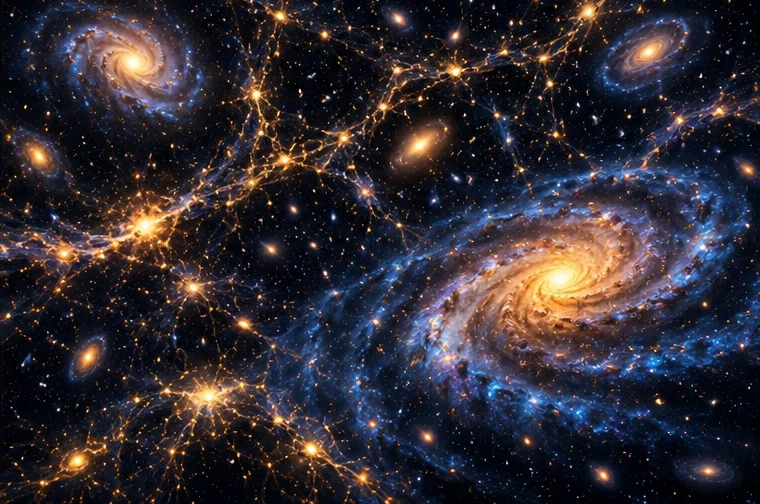
Ordinary matter—the atoms that form stars, planets, air and people—accounts for only about five percent of the universe’s total energy budget in the standard cosmological model. Roughly a quarter is attributed to dark matter, inferred from its gravitational effects on galaxies, galaxy clusters and the growth of cosmic structure. Around two-thirds is attributed to dark energy, a name for the phenomenon associated with accelerated cosmic expansion.
These percentages are approximate and model-dependent. We do not yet know what dark matter consists of, and the nature of dark energy is unsettled. A cosmological constant fits many observations, while scientists also test whether dark energy could evolve over time or whether gravity needs refinement. The universe has given us enough evidence to recognize our ignorance with unusual precision.
How Humanity Learned to Look
For thousands of years people in many civilizations charted the sky, developed calendars, predicted celestial motions and built mathematical models. Astronomers in Mesopotamia, China, India, the Islamic world, the Mediterranean and the Americas contributed to a cumulative history of observation and calculation. The modern telescope transformed what could be tested, but curiosity about the heavens has never belonged to one region.
Galileo Galilei did not invent the telescope. In 1609 he improved existing designs and began using them for astronomical observation, revealing mountains on the Moon and, in 1610, moons orbiting Jupiter. His observations strengthened the case against a simple Earth-centered cosmos. The heliocentric model had been developed by Copernicus and had much older intellectual precedents. Galileo’s conflict with church authorities was historically complex; it cannot be reduced to one sentence about punishment for discovering that Earth circles the Sun.
In the 1920s, observations of Cepheid variable stars in Andromeda helped establish that other galaxies exist beyond the Milky Way. Later, space telescopes carried our view above the atmosphere. The James Webb Space Telescope launched in 2021 and began scientific operations in 2022. It has observed galaxies from very early cosmic times, challenging researchers to refine models of how quickly galaxies assembled. Seeing ancient light is looking back in time, but it is not seeing the Big Bang itself.
Worlds Around Other Suns
The first confirmed planets beyond our solar system were discovered orbiting a pulsar in 1992; a planet around a Sun-like star was confirmed in 1995. Thousands of exoplanets are now confirmed, with the tally continually growing. Some orbit in regions where liquid water might be possible under suitable conditions, but a potentially habitable orbit is not evidence of life. Scientists study planetary atmospheres and chemistry while remaining cautious about what distant signals can prove.
The Fate of Everything
The universe’s future depends on its composition and on how dark energy behaves. If accelerated expansion persists, distant galaxies will drift beyond one another’s observable horizons. Over unimaginably long periods, star formation will decline, existing stars will burn out, and the cosmos could approach an increasingly dilute, cold state often called the Big Freeze or heat death.
Other proposed possibilities include a future recollapse, sometimes called the Big Crunch, or more exotic scenarios involving changes in dark energy. A Big Rip would require particular assumptions about the evolution of cosmic acceleration; it is not a prediction established by current evidence. The older steady-state model, in which the universe remains broadly unchanged through continuous matter creation, is not a leading explanation of present observations. We have no observational warrant to announce a definite final chapter.
The Universe and the Human Question
A person standing beneath a night sky seems impossibly small. The nearest stars are light-years away; distant galaxies send us light that began its journey long before Earth formed. Yet a human mind can measure the spectrum of that light, infer the chemistry of a star and ask how the cosmos came to be.
We are not separate from the universe. The atoms in our bodies emerged through cosmic processes, and the forces governing our lives are the same forces studied in distant nebulae. But it would be scientifically misleading to say that the universe deliberately created humans so that it could understand itself. Purpose belongs to philosophical reflection, not to a result established by cosmological observations.
Still, there is room for wonder without pretending that wonder is proof. When we look upward, we look backward. When we ask where everything came from, we join a conversation that began long before telescopes and may continue long after our own lifetimes. The story of the universe is not finished, and neither is the story of our attempts to understand it.
Perhaps our greatest achievement is not that we have solved the mystery of the beginning, but that a small part of the cosmos has learned to ask the question. The universe is vast; our questions are small; and yet those questions are one of the ways its history continues.
Sources and Further Reading
- NASA Science — Universe
- NASA — Cosmic Microwave Background
- European Space Agency — Planck
- NASA — James Webb Space Telescope
- NASA — Exoplanets
- Event Horizon Telescope Collaboration
- Encyclopaedia Britannica — Big Bang Model
Editorial note: Numerical estimates are approximate. The essay distinguishes well-supported observations from unsettled ideas about inflation, dark matter, dark energy, the beginning of time and the ultimate fate of the universe.



