

Birth Stories — Part Eight | Everything Has a Beginning. Every Beginning Has a Story.
Imagine a stranger arriving at a village with a basket of grain. Another family has pottery, another salt, another a debt that will be repaid after the harvest. How can people who need different things agree on what is fair? How can a promise made today remain valuable tomorrow? Money was not born on one particular morning when two hunters exchanged meat for wheat. It emerged through a long human struggle to measure obligations, remember debts, and cooperate with people beyond the family. Trade, in turn, is older than coins, older than writing, and perhaps older than farming itself.
Before Money: The Invisible Economy
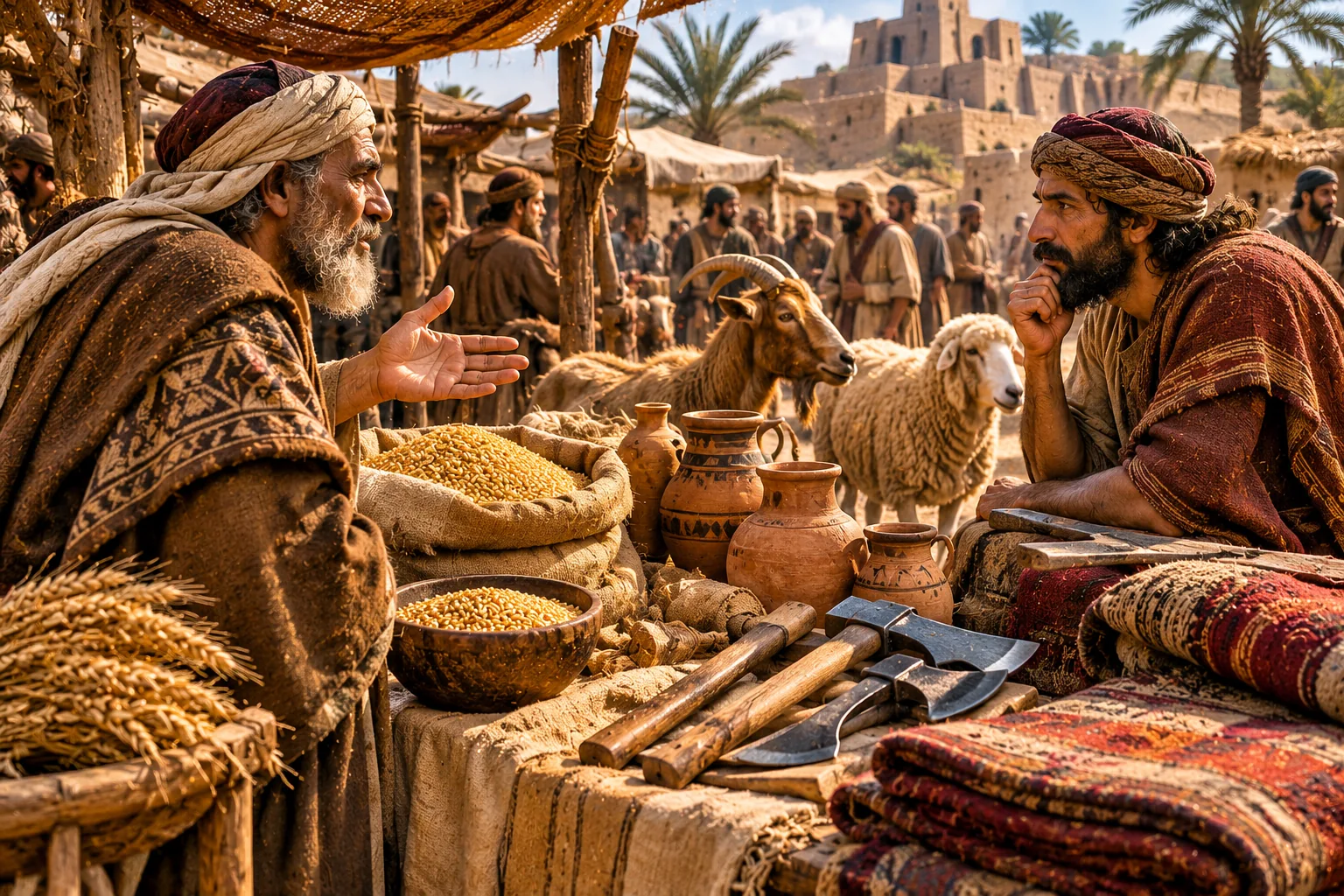
Prehistoric people moved stone, shells, pigments, and other materials over remarkable distances. Archaeological evidence of long-range exchange reaches far back into the Stone Age. Some objects may have been traded; others could have been gifts, carried by migrating groups, or passed along through many hands. We cannot reconstruct a single universal origin for commerce.
The familiar textbook tale says barter came first: a goat for grain, a pot for fish. But anthropologists have questioned whether entire early economies commonly operated as simple markets of strangers directly swapping goods. In many communities, gifts, shared resources, reciprocal obligations, and accounts of who owed what were just as important. Barter certainly existed, especially in particular circumstances, but it is misleading to present it as the proven first stage of every monetary system.
Farming, which arose independently in several regions over thousands of years, made storage, specialization, and organized distribution increasingly important. Grain could feed workers; livestock could represent wealth; debts could outlast a season. The first economic revolution may not have been a coin changing hands. It may have been the recognition that a promise could be counted.
Clay, Grain, Silver—and the Birth of Accounts
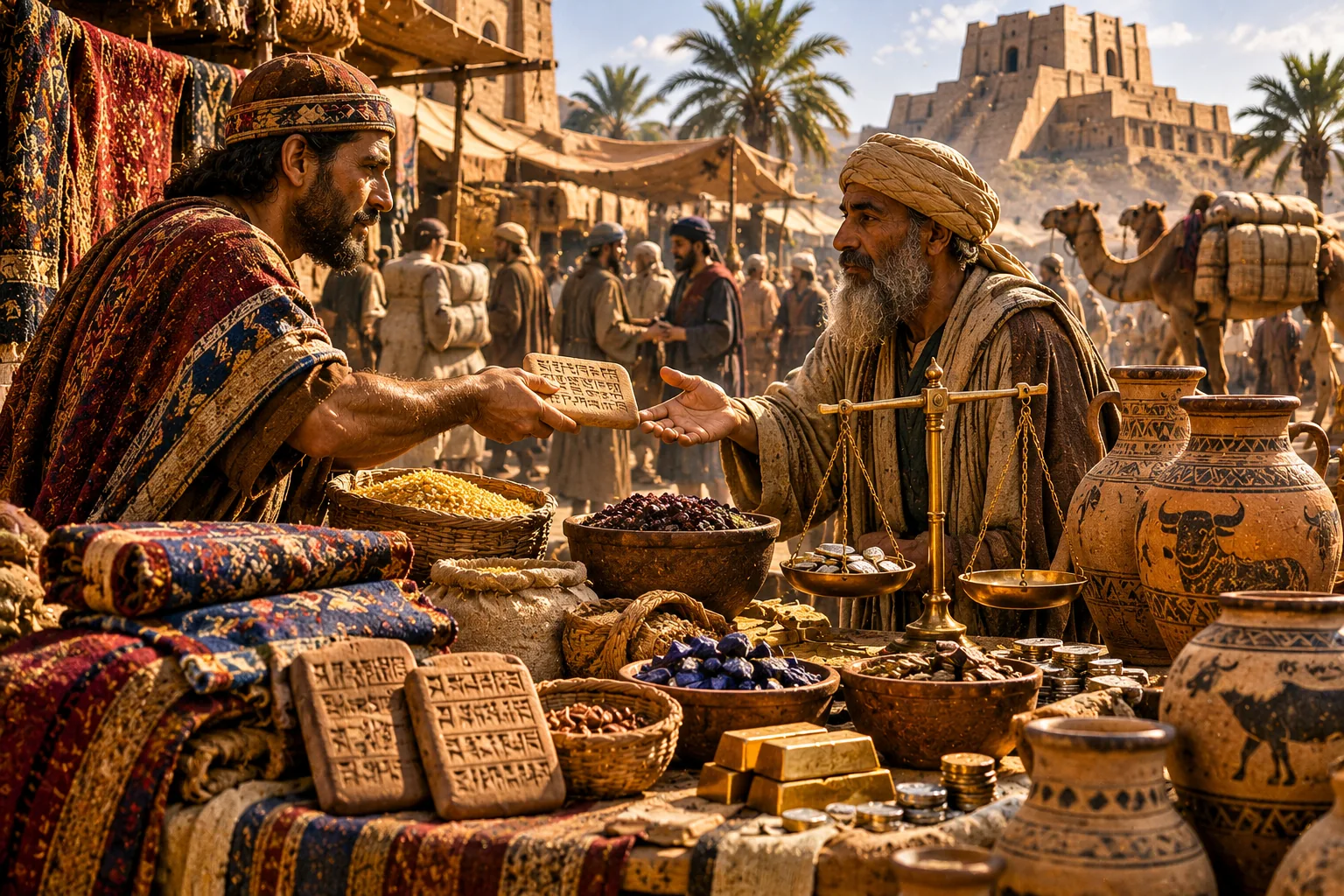
In ancient Mesopotamia, administrators recorded deliveries, rations, property, and obligations on clay tablets. By the third millennium BCE, barley and silver were used as units of account and means of payment in different contexts. A price could be expressed in silver even when the transaction itself was settled through other goods or arrangements. Money, therefore, did not always need to be a physical object passed from hand to hand.
Temples, palaces, merchants, and households all participated in economic life. Written contracts recorded loans and repayments. Interest, partnership, and commercial disputes are not modern inventions. Yet ancient accounting also reveals unequal power: records could protect a debtor or help a creditor enforce an obligation. The same institution that made cooperation possible could become an instrument of control.
Across the world, societies used objects that later historians call commodity money: shells, metal, cloth, beads, and other widely recognized valuables. Cowrie shells circulated in various African and Asian contexts for long periods. In parts of ancient China, cast bronze objects resembling knives and spades developed as forms of currency. These were different monetary traditions, not steps in one universal sequence.
The English word salary is connected etymologically to Latin salarium, a term associated with salt, but the popular claim that Roman soldiers were routinely paid their wages in salt is not established historical fact. Salt mattered enormously to preservation and commerce; a memorable origin story should not replace evidence.
The Small Piece of Metal That Carried a State
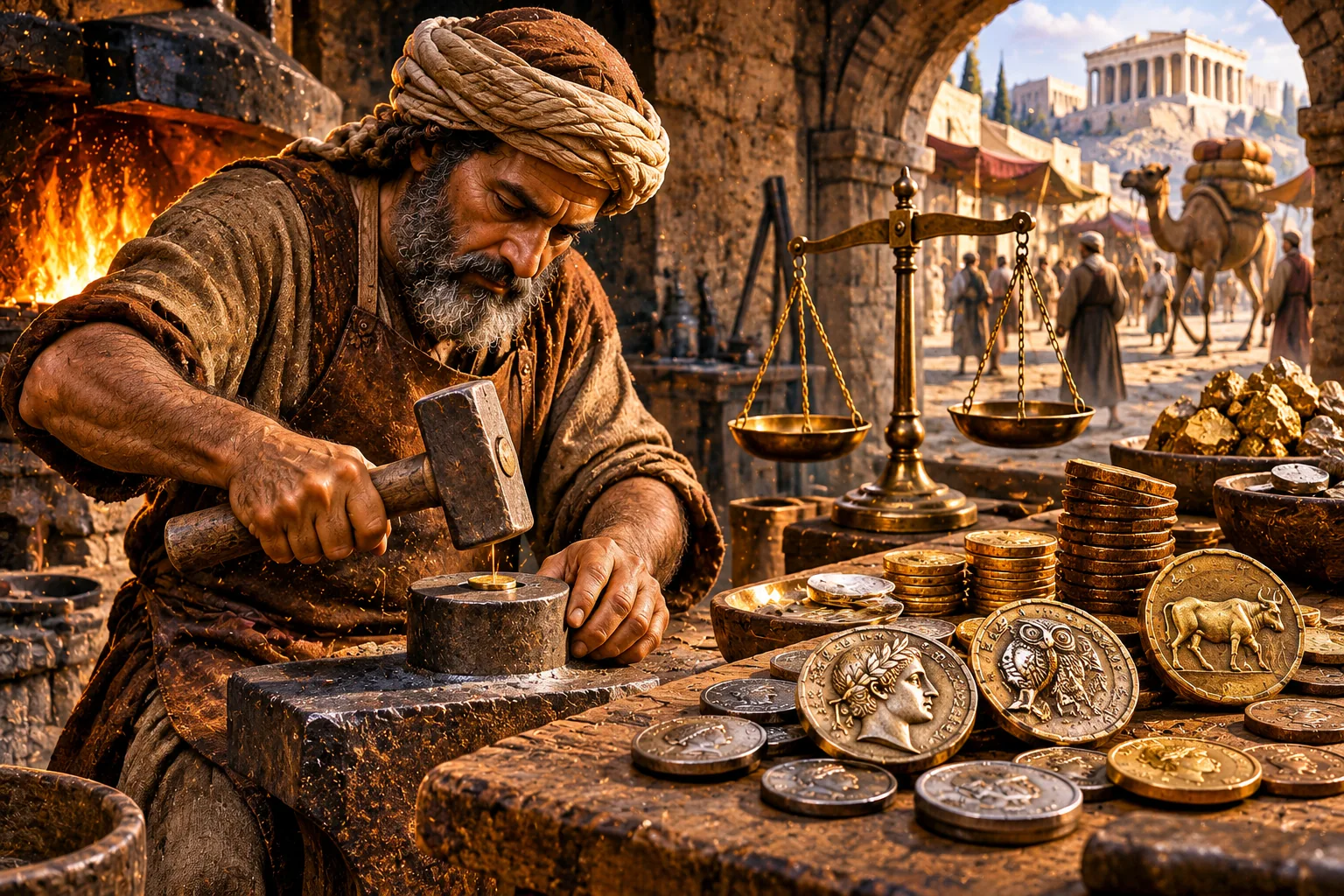
In western Anatolia, in the kingdom of Lydia and neighboring Greek cities, some of the earliest known stamped coins appeared in the late seventh century BCE. Early examples were made from electrum, a naturally occurring gold-silver alloy. Their precise origins and the roles of individual rulers are debated. Stamping metal with an official mark helped communicate authority and standardization, but it did not instantly eliminate weighing, testing, or distrust.
Coins traveled widely through the Greek and Roman worlds and beyond. Their images could advertise rulers, cities, gods, and political claims. A coin was never merely a tool for buying bread; it was a miniature statement about who had the power to define value. Roman monetary names, including the denarius, influenced later currencies and terminology, although the histories of modern dinars are complex.
Money acquired an extraordinary ability: it could connect people who did not know one another. But it also required something fragile—the expectation that others would continue to accept it.
Roads, Ships, and the World Beyond the Horizon
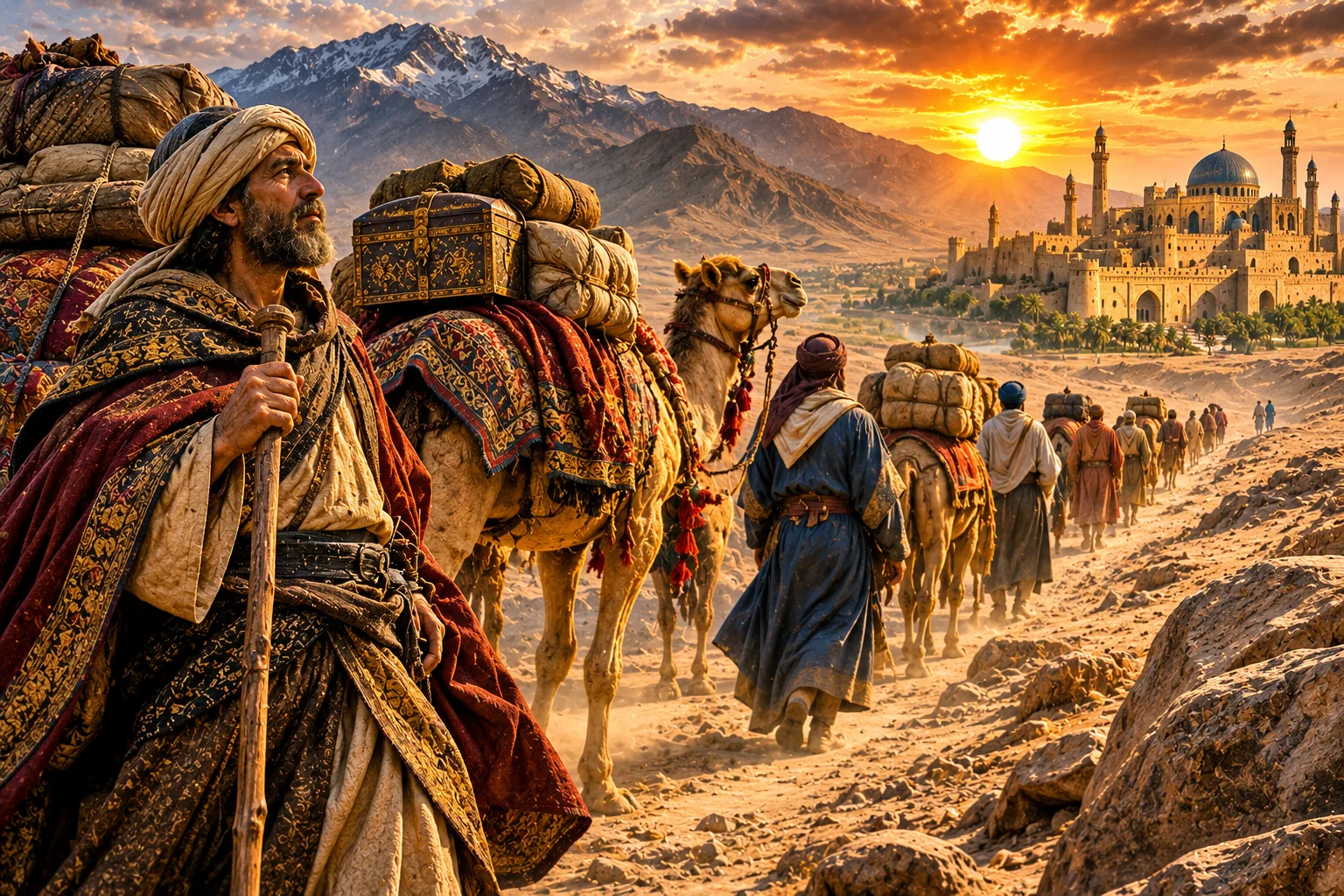
The Silk Roads were not one 6,400-kilometer highway opened on a single date. They were changing networks of overland and maritime routes connecting East Asia, Central Asia, South Asia, the Middle East, Africa, and Europe. The term itself was coined much later. Merchants carried silk, horses, glass, spices, metals, and many other goods. Along the same routes traveled religious ideas, artistic forms, technologies, and diseases.
The Indian Ocean was another vast commercial world. Seasonal monsoon winds helped sailors link ports around the Arabian Sea, East Africa, the Persian Gulf, India, and Southeast Asia. Pepper from South Asia reached Mediterranean markets; Roman authors complained about wealth flowing eastward for luxury goods. Yet the dramatic claim that one kilogram of pepper regularly cost one kilogram of gold cannot be treated as a universal historical price.
Trade created encounters, but not always peaceful ones. It also fueled conquest, enslavement, monopolies, and colonial extraction. The voyages of Columbus in 1492 and Vasco da Gama to India in 1498 reshaped global commercial routes, but their consequences included violence and dispossession. To tell the history of commerce without these costs would be to confuse the movement of wealth with the progress of humanity.
Merchants of the Islamic World
From the seventh century onward, commercial networks linking the Islamic world connected markets from the Mediterranean to the Indian Ocean and beyond. Cities such as Baghdad, Cairo, Damascus, and later many others supported sophisticated merchant communities. Islamic legal traditions developed rules for partnerships, sales, credit, inheritance, and commercial responsibility. Instruments associated with written payment orders and transferable obligations helped merchants reduce the danger of transporting large quantities of metal.
The Arabic word sakk, related to documentary certificates, is often discussed in the history of financial instruments. It should not, however, be asserted without qualification that the English word cheque derives directly from it; the English term has a different documented etymological history. Indian commercial traditions likewise developed instruments such as the hundi, used in varied forms for remittance, credit, and exchange.
Trade also relied on mathematics. Indian place-value numerals and the concept of zero circulated through Arabic-language scholarship into Europe over centuries, strengthening calculation and accounting. No single civilization invented modern finance by itself. It grew through borrowings, adaptations, and the practical intelligence of merchants across many languages.
When Paper Became Purchasing Power
China was a pioneer of paper money. Private merchant certificates and related paper instruments developed before the Song dynasty’s government-backed issues in the early eleventh century. The commonly cited year 1024 belongs to this broader Song-era story, but the evolution of paper currency was gradual. Paper promised relief from the burden of transporting strings of heavy coins, while introducing new dangers of overissue, forgery, and loss of confidence.
In Europe, banks and money changers developed through overlapping medieval and early modern traditions, with significant activity in Italian trading cities. The word bank is associated with Italian banco, a bench or counter. Genoa’s Bank of Saint George, founded in 1407, was an important early public financial institution, not simply the world’s first bank. Earlier banking-like arrangements existed in several civilizations.
In the seventeenth century, the Dutch Republic helped develop influential markets in company shares. The Dutch East India Company was chartered in 1602, and Amsterdam became a major center of securities trading. But neither stock trading nor shared investment began from nothing in that year. Moreover, the company was bound up with imperial power, coercion, and violence: the rise of modern finance cannot be separated from the history of colonialism.
Stockholms Banco issued early European banknotes in 1661. The Bank of England was founded in 1694. Over time, notes, bank deposits, and payment systems made money increasingly dependent on institutional credibility rather than the intrinsic value of the material in a person’s hand.
Steam, Telegraph, and the Price of Distance
Industrialization transformed the scale and speed of production. Steamships and railways shortened journeys, though neither was invented in one neat year. Telegraph networks then allowed merchants to learn prices and transmit instructions across vast distances. The durable transatlantic telegraph cable completed in 1866 dramatically accelerated communication between Europe and North America.
But faster markets did not guarantee fairer ones. Factory labor, imperial trade, financial panics, and widening inequalities became central political questions. Labor unions, consumer protections, competition laws, and financial regulation emerged partly because commercial freedom alone could not resolve every conflict it created.
In 1944 the Bretton Woods conference designed a postwar international monetary framework and led to the creation of the International Monetary Fund and World Bank. It did not simply declare the dollar the world’s currency; the system established exchange-rate arrangements centered on the dollar’s convertibility into gold for official holders. The General Agreement on Tariffs and Trade followed in 1947, while the World Trade Organization began in 1995.
What Happens When the Promise Breaks?
Money depends on institutions and expectations, and these can fail. Germany’s hyperinflation in 1923 and Zimbabwe’s monetary crisis in the 2000s offer striking examples of how prices can rise catastrophically and trust in currency can collapse. The details and causes differed, but the human consequences were painfully recognizable: wages lost purchasing power, savings evaporated, and ordinary planning became difficult.
In 1971 the United States suspended the dollar’s convertibility into gold for foreign monetary authorities, helping bring the Bretton Woods system to an end. It would be wrong to say that money became based on trust only then. Even gold-backed systems depended on law, institutions, and confidence. Modern fiat currencies are supported by a combination of state authority, monetary policy, economic activity, and public acceptance—not by belief alone.
From a Ledger to a Screen
Late twentieth-century payment cards, electronic transfers, and online commerce made transactions increasingly digital. There is no single uncontested ‘first online purchase’ in 1994: different early transactions claim that distinction depending on the definition. What matters is that trade could now cross borders without a physical marketplace.
Bitcoin’s network launched in 2009 under the pseudonym Satoshi Nakamoto. It demonstrated a new way to maintain a shared transaction record without a conventional central operator, though it also raised questions about volatility, energy use, fraud, governance, and regulation. Cryptocurrencies are not the same thing as ordinary bank deposits or state-issued money, and they have not displaced established monetary systems.
Mobile payments and digital banking have changed everyday life, including in Pakistan, where a worker can transfer funds without carrying cash across town. Yet digital inclusion depends on reliable networks, affordable access, identity systems, consumer safeguards, and protection against scams. A payment that moves in seconds can still be unjust, inaccessible, or dangerous.
The Price of a Cup of Tea
Consider an ordinary cup of tea. Its leaves may have been grown in one country, its sugar in another, its packaging produced somewhere else, and its journey financed and insured by firms the drinker will never meet. Behind a small purchase stand farmers, drivers, dockworkers, merchants, banks, laws, currencies, and countless agreements. Trade is a web of human interdependence, not merely a contest to acquire more.
That web can encourage cooperation, but it does not automatically prevent war. Trading partners have fought each other, and commercial ties can also become tools of pressure. The question is not whether trade makes people good. It is whether societies can design rules that allow exchange to create shared benefits without disguising exploitation.
Perhaps money’s most astonishing feature is its invisibility. A coin is visible; the promise behind it is not. A banknote can be held; the network of laws and expectations giving it value cannot. Money is a social technology for remembering and transferring claims. Commerce is a social practice for connecting needs, skills, resources, and people. Both have changed form countless times, and both will change again.
Return to the stranger with grain at the village gate. We do not know whether the first exchange was a gift, a loan, a bargain, or a favor. But the human question remains: Can we create an agreement that makes life possible for both of us? The history of money and trade is the long, unfinished attempt to answer yes.
Everything has a beginning. Sometimes an economy begins with a promise someone else believes.
Sources and Further Reading
- Encyclopaedia Britannica — Money
- Encyclopaedia Britannica — Coin
- Encyclopaedia Britannica — Silk Road
- Encyclopaedia Britannica — Banking
- Bank of England — Our History
- International Monetary Fund — Bretton Woods Conference
- World Trade Organization — The GATT Years
- Bank for International Settlements — Monetary and Financial Research
Editorial note: Early monetary systems varied greatly by region. Familiar stories about the invention of barter, salt salaries, and the world’s ‘first’ bank or stock exchange are presented with appropriate historical qualifications.



