

Birth Stories — Part Twelve | Everything Has a Beginning. Every Beginning Has a Story.
Imagine someone calling across a prehistoric valley. Another person turns. A warning has crossed the distance between two minds. Now imagine a mark pressed into wet clay, waiting for a reader who has not yet been born. Between that voice and that mark lies one of humanity’s greatest transformations: we learned to communicate with the living, then to leave messages for the future.
But language was not invented on a single morning, and writing did not begin with the first scratch on a stone. Their beginnings are more complicated—and more wonderful—than a simple tale of two inventions.
The Voice Before History
Homo sapiens emerged in Africa roughly 300,000 years ago. We do not know when fully developed human language appeared. There is no preserved recording of prehistoric speech, and the anatomical and archaeological clues are open to different interpretations. Claims that language suddenly emerged between 70,000 and 50,000 years ago during a single “cognitive revolution” are debated. The abilities required for language may have evolved over much longer periods, and other human species may also have possessed significant capacities for communication.
Human language is not merely a collection of cries. It allows speakers to combine meaningful units into new expressions, discuss absent things, imagine possibilities, and negotiate shared plans. Yet animal communication is more complex than the old caricature of creatures capable only of instinctive noises. Birds, primates, cetaceans, and other animals communicate in sophisticated ways. The important question is not whether animals communicate, but how human linguistic systems differ in their structure, flexibility, and social uses.
Did Language Begin in the Hands?
Scholars have proposed many explanations for the evolution of language. Some emphasize gesture and the coordination of hands, eyes, and attention. Others focus on vocal learning, social bonding, cooperative childcare, music-like communication, or the demands of collective work. None is established as the single definitive origin.
Gestures remain integral to conversation today, but that does not prove speech descended directly from a universal prehistoric sign language. Modern signed languages are complete natural languages, with their own grammars, histories, and expressive possibilities—not substitutes for “real” language. They remind us that human language belongs to the mind and community, not exclusively to the voice.
Language also allows deception, but humans did not invent all misleading signals: deceptive behavior exists in other species. What language transformed was the scale on which people could tell stories, make promises, formulate laws, teach skills, and imagine worlds beyond immediate experience.
Seven Thousand Living Worlds
There are roughly seven thousand living languages, depending on how researchers distinguish a language from a dialect and how they classify varieties. Counts of speakers change constantly, and rankings depend on whether first-language speakers or all speakers are included. English is among the most widely used languages when second-language speakers are counted; Mandarin Chinese has one of the largest native-speaking populations. Urdu, spoken across Pakistan, India, and diaspora communities, is one of the world’s major languages.
No language is a lesser form of thought because it has fewer speakers, no official status, or no established written tradition. A language can carry intricate ecological knowledge, humor, kinship systems, songs, and ways of understanding the world. Some communities are multilingual; others shift between languages across generations. Language is not a sealed vessel. It borrows, changes, and adapts.
Arabic influenced Spanish through centuries of contact in Iberia, leaving words associated with science, agriculture, administration, and everyday life. South Asian languages contributed words such as shampoo and jungle to English. Urdu itself developed through sustained interaction among Indo-Aryan speech forms, Persian, Arabic, and regional literary cultures. Words cross borders more easily than armies, and they often remain long after empires have gone.
When Pictures Were Not Yet Writing
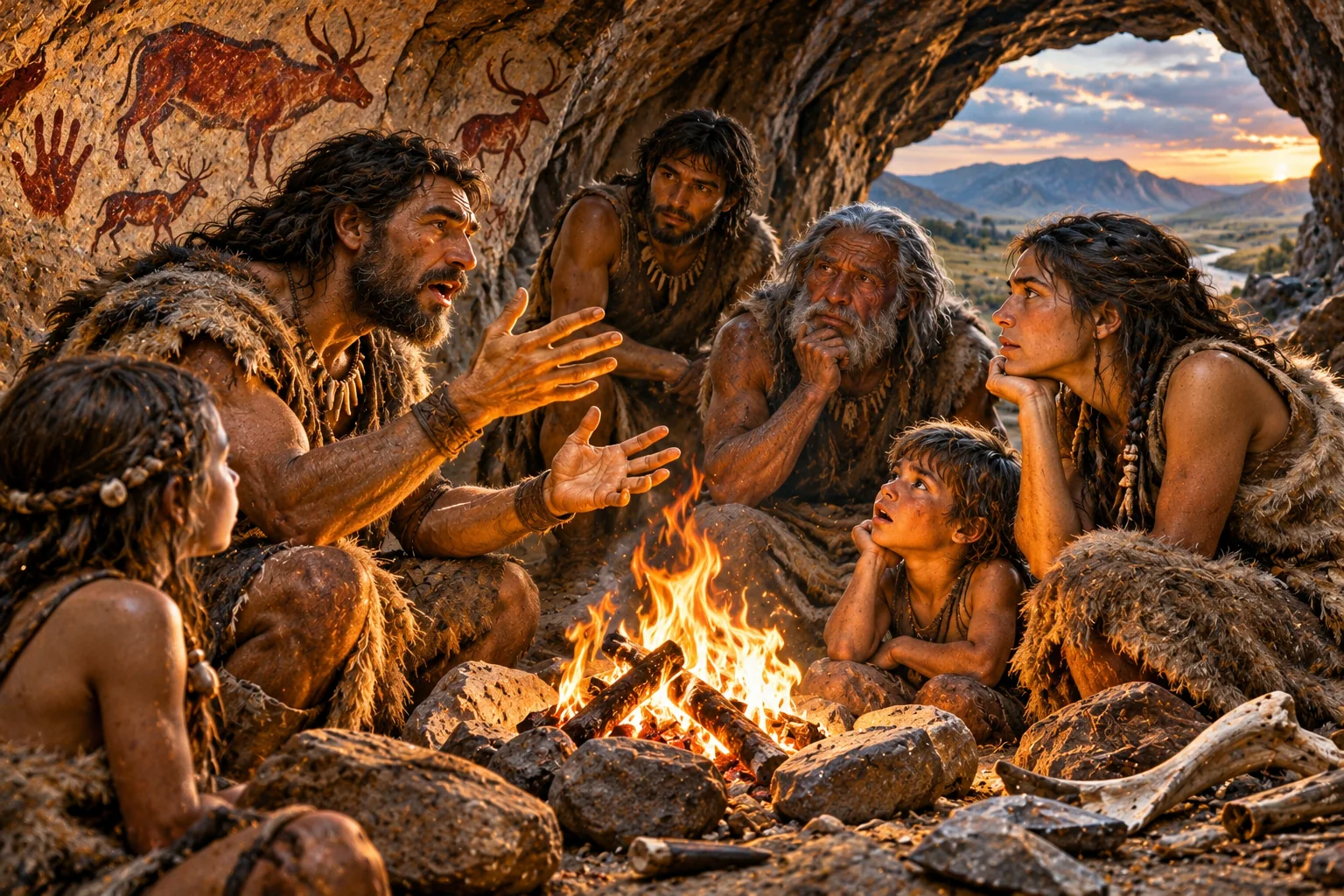
Prehistoric handprints, animal paintings, and engraved signs show that humans made durable marks long before cities and scribes. But an image is not automatically a written sentence. Writing, in the narrower historical sense, is a conventional system capable of recording linguistic information. A drawing of an animal may convey meaning without telling us the animal’s name, the grammar of a sentence, or who performed an action.
Many societies also used tally marks, tokens, cords, mnemonic devices, and other systems to record quantities or preserve knowledge. These were important technologies of memory, even where they did not function like fully developed writing. The transition from symbolic marks to writing was not one inevitable straight line.
Clay Tablets and the Birth of Records
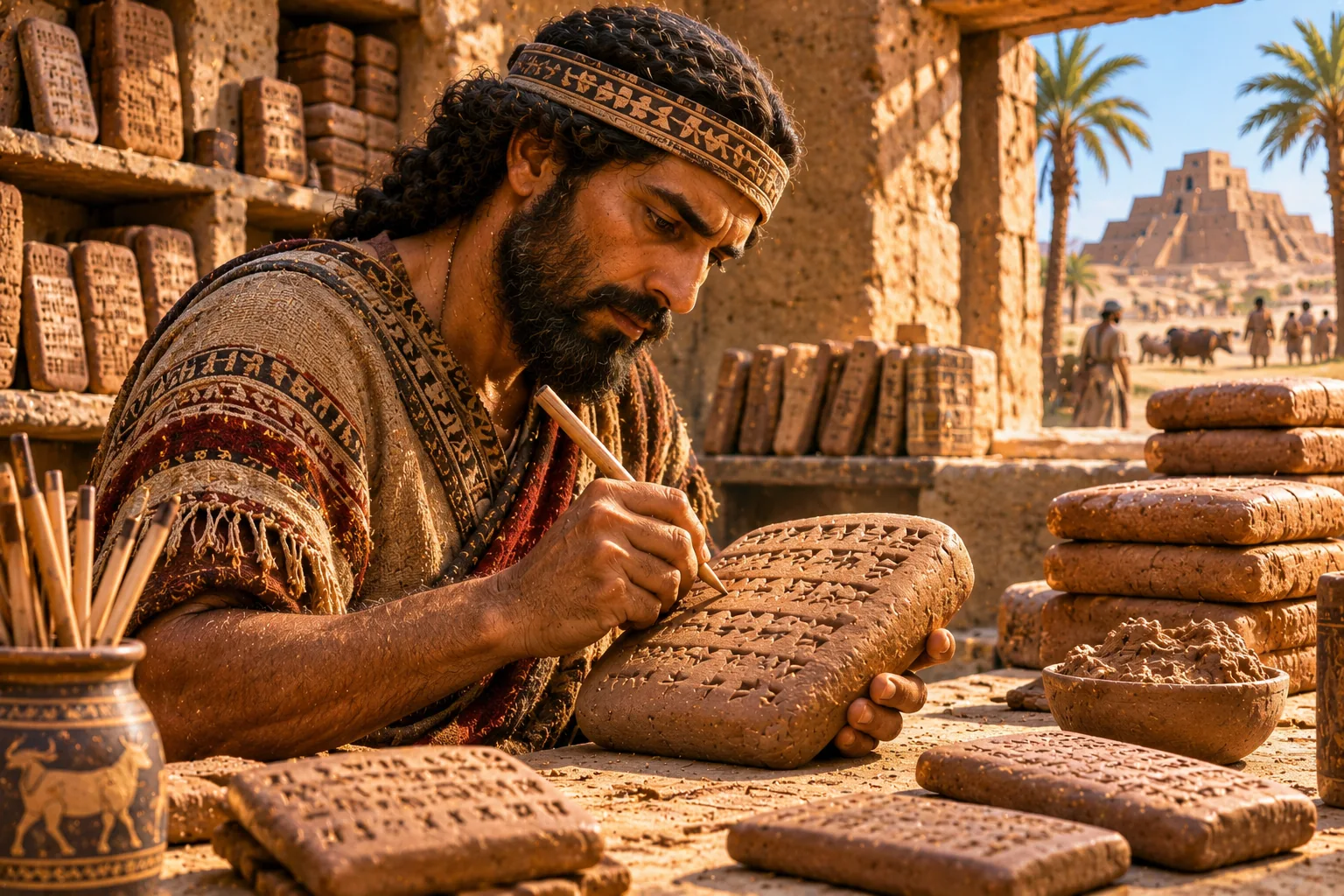
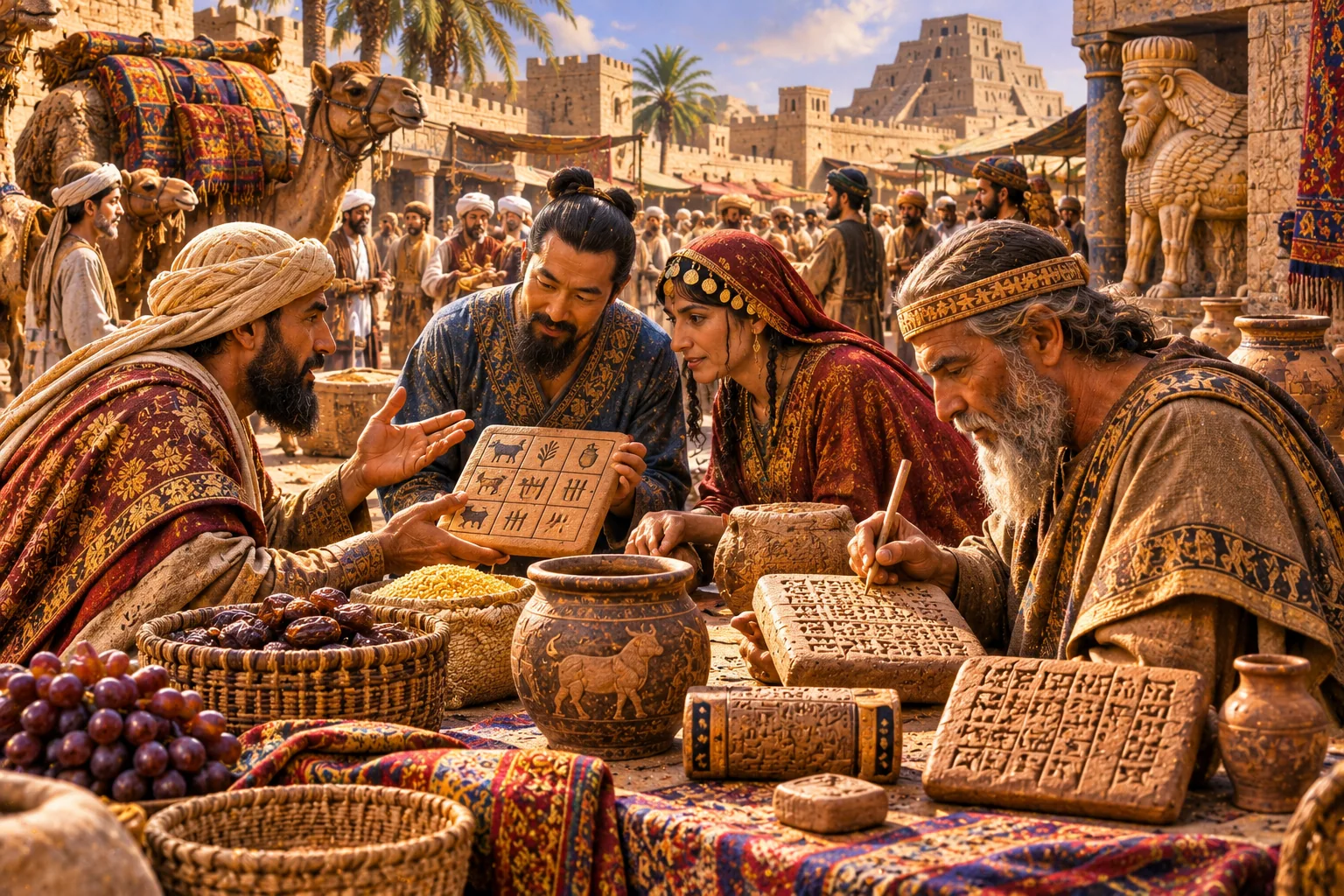
In southern Mesopotamia, proto-cuneiform appeared in the late fourth millennium BCE, around 3400–3200 BCE. Early tablets often recorded goods, labor, and transactions. Signs changed over time, and the wedge-shaped impressions associated with mature cuneiform developed through scribal practice. Writing made it possible to preserve obligations and eventually to record literature, legal collections, correspondence, and scientific observations.
The Epic of Gilgamesh survives in different ancient versions, including Sumerian poems and later Akkadian compositions. It is among the oldest major surviving literary works, not demonstrably the first story anyone ever wrote. Its concern with friendship and mortality shows what happened when writing moved beyond inventories: it began to preserve human questions.
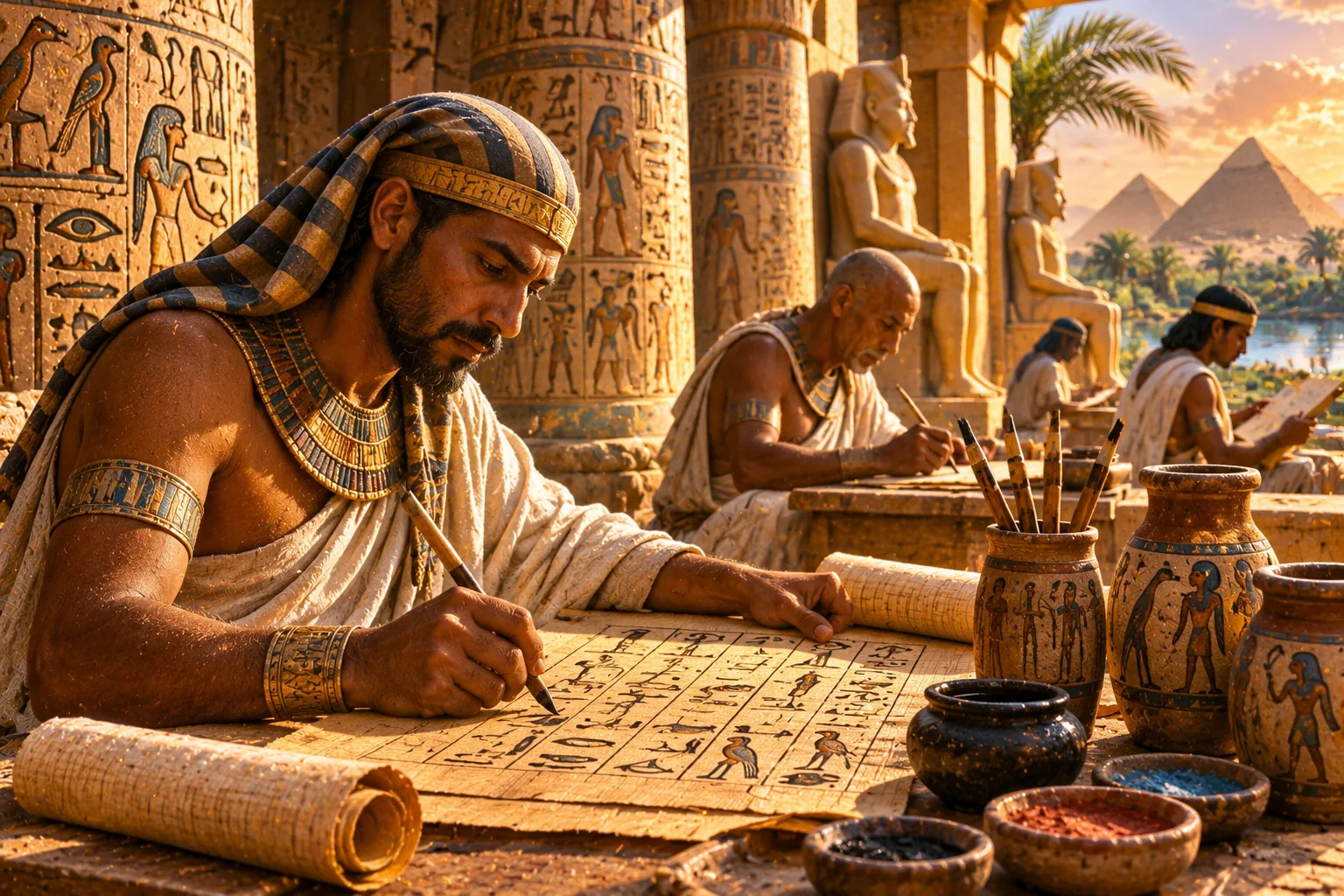
In Egypt, early hieroglyphic writing emerged around the late fourth millennium BCE. Hieroglyphs combined signs representing sounds with other kinds of signs; they were not simply pictures in which each drawing meant exactly what it depicted. Egyptian scribes used several related scripts for different purposes. Writing served government, religion, commerce, and remembrance, but literacy remained unevenly distributed.
The Stone That Opened a Lost Script
In 1799, a stone inscribed with a decree in hieroglyphic, Demotic, and ancient Greek was discovered near Rashid, known in European languages as Rosetta, in Egypt. Because scholars could read the Greek, the inscription became a key to deciphering Egyptian scripts. Jean-François Champollion’s breakthrough in 1822 built on earlier work, including that of Thomas Young and others. The Rosetta Stone did not single-handedly reveal all of Egyptian history, but it transformed the study of a vast written record.
The story carries a warning as well as a triumph. Scripts can become unreadable when the chain of readers breaks. A civilization may leave thousands of messages and still lose the people who know how to interpret them.
China and the Continuity of Characters
In China, oracle-bone inscriptions from the late Shang period, around the thirteenth century BCE, provide the earliest substantial body of securely attested Chinese writing. Questions about harvests, warfare, weather, and royal affairs were inscribed on bones and turtle shells used in divination. Chinese characters changed greatly over the centuries, but later writing traditions preserve important continuities with these early forms.
Chinese writing is not a collection of pictures alone. Characters often combine semantic and phonetic elements, and the number required for everyday literacy is far smaller than the total number listed in large dictionaries. Its history demonstrates that a writing system need not be alphabetic to sustain complex literature, administration, and scientific knowledge.
The Alphabet Was Not Born All at Once
Early alphabetic experiments appeared in the ancient Near East, including inscriptions associated with Semitic-speaking communities in Egyptian-influenced settings during the second millennium BCE. Their exact origins remain debated. Phoenician writing later became highly influential through Mediterranean trade and cultural contact. Greek adaptations included the systematic representation of vowel sounds, while Latin script developed through further historical transmission.
Arabic writing emerged through the evolution of earlier scripts, especially Nabataean Aramaic. The histories of Hebrew, Syriac, Arabic, Greek, and Latin are interconnected but not identical. Alphabetic writing did not automatically make everyone literate: education, materials, institutions, and social power still determined who could read.
South Asia developed major script traditions, including Brahmi, securely attested in the third century BCE and possibly rooted in earlier developments. Many later scripts, including Devanagari and Bengali, trace their histories through Brahmi-related lineages. Tamil writing has its own complex development within South Asian script history. These systems often represent consonants and vowels differently from European alphabets; the world’s scripts are not variations on one model.
Urdu: A Language Woven Across Worlds
Urdu’s literary and linguistic history reflects centuries of exchange across South Asia. Its script is a Perso-Arabic form adapted to represent sounds of the language, commonly written in the flowing Nastaliq calligraphic style. Urdu is written from right to left, while many of its numbers and embedded foreign expressions may follow different directional conventions in modern digital typography.
The beauty of Nastaliq is also a technical challenge: letters change shape according to context, and the diagonal flow of words demands sophisticated typesetting. Digital fonts and text-rendering systems have helped bring Urdu literature to screens, though reliable search, accessibility, and preservation still require care.
A script is not the same as a language. Urdu can be represented in other writing systems, and languages sharing a script need not be mutually intelligible. The voice of a language lives in its speakers; the script is one powerful way to carry that voice forward.
Paper, Printing, and the Multiplication of Memory
Writing materials changed the reach of written knowledge. Clay, stone, papyrus, parchment, bamboo, silk, and paper each shaped how records could be made and preserved. Papermaking developed in China long before it spread widely across Asia and into the Islamic world and Europe. Printing also has a global history: woodblock printing flourished in East Asia, and the dated Diamond Sutra of 868 CE is a famous early surviving printed book. Movable type appeared in East Asia centuries before Gutenberg.
In fifteenth-century Europe, Johannes Gutenberg and his contemporaries helped establish a powerful system of metal movable-type printing. Books could circulate in greater numbers, accelerating religious debate, scholarship, education, and the spread of new ideas. But printing did not instantly create universal literacy or freedom of expression. Censorship and unequal access persisted. Technology opened doors; societies decided who could enter.
Writing for Those Who Cannot See or Hear
The history of communication includes people who refused to accept that speech or sight should determine access to language. Signed languages developed within Deaf communities as rich, independent linguistic systems. In the nineteenth century, Louis Braille devised the tactile reading and writing system that bears his name, building on earlier raised-dot ideas. Braille opened new possibilities for independent literacy for blind readers.
These innovations expose a deeper truth: writing is not defined by ink, nor language by sound. What matters is a shared system through which meaning can move from one person to another.
From Telegraph Wires to the World Wide Web
The telegraph transformed long-distance written communication in the nineteenth century. The telephone extended spoken conversation across distances. In 1969, ARPANET transmitted its first message between networked computers; the attempt famously stopped after the letters “LO” before the system failed, with the full intended command sent afterward. The World Wide Web was proposed by Tim Berners-Lee in 1989 and developed at CERN, with the first website becoming available around 1990–1991.
Digital writing now moves through messages, websites, social platforms, subtitles, and searchable archives. Emoji enrich online communication but are not simply a return to prehistoric writing: their uses depend on context, culture, and shared conventions, much as gestures and punctuation do. The digital world has not replaced language; it has created new environments in which language evolves.
When a Language Falls Silent
Many languages are endangered as communities face displacement, discrimination, pressure to adopt dominant languages, and interruptions in transmission between generations. UNESCO and other organizations warn that a large share of the world’s languages are at risk, though exact percentages and the claim that one language disappears every two weeks depend on definitions and projections. Language loss is not an automatic natural law; it is often tied to political and social conditions.
When a language ceases to be spoken, unique stories, ecological terms, humor, and memories may become difficult to recover. Revitalization is possible through community-led education, documentation, intergenerational teaching, broadcasting, and digital tools. Saving a language does not mean freezing it. It means allowing its speakers to give it a future.
Machines That Speak, Humans Who Mean
Artificial intelligence can now translate, transcribe, summarize, and generate fluent prose. These tools can widen access across languages and assist with documentation, including for under-resourced languages. They can also make errors, flatten cultural distinctions, invent information, and reproduce biases in their training data. A convincing sentence is not automatically a truthful one.
The ethical questions are urgent. Who controls a community’s recordings and texts? Were speakers asked for permission? Will digital systems support smaller languages or push them further aside? Human language is not merely a dataset. It is a relationship among people, histories, and living communities.
The Word That Outlived Its Speaker
Imagine a child speaking a first word. Someone answers. The child learns that a sound can reach another mind. Imagine, centuries later, a student writing a name on a page. That name may be read tomorrow, or by a stranger after the writer is gone. These are different miracles: language makes shared life possible; writing gives some of that life a longer memory.
Neither language nor writing alone made humans human. Our species and its relatives lived, cooperated, and communicated long before surviving scripts. Yet these capacities expanded the reach of human thought beyond any one voice or generation.
There is something profoundly moving about a message that survives its maker. It says, in effect: I knew something. I felt something. I wanted someone else to know.
Everything has a beginning. Language lets us speak across space; writing lets us speak across time.
Sources and Further Reading
- Smithsonian Human Origins — Homo sapiens
- Encyclopaedia Britannica — Language
- Encyclopaedia Britannica — Writing
- British Museum — The Rosetta Stone
- Encyclopaedia Britannica — Cuneiform
- Encyclopaedia Britannica — Chinese Writing
- UNESCO — Languages
- CERN — The Birth of the Web
Editorial note: The origin of spoken language is not securely dated. Prehistoric images are distinguished from writing, and contested claims about scripts, language counts, and language endangerment are presented cautiously.



