

Birth Stories — Part Fifteen | Everything Has a Beginning. Every Beginning Has a Story.
Before there were recipes, restaurants, or even farms, there was hunger. Somewhere in a landscape we can no longer identify, a human ancestor reached for something edible: a fruit, a root, a seed, perhaps the remains of an animal. It was not the first meal on Earth. Living things had been feeding for billions of years. But over the immense course of human evolution, food became something more than fuel. It became a reason to travel, a skill to teach, a crop to protect, a commodity to exchange, and finally a language of affection.
Every meal is a map of journeys. A tomato sauce in Italy carries the history of the Americas. A chili-laden curry in South Asia tells of ocean crossings. Chocolate, associated with European confectionery, begins with cacao trees and Indigenous cultures of tropical America. The foods we call traditional are often the results of extraordinary change.
Before the Farm: The Intelligence of Eating
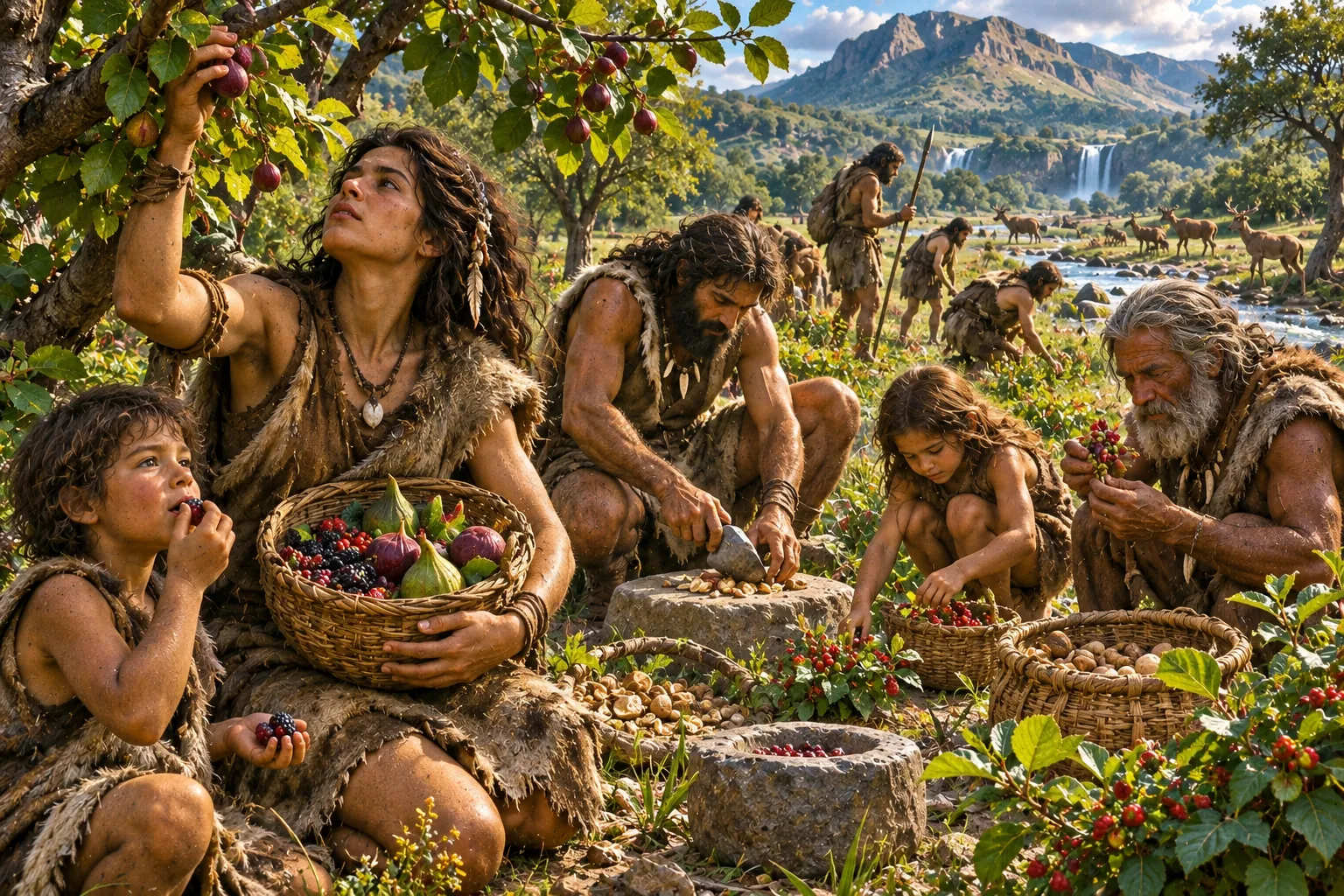
For most of human history, people obtained food through gathering, hunting, fishing, and other forms of foraging. Their diets varied widely according to climate, ecology, technology, and season. Some communities relied heavily on plant foods; others drew more calories from fish or hunted animals. There was never one universal “caveman diet,” and we cannot confidently assign every prehistoric population a fixed number of edible plants.
Finding food required close knowledge of the environment. Which fruit was ripe? Which tuber needed processing before it could be eaten safely? Where would migrating animals pass? When would the river bring fish? Such knowledge was learned socially and passed between generations. Food was already culture long before anyone wrote a cookbook.
Fire: The Meal That Changed Everything
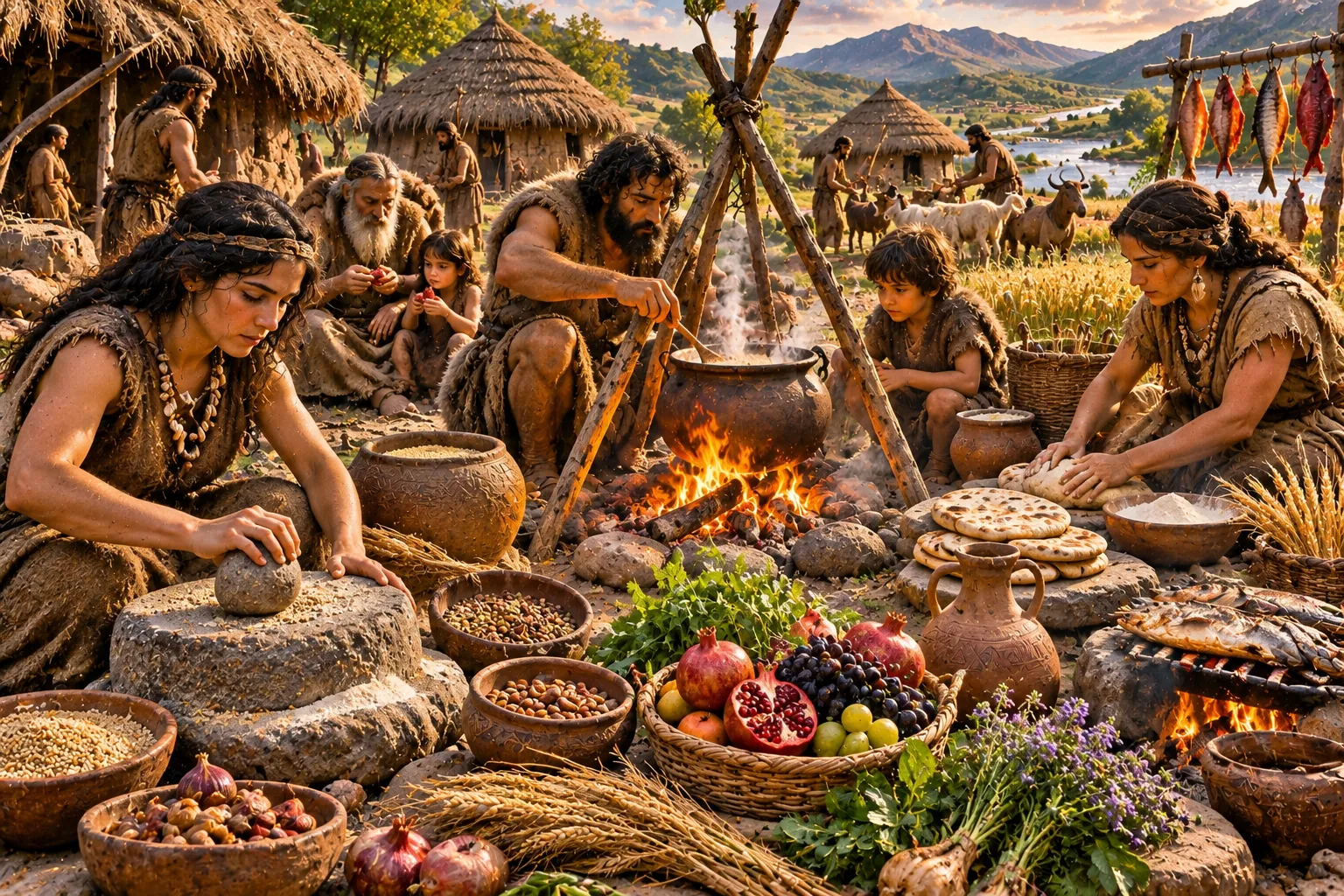
The controlled use of fire reaches deep into human prehistory, though evidence differs in age and certainty from site to site. Archaeological traces suggest some human ancestors used fire hundreds of thousands of years ago, possibly earlier in some settings. Exactly when regular cooking became widespread remains debated.
Cooking can soften tough foods, increase the energy available from some ingredients, and reduce certain pathogens and toxins when done properly. The evolutionary biologist Richard Wrangham has argued that cooking helped shape human anatomy and energetics. This is an influential hypothesis, not a settled explanation proving that fire alone caused the human brain to grow. Nor did fire invent family life: social bonds long predate the hearths we can identify archaeologically.
Yet the shared fire altered the possibilities of a meal. Food could be transformed, divided, and consumed together. The flame illuminated faces as well as meat. A meal could become an occasion for conversation, teaching, and memory.
Farming Had More Than One Birthplace
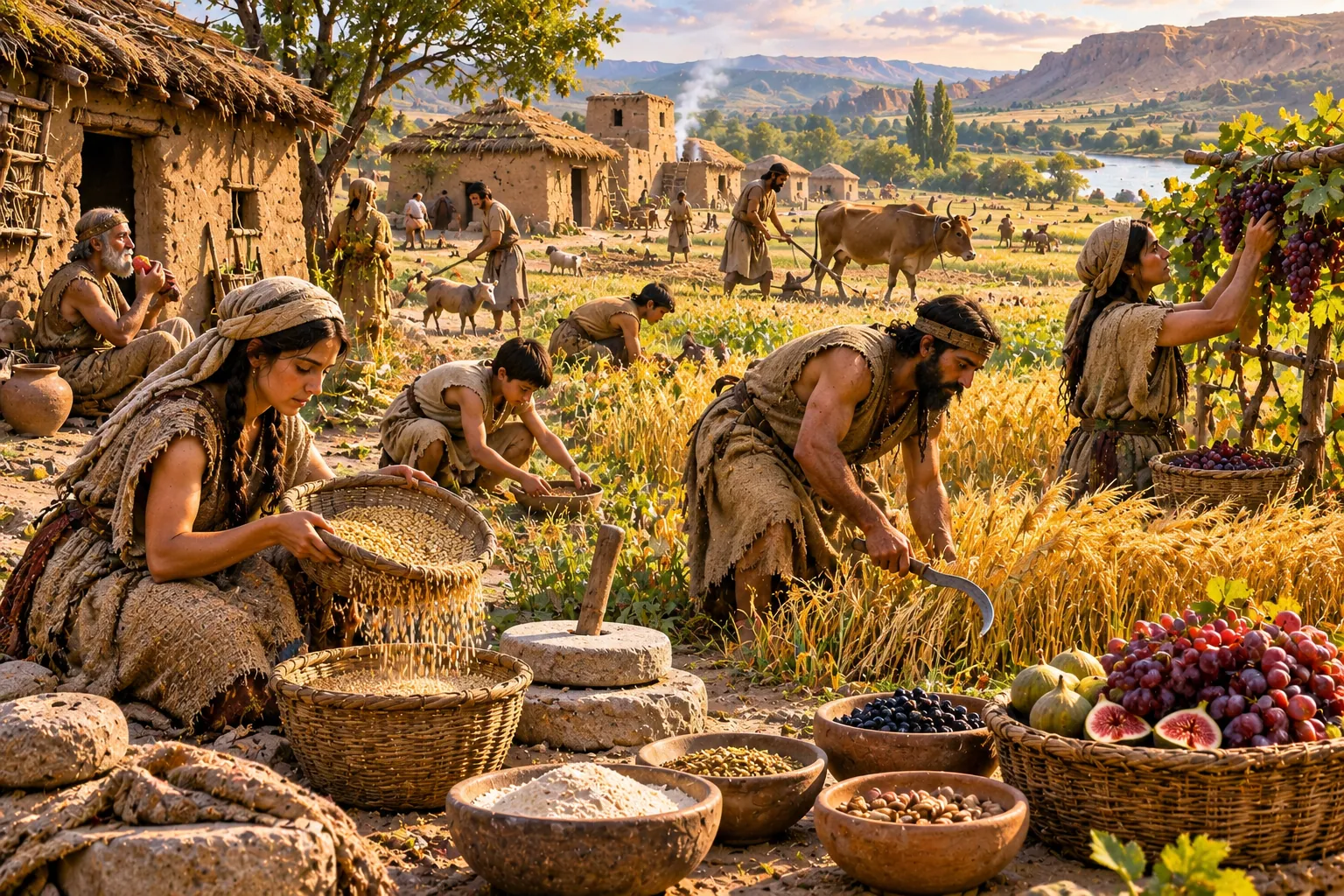
Beginning more than ten thousand years ago, farming emerged through long processes of experimentation and domestication in several parts of the world. In Southwest Asia, communities cultivated wheat, barley, and pulses and domesticated animals such as sheep and goats. In East Asia, rice and millets developed into major crops. In Mesoamerica, maize was domesticated from teosinte through generations of human selection. In the Andes, people cultivated potatoes and other crops. African farming histories include sorghum, pearl millet, and indigenous vegetables; New Guinea has evidence of early cultivation of crops such as taro and bananas.
These were not simultaneous discoveries by identical societies. Some communities combined cultivation with foraging for millennia. Nor did agriculture always make life easier. It could increase food production and support larger settlements, but also bring heavier labor, less diverse diets, infectious disease, and unequal control of land and harvests.
The first farmers did something profound: they changed the future of plants. They saved seeds from desirable specimens and planted them again. Over generations, wild grasses and fruits became crops that often looked very different from their ancestors. Agriculture was not only the domestication of plants. It was the beginning of a long relationship in which plants and people transformed one another.
The Apple: A Fruit with Many Ancestors
The cultivated apple has a particularly rich history in Central Asia. The wild species Malus sieversii, found in the mountains of present-day Kazakhstan and neighboring regions, contributed substantially to the ancestry of modern apples. As apples moved along trade routes, they hybridized with other wild relatives. Their history cannot be reduced to one orchard planted on a known date.
Apples also illustrate a biological curiosity: seeds do not reliably produce fruit identical to the parent tree. Many familiar varieties are preserved through grafting, a technique that joins living plant tissues. The apple in a market is therefore both a biological descendant and a product of centuries of horticultural knowledge.
Bananas, Mangoes, Grapes, and Pomegranates
Banana domestication involved complex histories across Southeast Asia and New Guinea, including hybridization among wild banana species. Many edible bananas are seedless or nearly so, and farmers propagate them vegetatively. Their sweetness and convenience conceal a remarkable history of plant breeding—and modern vulnerability when genetically similar crops face disease.
Mangoes have deep roots in South Asia, where they became important in horticulture, literature, and religious and cultural traditions. Their many varieties reflect long selection and movement across tropical regions. Grapes were domesticated in western Eurasia, with the South Caucasus and surrounding areas important in early wine history; archaeological evidence of ancient winemaking does not establish one exclusive origin for all grape cultivation. Pomegranates have an ancient distribution across parts of western and southern Asia and became symbols of fertility and abundance in several cultures.
These fruits were never merely sweet objects. They could signify status, hospitality, ritual, memory, and the promise of another season.
Food in Africa and the Pacific
Global food history becomes distorted when it is told only through wheat, rice, and European voyages. African societies domesticated and developed crops suited to varied environments, including sorghum, pearl millet, African rice, yams, and cowpeas. These crops supported cuisines and farming systems across savannas, river valleys, and tropical regions. Teff became central to the food traditions of the Horn of Africa.
Across the Pacific, communities cultivated and transported taro, breadfruit, yams, coconuts, and bananas, carrying food plants across vast distances by sea. Oceanic voyaging was also an agricultural achievement: settlers had to bring the means to feed future generations. The movement of a plant could be as consequential as the movement of a ship.
Salt, Preservation, and the Taste of Time
Salt is essential to human physiology and has long been valued for seasoning and preservation. Societies extracted it from seawater, mineral deposits, and brines. It traveled through trade networks, sometimes becoming an important source of taxation and political power. In parts of the Sahara and Sahel, salt was a valuable commodity carried across difficult desert routes.
But the familiar story that Roman soldiers routinely received their wages in salt is not established by reliable evidence. The English word salary is linked to Latin salarium, whose precise historical relationship to salt is more complicated than the popular anecdote suggests. Claims that salt or pepper always exchanged weight for weight with gold are similarly misleading: prices varied dramatically by place, period, and quality.
Preservation techniques—including drying, smoking, salting, fermentation, and later refrigeration—allowed food to survive beyond harvest and travel farther than it otherwise could. Preserved food made long journeys, military campaigns, cities, and winter survival more manageable. A jar of pickles or a piece of dried fish belongs to the history of technology as much as to the history of taste.
Spices and the Routes That Joined Continents
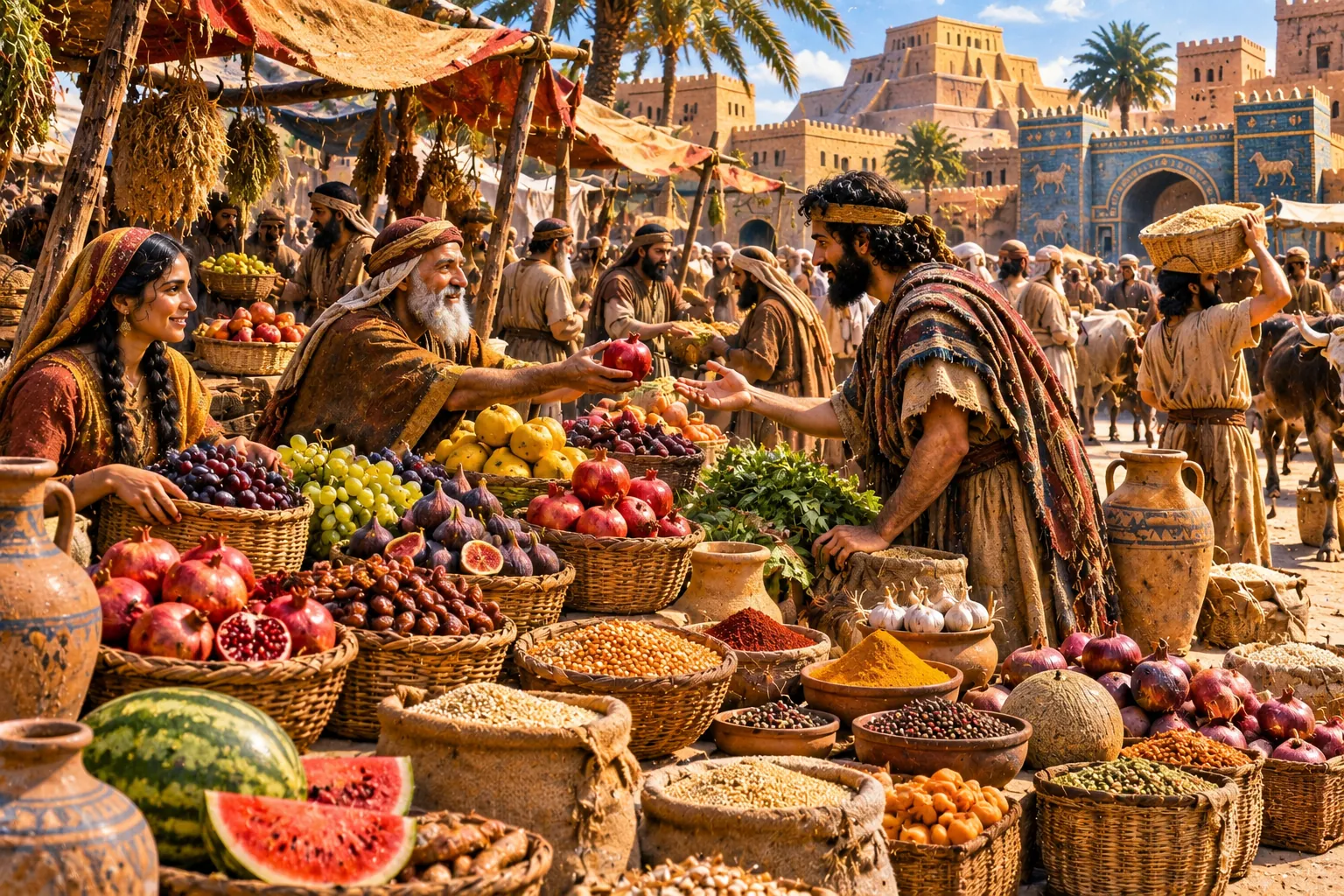
Black pepper from South India’s Malabar region, cinnamon and cassia from different Asian sources, cloves from the Moluccas, and other aromatic goods moved through networks linking Asian, African, Middle Eastern, and European merchants. Their value encouraged trade and competition, but they were never the only goods or motives shaping global exploration.
European maritime expansion in the late fifteenth century sought routes to Asian markets and was bound up with commerce, religion, state rivalry, and imperial ambition. Columbus’s 1492 voyage and Vasco da Gama’s arrival on India’s coast in 1498 became turning points in a history that also included conquest, enslavement, and catastrophic consequences for Indigenous peoples. The search for profitable goods did not merely connect the world; it changed who could control its trade.
The Columbian Exchange: A Planet Changes Its Menu
After sustained contact between the Americas and the rest of the world began in the late fifteenth century, plants, animals, microbes, and people moved across oceans on an unprecedented scale. Historians call this the Columbian Exchange. From the Americas came potatoes, tomatoes, maize, cacao, chili peppers, and many other crops. From Eurasia and Africa came wheat, sugarcane, coffee, livestock, and numerous other organisms.
Imagine Italian cooking before the tomato became familiar, or the cuisines of South and Southeast Asia before American chili peppers spread through trade. Many foods now regarded as timeless national traditions are comparatively recent combinations. European potato cultivation transformed diets in several regions; maize became important in parts of Africa and Asia; cacao was reworked into new forms of chocolate far from its original cultural setting.
But exchange was not a happy story of ingredients alone. Epidemic disease devastated Indigenous populations in the Americas. Plantation agriculture expanded through enslaved labor and colonial extraction. Sugar’s sweetness became inseparable from histories of violence. A responsible history of food must tell both sides of the voyage.
How Dishes Acquire New Homelands
Recipes rarely possess a single uncontested inventor. The history of biryani draws on Persianate rice traditions and diverse South Asian culinary developments; claims that one royal kitchen invented it are too simple. Samosa-like pastries traveled through Persianate and Central Asian networks and changed form across regions. Noodles, filled breads, stews, and dumplings have complex, sometimes independent histories across cultures.
Tea originated as a cultivated and consumed plant in East Asia, with particularly deep roots in China. The story of leaves falling into Emperor Shennong’s boiling water is a legend, not a verified account from 2737 BCE. Tea later spread through trade, empire, plantation economies, and local adaptation. British tea culture, South Asian chai, Japanese tea practice, and Moroccan mint tea are different chapters in its global life.
What we call a national dish may be a conversation among centuries and continents. Food identities matter, but they are not proof that cultures developed in isolation.
Fermentation: The Invisible Cooks
Long before microbiology explained their work, people learned to make bread rise, milk turn into yogurt and cheese, vegetables sour, and grains or fruit ferment into beverages. Yeasts and bacteria transformed ingredients in ways humans could taste and preserve. Fermentation could improve shelf life, change texture, and create distinctive flavors, though its safety depends on ingredients and methods.
Across the world, fermented foods took strikingly different forms: sourdough breads, kimchi, miso, injera, yogurt, cheeses, and many others. These were not one invention spread from a single source. They show how communities repeatedly learned to cooperate—often without knowing it—with microscopic life.
What Fruit Can and Cannot Promise
Fruits provide combinations of fiber, vitamins, minerals, water, and plant compounds. Apples can contribute dietary fiber; bananas provide potassium; mangoes contain carotenoids; citrus fruits can be useful sources of vitamin C. But no single fruit guarantees a healthy heart, prevents aging, corrects blood pressure, or eliminates the need for medical care. The old saying about an apple a day is a proverb, not a scientific law.
Health depends on overall dietary patterns, sufficient and varied nutrition, physical conditions, and access to care. The nutritional value of food also depends on portion size, preparation, and individual needs. The wonder of fruit lies not in miracle claims but in the biological richness produced by plants and the many ways humans have learned to cultivate them.
Industry, Refrigeration, and the Global Table
Industrialization changed food through mechanized milling, transport, canning, refrigeration, fertilizers, food safety science, and mass production. Railways and cold chains enabled food to travel farther. Supermarkets and restaurant chains reshaped shopping and eating habits. McDonald’s opened its original restaurant in California in 1940 and later became a global franchise, one visible symbol of a much wider transformation.
Industrial food systems have made some products more accessible and reliable, but they also raise questions about labor, animal welfare, ultra-processed foods, marketing, environmental impact, and concentration of corporate power. Local and slow-food movements respond to some of these concerns by emphasizing regional traditions, ecological care, and the pleasure of meals made with attention. Neither “traditional” nor “industrial” automatically means healthy; evidence and context matter.
Abundance Beside Hunger
Our world produces enormous quantities of food, yet hunger and food insecurity persist. Meanwhile substantial food is lost between harvest and retail or wasted in shops, restaurants, and homes. The precise totals change by year and by definition. Waste reduction matters, but it cannot by itself end hunger: poverty, conflict, inequality, logistics, climate shocks, and access to land and markets also determine who eats.
There is a moral contradiction in a world where some households discard edible meals while others struggle to afford basic nutrition. Solving it requires more than telling individuals to clean their plates. It requires resilient farming, fair distribution, functioning infrastructure, peace, and public policy that treats nourishment as a human priority.
The Next Food Revolution
Climate change is altering growing conditions, water availability, and the frequency of damaging extremes. Farmers and scientists are developing more resilient crops, improved irrigation, precision agriculture, alternative proteins, and methods to reduce losses. New technologies may help, but they also raise questions about cost, ownership of seeds and data, energy use, and the livelihoods of small farmers.
Food’s future will not be decided in laboratories alone. It will also be decided in fields, fishing communities, kitchens, marketplaces, and homes. A sustainable food system must nourish people without exhausting the ecosystems that make nourishment possible.
The Table Where the World Meets
Consider a simple meal: bread from grain domesticated thousands of years ago, a tomato descended from American plants, a spice carried through old trade routes, tea shaped by centuries of cultivation, and fruit whose ancestors grew in distant mountains. On one table sit histories that once belonged to separate continents.
When someone cooks for another person, food becomes care. When families gather to eat, recipes become memory. Yet shared meals do not automatically erase inequality; the table becomes truly generous when everyone has a place and enough to eat.
We began with hunger, but the history of food cannot end there. A seed is a wager on tomorrow. A preserved recipe is a message from yesterday. A meal offered to a stranger is an act of trust in the present.
Everything has a beginning. Food begins in the living world—and becomes human history when we learn to grow it, transform it, share it, and remember it.
Sources and Further Reading
- Encyclopaedia Britannica — Agriculture
- Encyclopaedia Britannica — Domestication
- Encyclopaedia Britannica — Columbian Exchange
- Food and Agriculture Organization of the United Nations
- UNEP — Food Waste Index Report 2024
- World Health Organization — Healthy Diet
- Encyclopaedia Britannica — Apple
- Encyclopaedia Britannica — Banana
Editorial note: Dates of domestication are approximate and often debated. Popular claims about ancient food prices, the origins of dishes, and the medical effects of individual fruits are distinguished from established evidence.



