

Birth Stories — Part Thirteen | Everything Has a Beginning. Every Beginning Has a Story.
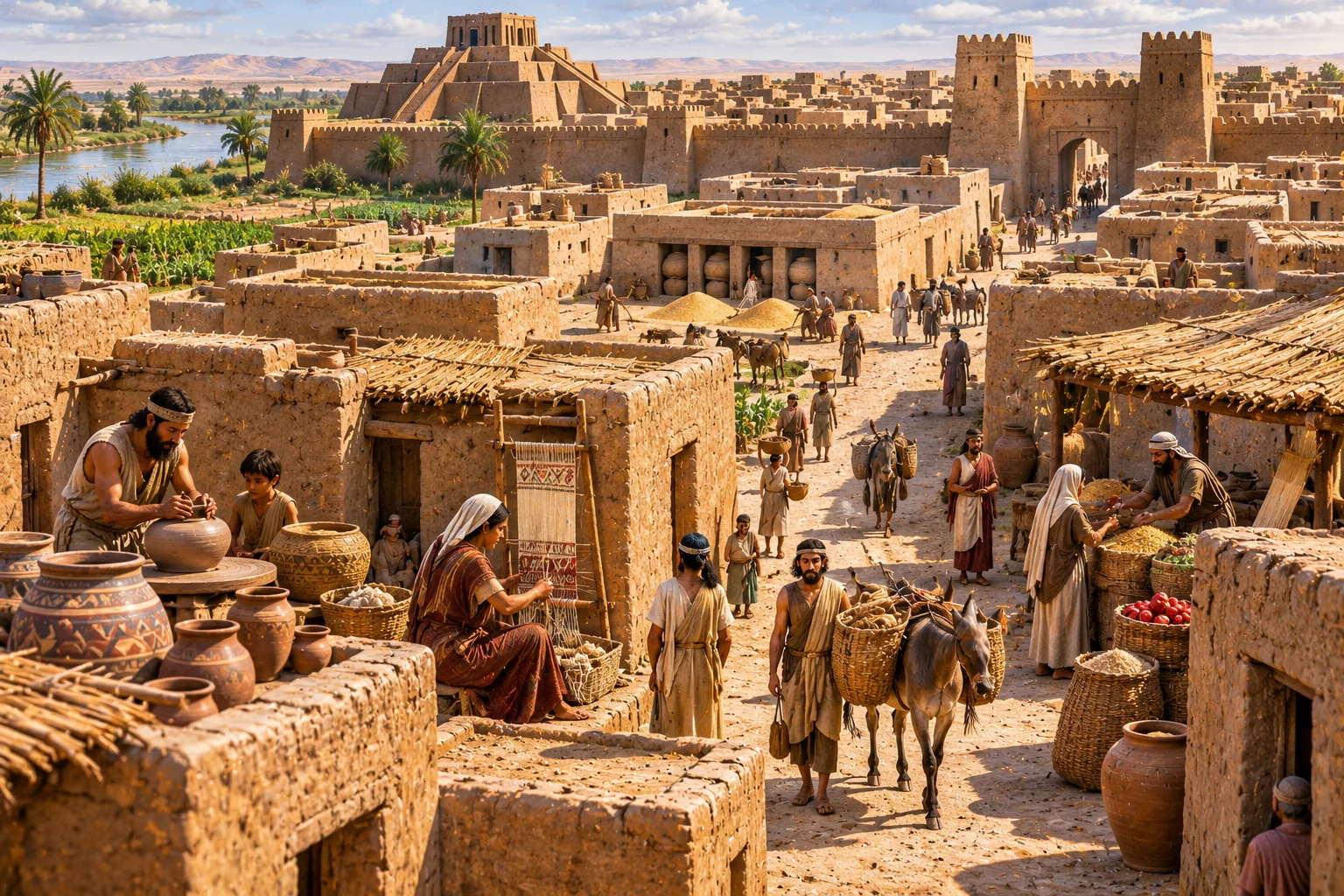
Imagine a traveler returning to the same bend in a river. There is water, fertile soil, a place to shelter from the wind. Other families have stopped there too. Someone makes pots, someone tends grain, someone knows how to repair a roof. A path becomes a lane. A gathering becomes a market. A place acquires a name. No one announces that a city has been born. Yet something remarkable has happened: strangers have begun to depend upon one another.
This is an imagined scene, not a record of the first city. Archaeology offers no single day when humanity decided to stop wandering. Some communities settled before agriculture became their main source of food; others continued to move even after farming spread. And the boundary between village, town, and city remains a matter of debate. But the question is clear: how did people learn to live in such numbers that no one could know everyone else?
Before the City: The Long Art of Staying
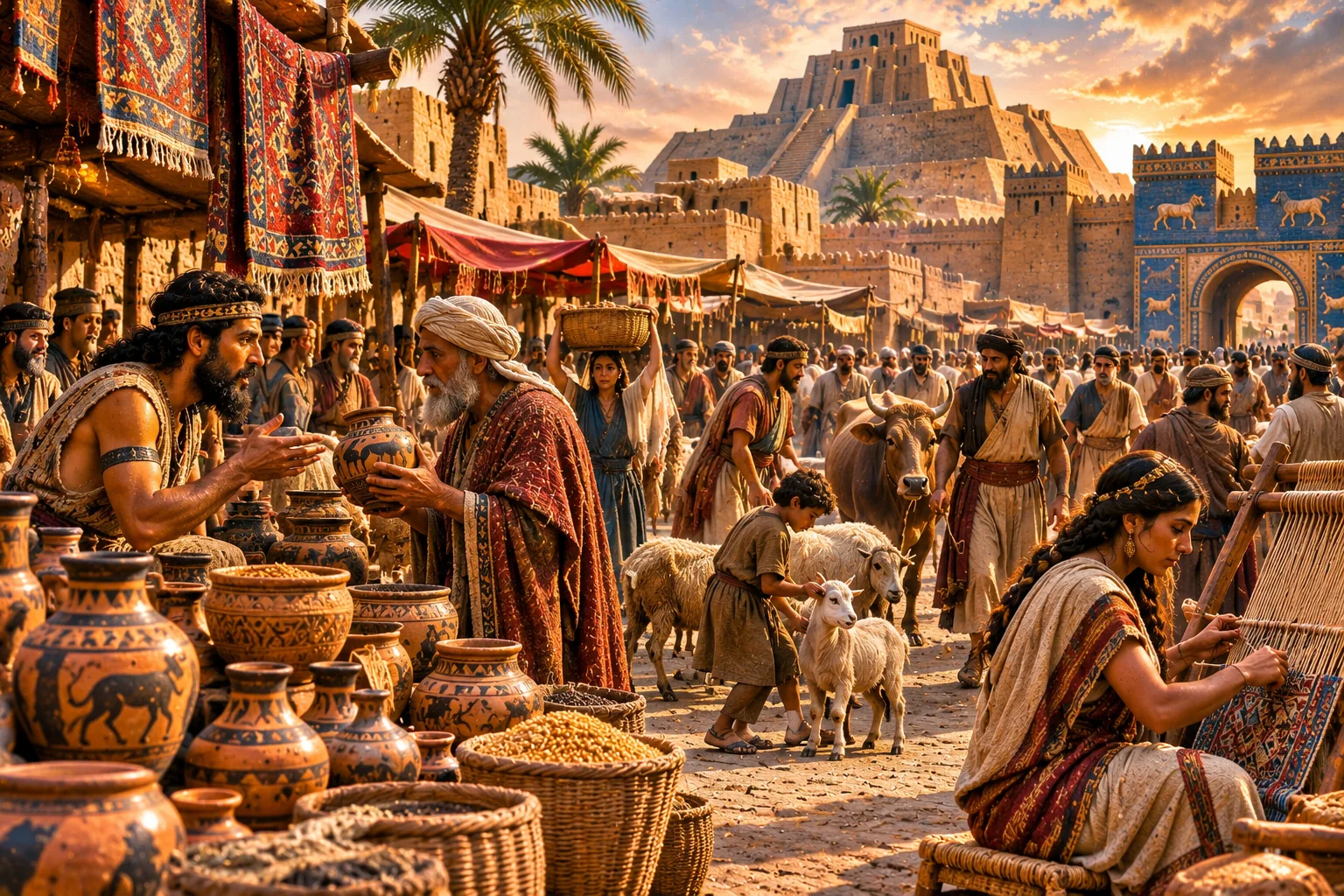
Human societies lived in varied ways for tens of thousands of years. Some hunted and gathered while moving seasonally; others returned to favored places or established long-lived settlements. The spread of cultivation and animal domestication in several regions, beginning more than 10,000 years ago, made new kinds of settlement possible. Agriculture was not a single invention in one place, and permanent residence was not its automatic consequence.
Surplus food could support craftspeople, administrators, traders, and religious specialists. Yet concentrated populations also created risks: contagious disease, disputes over land and water, waste disposal, fire, and unequal power. The city would become humanity’s most ambitious experiment in cooperation—and one of its most demanding.
Jericho: A Wall Before the Metropolis
At Tell es-Sultan, associated with ancient Jericho in the Jordan Valley, archaeological remains reveal very early settlement and substantial stone construction in the Pre-Pottery Neolithic period, around the ninth millennium BCE. The site’s famous stone wall and tower are among the most remarkable early monumental works. Scholars have debated whether these structures served defense, flood protection, ritual, social organization, or more than one purpose. It would be too confident to assign them one settled explanation.
Jericho is often promoted as the world’s oldest continuously inhabited city. That claim depends on how one defines a city and how one accounts for interruptions in occupation. The safer—and still extraordinary—statement is that it is among the oldest places with evidence of long human settlement. Its ancient builders already faced a recognizably urban problem: how do we organize people, resources, and space around a shared place?
Çatalhöyük: A Settlement Without Familiar Streets
In present-day Türkiye, Çatalhöyük flourished during the Neolithic, especially in the seventh millennium BCE. Its closely packed mudbrick houses formed a dense settlement unlike a modern town. People commonly entered buildings through openings in their roofs; movement across roof surfaces played a role in circulation. Interior paintings, installations, and burials beneath house floors reveal complex relationships among household life, memory, and ritual.
Population estimates vary, and archaeologists debate how best to classify Çatalhöyük. Its significance does not require calling it a city in exactly the modern sense. It shows that dense communities could organize everyday life without the grand avenues, royal palaces, or civic squares that later came to symbolize urbanism.
Uruk: When the City Became a System
By the fourth millennium BCE, Uruk in southern Mesopotamia had grown into one of the ancient world’s most important urban centers. Temples, workshops, long-distance exchange, and administrative practices linked a large and differentiated population. The earliest proto-cuneiform tablets recorded quantities, labor, and commodities; writing was deeply entangled with the challenges of managing a complex society.
Uruk did not single-handedly invent the wheel, brickmaking, kingship, or every specialized occupation. Such innovations have broader and sometimes uncertain histories. Its achievement was the scale at which people, materials, knowledge, and institutions were brought together. A potter could make vessels for people never met; a scribe could record obligations involving goods not personally owned. The city made strangers part of the same economic and political story.
Egypt: Capitals Along the Nile
Ancient Egypt’s urban history developed along the Nile through settlements, religious centers, administrative towns, and royal capitals. Memphis became a major center in the early dynastic period, although its founding cannot be reduced to a securely documented single year. Later, Thebes and other cities played changing roles in political and religious life.
Egyptian cities were shaped by the river’s seasonal rhythms, agricultural hinterlands, temples, trade, and royal institutions. Monumental architecture depended on extensive networks of workers and supplies. The ancient city was not simply a place where rulers lived. It was a machine for bringing food, labor, belief, and authority into contact.
The Indus: Water, Bricks, and the Discipline of Streets
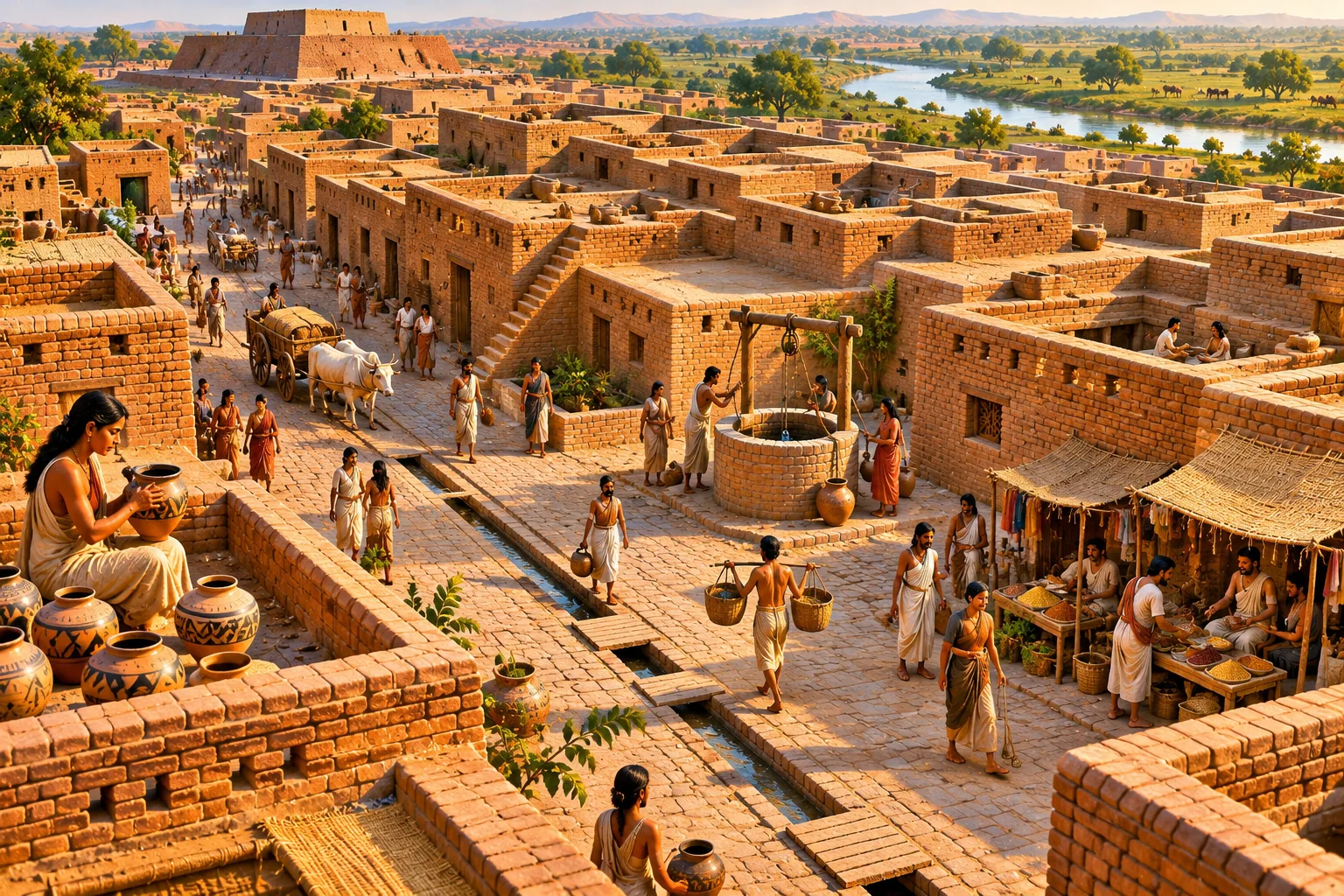
In the mature Harappan period, roughly 2600–1900 BCE, cities including Mohenjo-daro and Harappa, in present-day Pakistan, developed impressive urban systems. Standardized bricks, carefully laid streets, drainage channels, wells, and bathing facilities testify to substantial planning and maintenance. Mohenjo-daro’s Great Bath remains an unforgettable monument to the importance of water and communal space.
Not every house had its own well, and it is not true that covered drains were unknown elsewhere. What is exceptional is the scale and consistency of certain arrangements across these settlements. Because the Indus script remains undeciphered, much about political authority and religious practice is uncertain. The absence of obvious palaces of the Egyptian kind cannot prove that rulers did not exist. It may instead reveal institutions unlike those we know best—or gaps in what survives.
Here is a question worth asking in any modern city: what does the arrangement of water, waste, and streets tell us about what a society considered important?
Rome: The City That Had to Be Fed
Ancient Athens became famous for experiments in citizen government, particularly reforms associated with Cleisthenes in 508/507 BCE. Yet participation excluded women, enslaved people, and many other residents. The word citizen carried both possibility and restriction.
Rome eventually reached a scale that challenged the ancient world’s capacity to feed, supply, and administer an urban population. Estimates that its population approached or exceeded a million at its height remain debated. Aqueducts, roads, baths, sewers, warehouses, and public buildings supported a vast metropolis, but not all inhabitants enjoyed equal access to its benefits. Crowded housing, fire, disease, and poverty were part of Roman urban life.
“All roads lead to Rome” is a proverb reflecting the city’s imperial centrality, not a literal map of every road. More important is the principle it suggests: the great city depends on an enormous territory beyond its walls. Grain, stone, labor, and taxes must arrive continually. An urban population may be concentrated, but its needs are scattered across a continent.
Great Cities Beyond Europe
The world’s urban imagination never belonged to one region. Chinese capitals developed elaborate planning and administration. Chang’an, especially under the Tang dynasty, became a cosmopolitan center linked to trade routes across Eurasia. Under the Song, cities such as Kaifeng supported bustling markets, commercial services, and sophisticated urban cultures. Exact medieval population figures are uncertain, but their scale and complexity are beyond dispute.
Baghdad, founded in the eighth century as an Abbasid capital, became a center of administration, commerce, scholarship, and intellectual exchange. Córdoba in al-Andalus flourished as another major urban and cultural center. Claims that these cities had precisely one million or half a million inhabitants—or fixed, spectacular numbers of libraries and mosques—are often repeated without dependable evidence. Their importance is not diminished by careful estimates.
Across Africa, cities such as Timbuktu, Djenné, Kilwa, and Great Zimbabwe developed through distinct networks of scholarship, trade, craft, and political power. In the Americas, Teotihuacan became a vast urban center long before European contact; later Tenochtitlan astonished observers with its causeways, canals, markets, and lake setting. In the Andes, Cusco anchored an imperial system adapted to mountainous geography. Each city solved the problem of living together in its own way.
Markets, Mosques, Temples, and Meeting Places
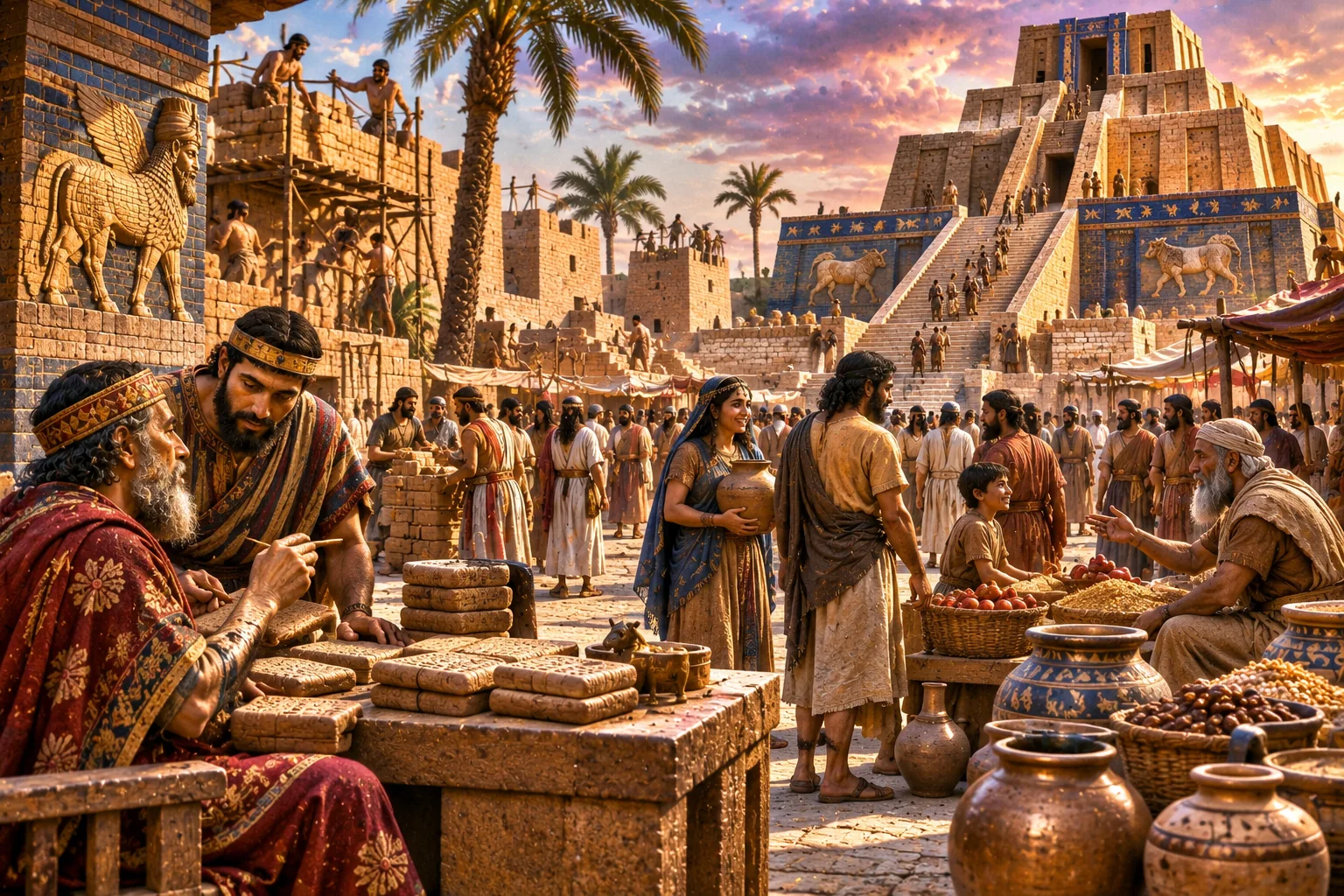
A city is more than housing. Its markets allow specialized work to flourish. Its public spaces bring people together who might otherwise never meet. Its religious buildings, schools, workshops, courts, and libraries help preserve and contest collective memory. Yet cities can also segregate people by wealth, occupation, ethnicity, or legal status.
There is no universal blueprint. Some cities grew around royal courts; others around ports, pilgrimage routes, fortresses, crossroads, or manufacturing centers. The urban form reflects geography and power as much as ideals. A wide boulevard may represent civic pride—or a ruler’s ability to demolish neighborhoods. A marketplace may offer opportunity—or conceal exploitation. To read a city, one must ask who designed it and who was required to live with the design.
The Industrial City: A New Kind of Crowd
Industrialization accelerated urban growth in Britain and elsewhere from the late eighteenth century onward. Factories drew workers into expanding settlements, while railways and steamships connected production to distant markets. Cities created jobs and new social movements, but also overcrowded housing, dangerous workplaces, contaminated water, and polluted air.
In nineteenth-century London, repeated cholera outbreaks exposed the deadly consequences of inadequate sanitation. During the 1854 Soho outbreak, physician John Snow investigated the geographic pattern of deaths associated with a contaminated water pump on Broad Street. His work became a landmark in epidemiology, though it did not single-handedly create modern urban sanitation. Reform required engineering, public institutions, political pressure, and enormous investment.
The city taught a harsh lesson: the health of one household depends on the health of its neighbors. Clean water and sewers are not private luxuries. They are collective achievements.
Urbanization and the Problem of Numbers
Today, a majority of humanity lives in places classified as urban, but international figures depend on how countries and researchers define city boundaries. A municipality, a continuous built-up area, and a wider metropolitan region may have very different population counts. Rankings of Tokyo, Delhi, Shanghai, Dhaka, São Paulo, and other megacities therefore vary by method and year. It is more accurate to explain those differences than to proclaim one permanent winner.
Karachi and Lahore illustrate the opportunities and pressures of rapid urban growth in Pakistan: commerce, education, culture, migration, and entrepreneurship alongside demands for housing, transport, water, sanitation, and clean air. Similar pressures confront cities across the world. Population alone does not determine a city’s success. Institutions, planning, affordability, and the distribution of services matter enormously.
Who Has the Right to the City?
The city promises opportunity, but opportunity is not distributed evenly. Migrant workers may build towers they cannot afford to enter. Families may spend hours commuting from neighborhoods far from schools and jobs. Informal settlements can emerge where formal housing markets and public policy fail to meet human need. Eviction, inaccessible transport, and discrimination can turn physical closeness into social distance.
Urban thinkers and activists have asked who gets to shape public space. Should streets prioritize cars or people? Can children play safely outdoors? Can an older person cross a road? Is a library within reach of a low-income neighborhood? Are women and disabled residents able to move freely and securely? A city becomes humane through answers to questions such as these, not merely through the height of its skyline.
The Climate Test
Cities concentrate people and infrastructure, making them vulnerable to heat waves, floods, storms, and failures of water or power systems. At the same time, well-designed density, reliable public transport, efficient buildings, trees, and shared infrastructure can reduce environmental pressures. The choices are not simply between skyscrapers and villages. They concern energy, land use, resilience, and fairness.
Some cities now use digital sensors and data systems to manage traffic, water, or electricity. Driverless metro systems and automated infrastructure are real achievements, but the label smart city can obscure basic needs. A city with dazzling software but unsafe drinking water is not intelligently governed. Technology should serve residents rather than turn them into data points without consent or accountability.
The City Yet to Be Born
Future cities may include more mixed-use neighborhoods, cleaner public transport, accessible streets, adaptable housing, urban forests, and digital systems that help manage resources. Tall buildings will remain part of some skylines, but the future is not necessarily vertical everywhere. The best form depends on local geography, climate, culture, and the needs of residents.
The Burj Khalifa in Dubai rises to 828 meters, a striking expression of engineering ambition. Yet the true measure of an urban future may be found at ground level: whether a child can walk safely to school, whether a worker can afford a home, whether a neighborhood survives a heat wave, whether strangers can share a public square without fear.
The Day Strangers Became Neighbors
Return to the riverbank. One person knows how to grow grain. Another knows how to shape clay. Someone remembers the seasons; someone tends the sick; someone settles an argument. Their settlement may never become famous. It may vanish beneath later buildings, leaving only a few stones and broken vessels. But its essential experiment continues in every city on Earth.
We often imagine that a city begins when a wall is built. Perhaps its deeper beginning is when people accept obligations to those beyond their own families. Urban life makes dependence unavoidable. Its highest achievement is to turn that dependence into shared possibility.
From the ancient streets of Mohenjo-daro to a crowded market in Lahore, from a Roman aqueduct to a modern train platform, the same unfinished question remains: can we build a place where living together makes life better for everyone?
Everything has a beginning. A city begins when a place becomes a shared responsibility.
Sources and Further Reading
- UNESCO — Ancient Jericho / Tell es-Sultan
- UNESCO — Neolithic Site of Çatalhöyük
- Encyclopaedia Britannica — Uruk
- UNESCO — Archaeological Ruins at Moenjodaro
- Encyclopaedia Britannica — Ancient Rome
- Encyclopaedia Britannica — John Snow
- United Nations — World Urbanization Prospects
- UN-Habitat — Sustainable Urban Development
Editorial note: The definition of a city and estimates of ancient populations are disputed. Modern population rankings depend on geographic boundaries and dates. The opening scene is literary reconstruction, not a documented event.



