

Birth Stories — Part Eleven | Everything Has a Beginning. Every Beginning Has a Story.
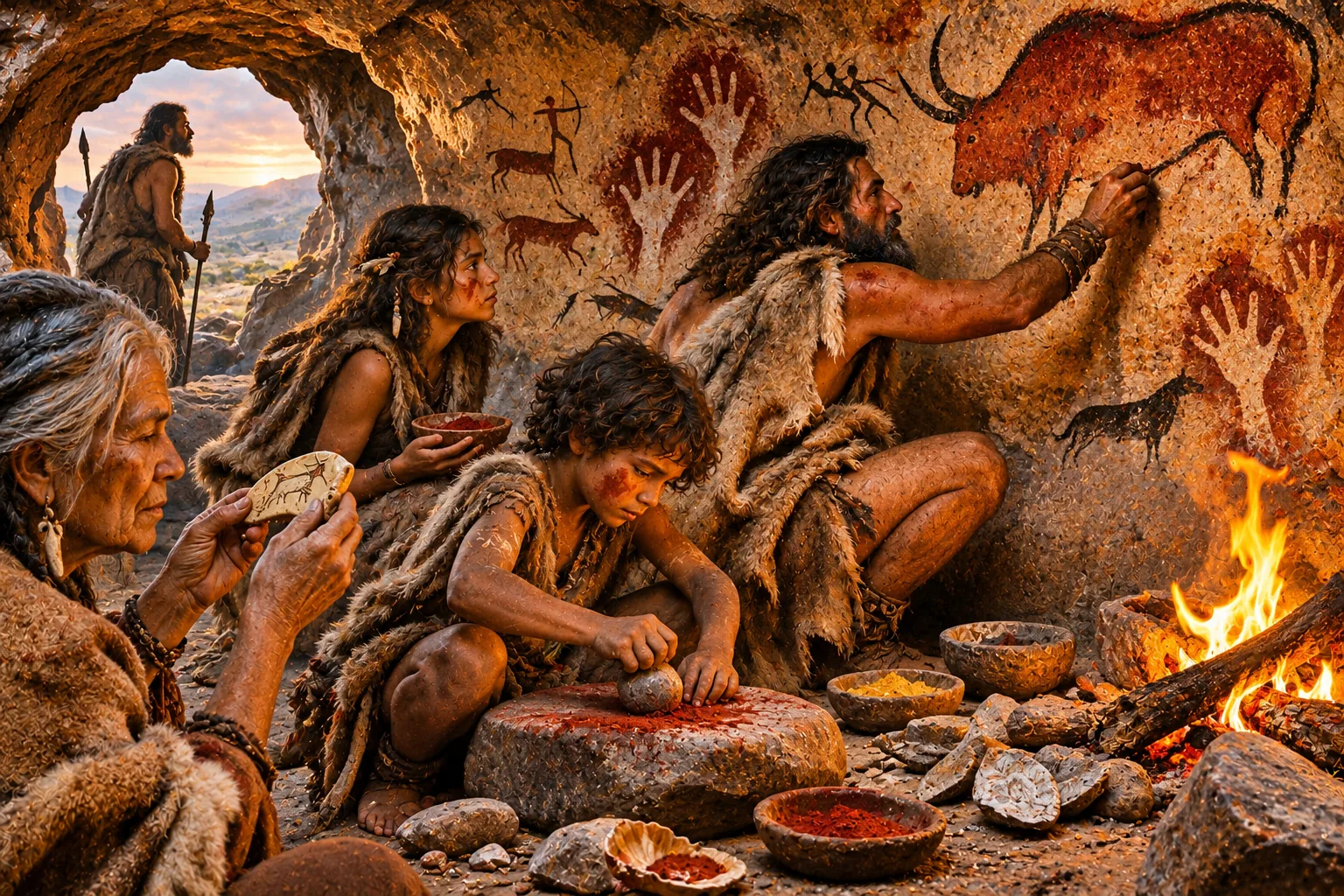
Somewhere in the distant past, a human being placed a hand against stone, blew pigment around the fingers, and withdrew it. The outline remained. We do not know the artist’s name, the reason for the gesture, or whether anyone thought of it as art. Yet thousands of years later, another human can stand before such a mark and feel the unsettling intimacy of an encounter across time. A hand once touched this wall. A person once lived here.
Art and literature have no single birthday. They emerged through many forms of making, remembering, performing, imagining, and sharing. Their history is not merely the story of beauty. It is the story of human beings discovering that an experience can become a form—and that the form may outlive them.
Before the First Canvas
Some of the oldest known evidence of deliberate marking and ornamentation comes from Africa, where engraved ochre and shell beads suggest symbolic practices tens of thousands of years before the celebrated European cave paintings. Such objects do not tell us exactly what their makers meant. Decoration, identity, memory, exchange, and ritual may have overlapped.
In Indonesia, discoveries on Sulawesi have transformed discussions of early figurative and narrative art. Research published in 2024 reported a scene interpreted as human-animal interaction dated to at least 51,200 years ago, using a method for dating mineral layers associated with the image. Interpretations and dates continue to be tested as new evidence emerges. In France, Chauvet Cave preserves extraordinary animal images created in phases roughly 30,000–37,000 years ago. Lascaux, another famous cave complex, is much later. None can safely be called the world’s first painting: archaeology can only identify the earliest surviving and recognized examples.
What did those animals mean? Successful hunting? Sacred beings? A story? A lesson? We cannot confidently say. The honest answer is also the most haunting: the image survived, but the artist’s explanation did not.
The Creature That Never Existed
At Hohlenstein-Stadel in Germany, a remarkable ivory figure known as the Lion Man, dating to the Upper Paleolithic, joins a human-like body with a feline head. It suggests the capacity to represent something not ordinarily encountered in nature. The small figurine commonly called the Venus of Willendorf, made roughly 29,000 years ago, raises different questions. It has been described as a fertility symbol, an idealized body, an object of identity, or something else. No interpretation is certain.
These objects remind us that imagination was not a luxury added after survival. It was already part of how humans understood themselves. The first sculptor did not need to write a manifesto. The impossible creature was itself a question.
Literature Before Writing
Long before books, there were voices. Stories traveled through songs, chants, praise poetry, myths, genealogies, jokes, riddles, and performances. Oral traditions are not primitive drafts of written literature. They have their own artistry: rhythm, repetition, audience participation, improvisation, and the skill of remembering what matters while allowing a story to change.
Across Africa, Asia, Oceania, the Americas, and Europe, communities developed rich oral traditions that cannot be assigned a single starting date. The epic traditions associated with Homer grew out of Greek oral performance; the Iliad and Odyssey were shaped over time, and scholars debate when their familiar forms were composed and written down. Their importance is not that one poet suddenly invented storytelling, but that they reveal what oral poetry could accomplish on an immense scale.
Imagine a storyteller beside a fire. One listener hears a warning, another a memory, another a promise. The same tale becomes different things to different people. Literature begins wherever language is shaped so that experience can be felt again.
When Stories Entered Clay
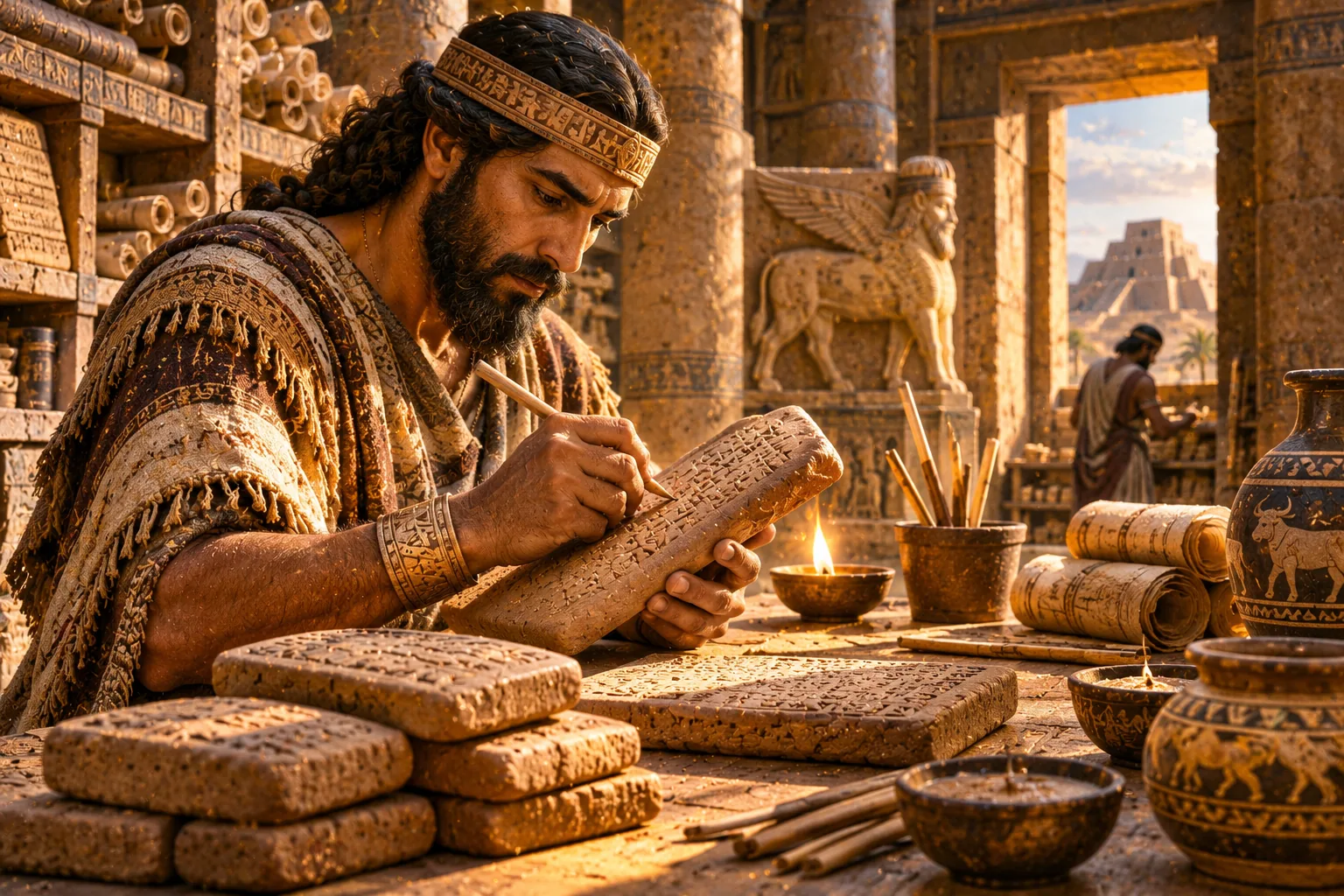
Writing developed in ancient Mesopotamia in the late fourth millennium BCE, initially serving many administrative purposes. Over time, scribes also preserved hymns, laments, debates, myths, and epics. The stories of Gilgamesh, king of Uruk, survive in several versions and languages, with Sumerian poems and later Akkadian compositions. The famous Standard Babylonian epic took shape through a long literary history. It is among the oldest surviving major works of literature, not demonstrably the first story ever told.
Gilgamesh seeks a way to overcome death and learns the limits of human power. Its central anxiety remains astonishingly familiar: if life ends, what can a person leave behind? Ancient Egyptian literature, including wisdom texts, hymns, narratives, and funerary compositions, asked its own questions about justice, loss, kingship, and eternity. The Pyramid Texts and the later collection known as the Book of the Dead belong to different periods and forms; they should not be collapsed into one book written on pyramid walls.
Asia’s Vast Libraries of Imagination
South Asian literature includes the orally transmitted Vedic corpus and the vast traditions associated with the Mahabharata and Ramayana. These epics grew and changed across centuries, languages, regions, and performances. The Mahabharata is among the longest epic poems in world literature; numerical comparisons depend on what counts as a verse or a version. Its narratives confront duty, kinship, violence, justice, and the terrible cost of war. The Ramayana likewise exists in many retellings rather than one unchanging cultural form.
Chinese literary traditions include early poetry collected in the Shijing, philosophical writing, historical prose, and later extraordinary achievements in lyric poetry and fiction. The Dao De Jing, associated by tradition with Laozi, belongs to a complex textual history. In Japan, Murasaki Shikibu’s The Tale of Genji, composed in the early eleventh century, is often celebrated as one of the earliest great psychological novels. Calling it simply the first novel ignores earlier long prose narratives and the difficulty of applying modern categories across cultures. Yet its insight into desire, memory, and social life remains remarkable.
Literature did not develop in a single capital and then spread outward. It grew wherever human communities found forms capable of carrying a voice beyond its moment.
Drama: A Story Becomes a Living Body
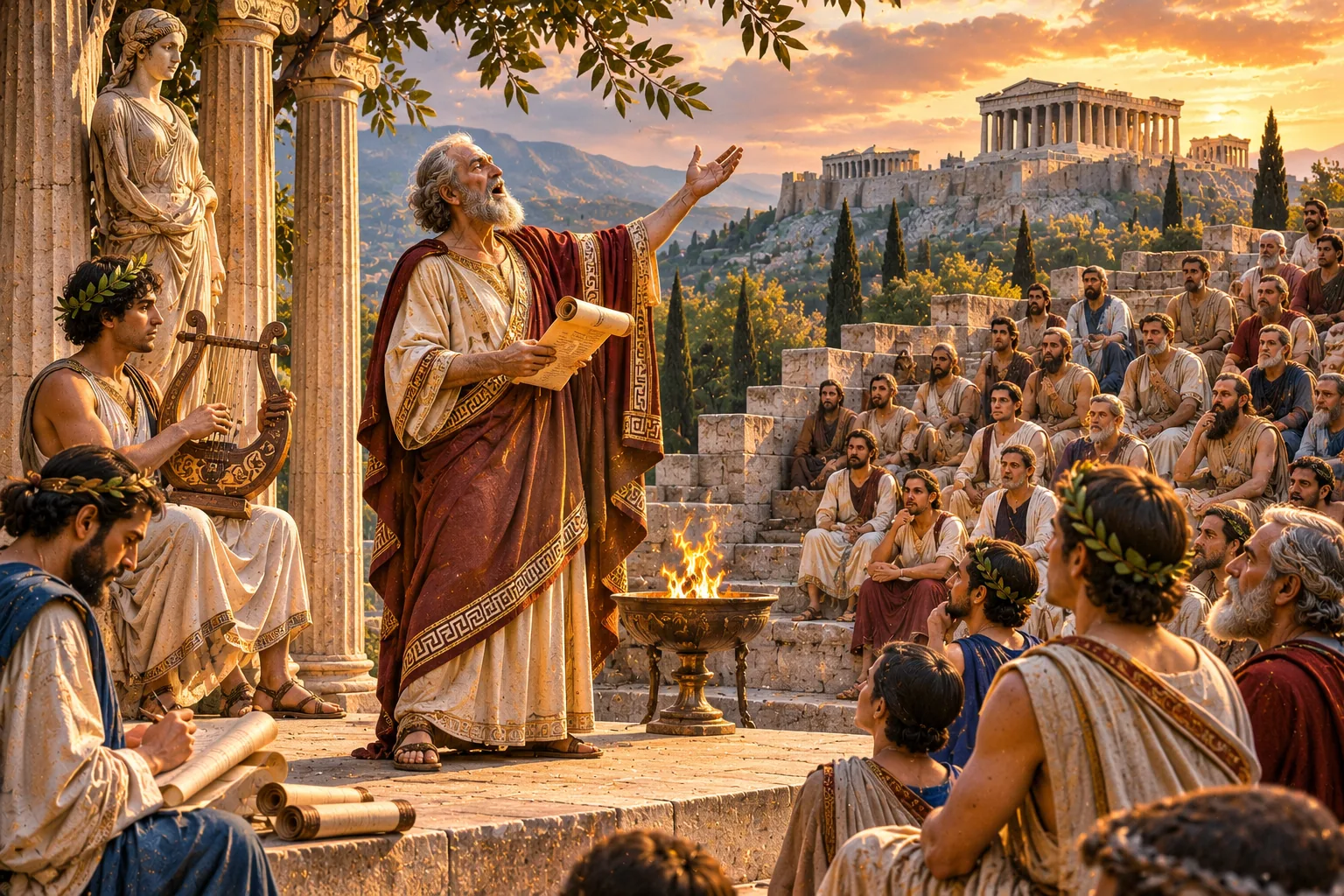
Ancient Greek tragedy and comedy transformed stories into public performance. Playwrights such as Aeschylus, Sophocles, Euripides, and Aristophanes brought conflicts of law, family, power, and fate before civic audiences. Aristotle’s Poetics offered an influential analysis of tragedy, plot, recognition, and reversal; it should not be reduced to a universal rule that every story must simply have a beginning, middle, and end.
Greek theatre was only one among the world’s dramatic traditions. South Asia developed classical Sanskrit drama, represented by playwrights such as Kalidasa. East Asian performance traditions evolved into distinctive forms including Chinese opera and Japanese Noh and Kabuki. African performance traditions have long woven music, dance, storytelling, and communal participation together. Drama is the art of asking a human body to carry someone else’s life for a little while.
Persian, Arabic, and the Art of the Endless Tale
Arabic poetry flourished in pre-Islamic and later Islamic societies, while the Qur’an profoundly influenced Arabic language, recitation, and literary culture. Translation, scholarship, and courtly patronage helped create wide networks of writing. One Thousand and One Nights emerged through layers of storytelling from different regions and centuries. Its frame tale of Shahrazad turns narrative itself into a means of survival. Some famous stories, including versions of Aladdin and Ali Baba, entered widely circulated European collections through later transmission and were not necessarily part of the oldest surviving Arabic manuscripts.
In Persian, Ferdowsi’s Shahnameh, completed around the early eleventh century, gave monumental poetic form to Iranian legendary and historical memory. Later poets such as Rumi, Saadi, Hafez, and Omar Khayyam explored love, mortality, ethics, longing, and uncertainty in different voices. Their poetry crossed borders, but translation also changed how it was understood. Every language adds something to the world; every translation is both a bridge and an interpretation.
The Urdu Voice
Urdu literature developed through long interaction among regional speech, Persianate literary culture, and South Asian social worlds. The poetry of Wali Dakhni, Mir Taqi Mir, Ghalib, Momin, Zauq, and later Muhammad Iqbal reveals how a language can hold grief, irony, love, philosophy, and political imagination within a few lines. The ghazal’s discipline of meter, rhyme, and recurring refrain makes emotional intensity possible through formal constraint.
Modern Urdu prose and fiction expanded through figures such as Deputy Nazir Ahmad, Premchand, Ismat Chughtai, Saadat Hasan Manto, Qurratulain Hyder, and many others. Their works questioned class, gender, Partition, violence, memory, and the stories societies tell about themselves. Urdu’s literary history is not a footnote to English literature; it is one of the world’s great continuing conversations about what it means to be human.
Renaissance Light—and Its Shadows
European Renaissance artists experimented with perspective, anatomy, portraiture, and the representation of space. Leonardo da Vinci’s Mona Lisa and Michelangelo’s Sistine Chapel ceiling became iconic, but neither emerged from genius alone. Workshops, patrons, apprentices, materials, and inherited knowledge made the works possible. Linear perspective had a particular development in Renaissance Europe, while artists elsewhere had long invented other sophisticated ways to represent space.
Mughal painting developed an extraordinary visual language through Persianate, South Asian, and other influences, with refined manuscript illustration, portraiture, and studies of nature. African sculpture and textile traditions, Islamic calligraphy, Chinese landscape painting, and Indigenous arts across the world resist any account in which artistic innovation belongs to one continent. What a culture chooses to depict—and what it refuses to depict—can be as revealing as its technical mastery.
Shakespeare and the Many Inventions of the Stage
William Shakespeare, born in 1564, wrote plays and sonnets that continue to be performed and reinterpreted. His surviving dramatic canon is commonly counted at about 38 or 39 plays, depending on attribution and classification. The claim that he personally invented more than 1,700 English words is not securely established; many words first recorded in his work may already have existed in speech or lost texts. His achievement lies not in a mythical dictionary of inventions but in the complexity of his characters, language, and dramatic situations.
Hamlet’s hesitation, Macbeth’s ambition, and the lovers of Romeo and Juliet remain recognizable because literature can make a private conflict feel universal. Yet the stage also reminds us of historical exclusions: for long periods, women and marginalized communities were denied equal opportunities to write, perform, or be remembered.
When the Novel Opened a Thousand Doors
The novel did not suddenly appear in nineteenth-century Europe. Long prose fiction existed earlier in multiple traditions, including classical and medieval narratives. What the eighteenth and nineteenth centuries helped transform was the scale of commercial publishing and the place of prose fiction in mass reading cultures.
Jane Austen, Charles Dickens, George Eliot, Leo Tolstoy, Fyodor Dostoevsky, and many others explored social life through intricate fictional worlds. Dickens portrayed poverty and institutional cruelty; Tolstoy examined war, family, and history. Across other languages, novelists were equally transforming literary form. A novel could now become a city of voices, a mirror of society, or a private room in which a reader encountered a stranger’s conscience.
Vincent van Gogh’s paintings later became emblematic of the misunderstood artist, but the familiar claim that he sold exactly one painting in his lifetime is too simplistic: evidence of sales and exchanges is incomplete and more complicated. The myth should not overshadow the paintings themselves. Art history is often distorted when a dramatic anecdote replaces the work.
Photography, Film, and the Moving Image
Photography challenged painting to reconsider what an image could do. Motion-picture experiments unfolded across the nineteenth century; there is no single universally agreed first film. The Lumière brothers’ public screenings in 1895 became landmarks, while earlier innovators also contributed. Synchronized-sound cinema developed through multiple experiments, with The Jazz Singer in 1927 remembered as a major commercial breakthrough rather than literally the first film with any sound.
Film united writing, acting, music, photography, design, and editing in a new language of time. South Asian cinema developed rich traditions in many languages. Teri Yaad (1948) is generally identified as the first feature film released in Pakistan after independence, not a 1950 production. Later filmmakers around the world used cinema to record social realities, invent impossible worlds, and ask questions that might have been difficult to speak aloud.
Who Gets to Make Art?
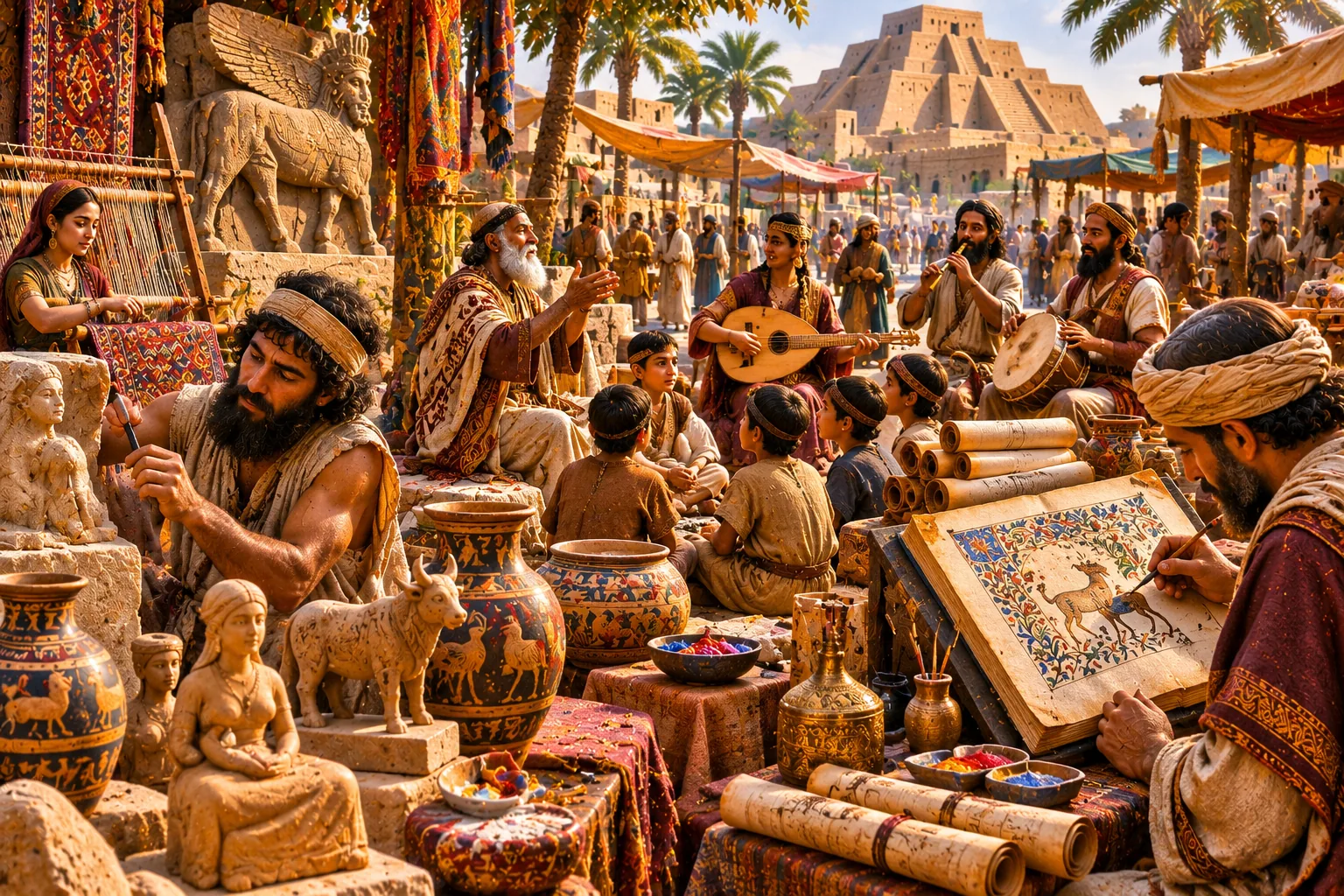
Artistic history is also a history of access. For centuries, wealth, caste, race, gender, empire, and education shaped whose works were preserved and whose names disappeared. Women composed songs, told stories, embroidered histories, wrote poems, and made visual art even when institutions denied them recognition. Enslaved and colonized peoples created forms of expression under profound constraints. Museums and libraries are therefore not neutral mirrors of all that humanity made; they are selective archives shaped by power and survival.
To study the birth of art honestly is to ask not only who created a masterpiece, but who was allowed to sign it, who paid for it, who carried it away, and who still has the right to tell its story.
The Digital Canvas and the Artificial Muse
Today a poem can reach readers across continents in seconds. A short film can be edited on a phone. Digital archives can preserve endangered languages and make forgotten works accessible. Yet platforms also determine visibility, ownership, and payment. A work can be copied infinitely while its creator struggles to earn a living.
Generative artificial intelligence adds new questions. If a machine produces an image from a prompt, what role belongs to the human directing it? What happens when systems learn from artists’ work without clear permission or compensation? Can a fluent imitation replace the experience that gave a poem its urgency? These are not merely technical questions; they concern authorship, consent, cultural memory, and the value of human labor.
Tools change. The need to express, witness, and interpret remains. Technology may widen the canvas, but it does not make the ethical questions disappear.
The Handprint That Never Dried
Return to the ancient hand on the cave wall. Perhaps it was a ritual, a game, a record of belonging, or something we have not imagined. We should not pretend to know. Yet it still reaches us. The artist and the viewer are separated by millennia, but the image makes their distance briefly bearable.
Art does not always console. Literature does not always teach a moral. Both can disturb, mock, mourn, celebrate, resist, or leave a question unanswered. Their power lies in making another consciousness imaginable.
A mother singing to a child, a poet measuring a line, a sculptor shaping stone, a filmmaker cutting between two faces: each gives form to something that might otherwise vanish. And each, in a different language, repeats the ancient gesture: I was here. I felt this. Perhaps you have felt it too.
Everything has a beginning. Art begins whenever experience becomes something another human being can encounter.
Sources and Further Reading
- Nature — Narrative cave art in Indonesia, 2024
- UNESCO — Decorated Cave of Pont d’Arc (Chauvet)
- Encyclopaedia Britannica — Oral literature
- Encyclopaedia Britannica — Epic of Gilgamesh
- Encyclopaedia Britannica — The Tale of Genji
- Encyclopaedia Britannica — The Thousand and One Nights
- Folger Shakespeare Library — Shakespeare’s works
- Encyclopaedia Britannica — Urdu literature
Editorial note: Prehistoric artworks cannot be assigned certain meanings; ancient dates and literary attributions are qualified where debated. Artistic achievements are presented as contributions from many cultures rather than a single linear tradition.



