

For 27 years, an orbiting observatory has watched the changing face of Earth. NASA now says its Terra satellite will stop collecting scientific data on 1 December 2026. Its final observations raise a question that extends far beyond one aging machine: how do we preserve a continuous record of a changing planet?
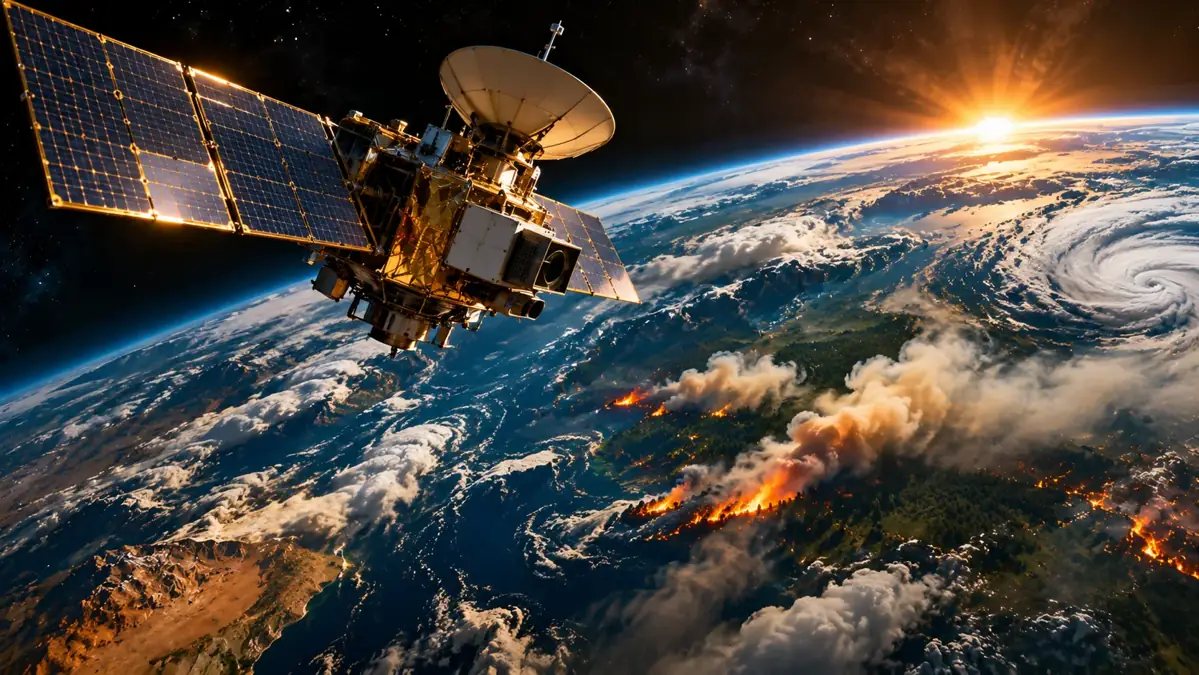
A six-year mission that lasted 27
Terra was designed for a mission lasting about six years. Instead, it continued working for more than a quarter of a century, helping researchers study the relationships between Earth’s atmosphere, land, oceans and living systems. NASA announced on 17 November 2026 that the satellite would cease science data collection on 1 December, as its hardware ages and its orbit changes.
Its observations helped researchers follow clouds, aerosols, fires, surface temperatures and other parts of the Earth system. The significance of such long-running missions lies not only in spectacular individual pictures but also in consistency: repeated observations make slow trends visible.
Why the end of a satellite matters
Environmental changes can unfold over decades. A long-lived instrument offers an unusually sustained perspective, but its measurements are not automatically interchangeable with those of newer satellites. Researchers must account for differences in sensors, calibration and orbital conditions when building a continuous record.
Ending science operations is not the same as the immediate disappearance of all Terra data. The measurements already collected remain a scientific archive that researchers can revisit, compare and reinterpret. NASA’s announcement concerns future collection, not the erasure of the past.
What will replace the view?
Earth observation now depends on many spacecraft and international systems rather than one satellite alone. The challenge is to preserve the ability to compare observations across instruments and generations. When one set of eyes closes, others must continue watching with enough continuity for scientists to distinguish real environmental change from changes in the way we measure it.
A final question
Terra was built for six years and served for 27. Its longevity is a remarkable engineering achievement. Yet the deeper story may be about time itself: how many years of observation are enough to understand a planet that never stops changing?



