

Birth Stories — Research Feature 04 | How humanity learned to question nature
The Night a Man Looked Through a Telescope
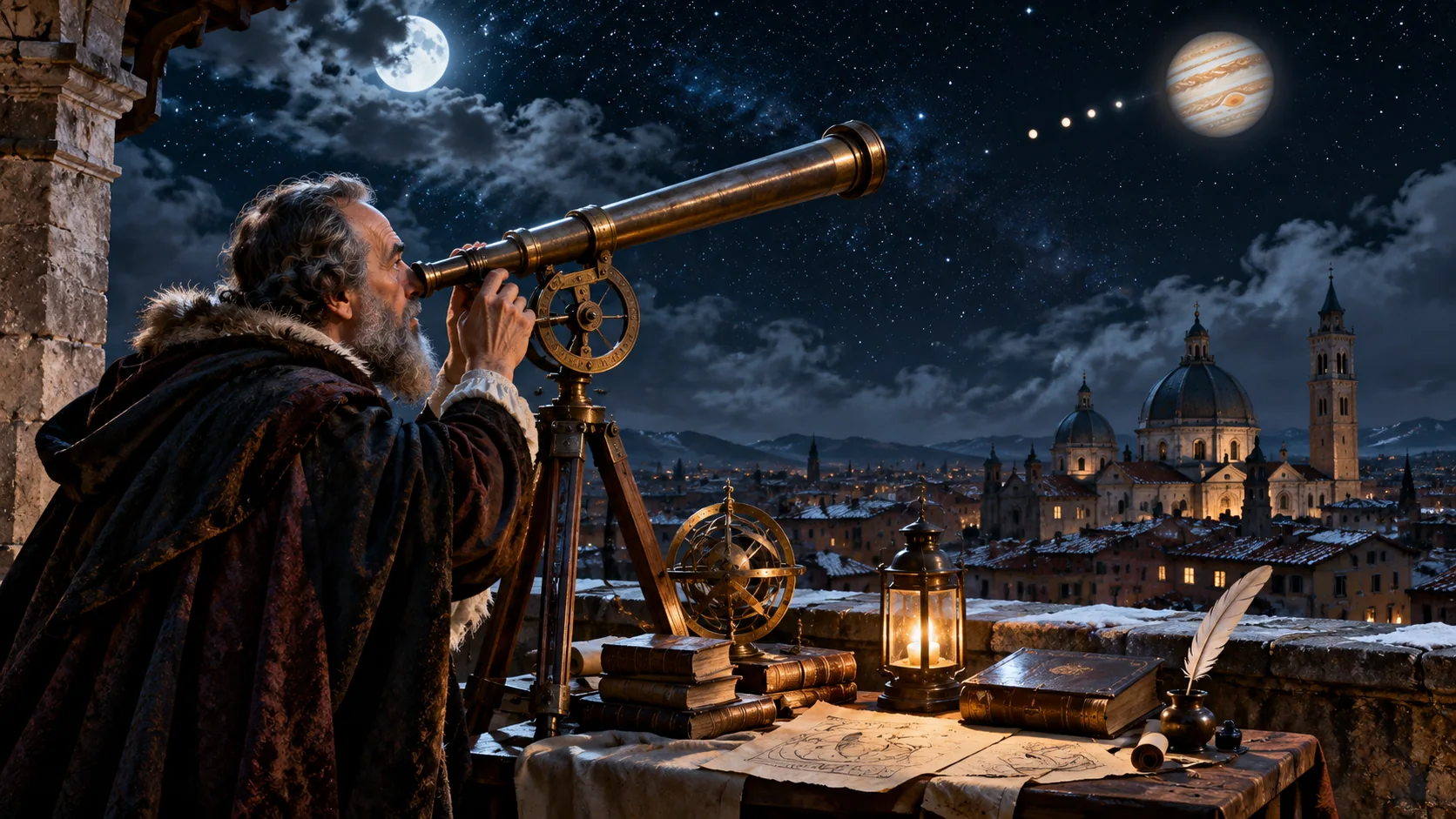
Padua, January 1610. Jupiter shone above the winter rooftops. Galileo Galilei aimed his telescope at the planet and saw tiny points of light nearby. Night after night, they shifted position. By mid-January he had identified four bodies orbiting Jupiter, now known as Io, Europa, Ganymede and Callisto. Their existence challenged the idea that everything in the heavens revolved around Earth. It did not by itself prove heliocentrism; competing models could accommodate Jupiter’s satellites. But it showed that observation could overturn an assumption. The sky had become evidence.
Before Science Had a Name
Imagine a person beside a prehistoric river, noticing that floods return with the seasons. This is an imagined scene, not a recovered historical event. People learned patterns in weather, plants, animal movements and stars long before written records. Such knowledge could save lives. Yet observing a pattern is not necessarily discovering its cause. The history of science is not the moment humanity became intelligent: it is the long development of ways to test whether an explanation deserves our confidence.
The First Laboratory Was the Sky
Babylonian astronomers maintained systematic records and developed mathematical predictions. Ancient Egyptian calendars, Chinese observations of comets and eclipses, Indian mathematical astronomy, and Mesoamerican astronomical traditions arose in different cultural contexts. Their purposes varied, from agriculture and navigation to ceremony and political authority. They did not all employ the same methods. But across continents, people discovered that repeated observation could reveal regularities in celestial motion.
When Nature Became a Question
In the ancient Greek world, thinkers such as Thales, Democritus and Aristotle pursued explanations of nature through reasoning and observation, sometimes alongside speculation that later proved mistaken. Ancient atomism was not modern atomic physics. Still, the attempt to ask what the world is made of, and why things happen, helped build intellectual traditions of natural inquiry. The crucial distinction would emerge over centuries: an elegant explanation is not enough if the world refuses to support it.
The Scholar Who Put Light to the Test
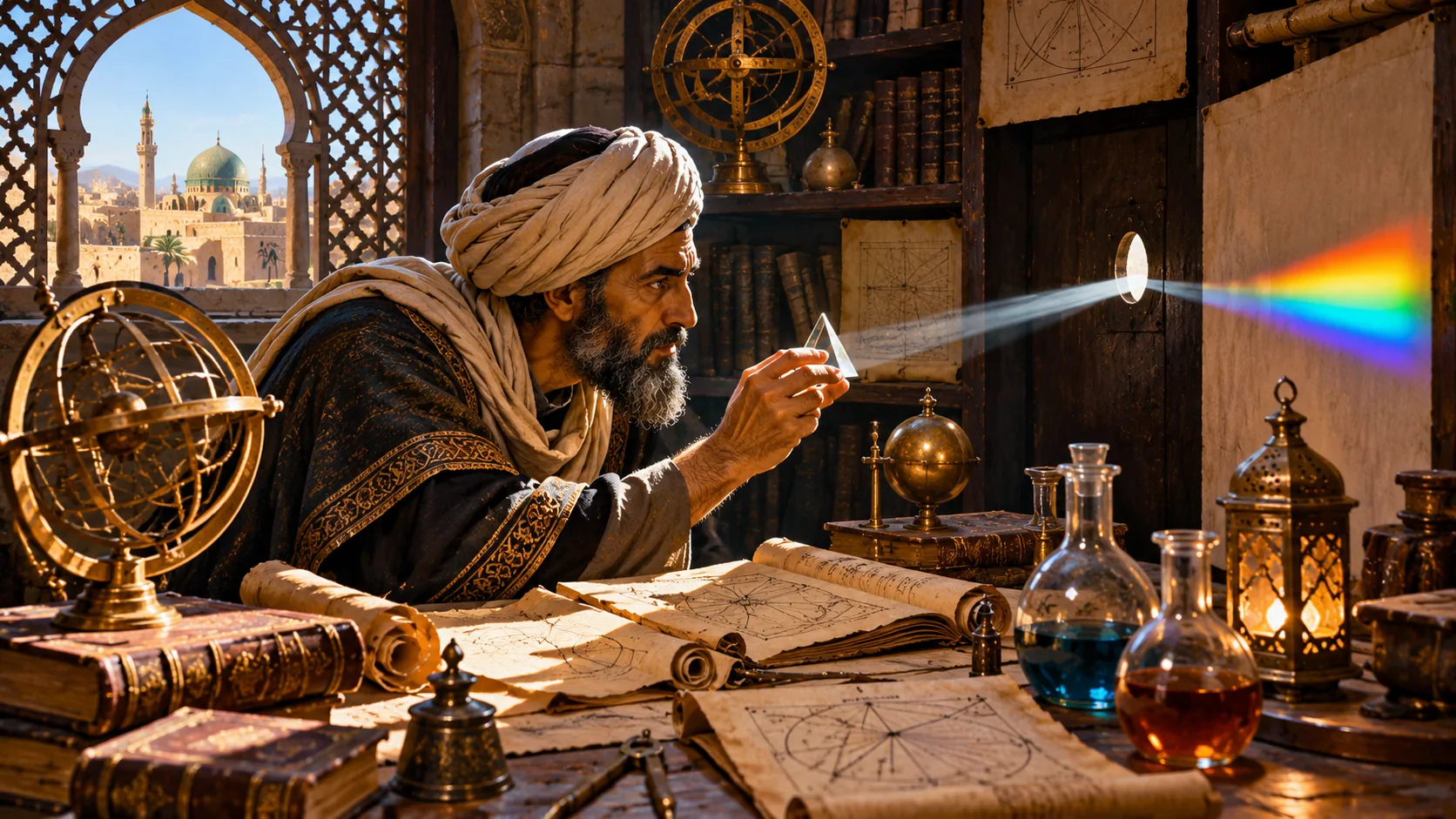
In the eleventh-century Islamic intellectual world, Ibn al-Haytham investigated optics and vision. Earlier accounts sometimes imagined rays emerging from the eyes; he argued for light entering the eye from objects and their surroundings. His Book of Optics brought careful reasoning and experimental arrangements to problems of reflection, refraction and perception. He did not single-handedly invent scientific method, which has a global, cumulative history. His work nevertheless illustrates an essential principle: theories must face observation, including observations that might disprove them.
Knowledge Without Borders
The familiar leap from ancient Greece to Renaissance Europe leaves much of the story untold. South Asian mathematical traditions contributed decisively to place-value notation and zero. Chinese scholarship and technology advanced navigation, printing, engineering and other fields. Scholars writing in Arabic and Persian translated, criticised and expanded mathematics, medicine, geography and astronomy. Al-Razi, Ibn Sina and al-Biruni exemplify different forms of rigorous inquiry. Ideas travelled through trade, translation and contact. Science was never the possession of one civilisation.
The Earth That Would Not Stand Still
Copernicus proposed a mathematical Sun-centred arrangement in sixteenth-century Europe, though Aristarchus had considered heliocentrism in antiquity. Kepler found elliptical planetary orbits; Galileo’s observations challenged inherited cosmology. Newton then connected falling objects and celestial motion through laws of motion and universal gravitation. An apple and the Moon could be described within one mathematical framework. Yet the famous falling-apple anecdote compresses a long intellectual achievement into a single scene.
The Theory That Worked—and Was Not Final
Newtonian physics predicted an astonishing range of motion, but later measurements exposed limitations. Mercury’s orbit contained a small discrepancy. In 1905, while employed at the Swiss patent office, Albert Einstein published special relativity, transforming the relationship between space and time. His later general relativity described gravitation through spacetime geometry and accounted for Mercury’s anomalous orbital precession. Newton was not rendered useless; his theory remains highly accurate in many everyday settings. Science often advances by discovering where a powerful explanation reaches its limits.
The Atom That Was Not Indivisible
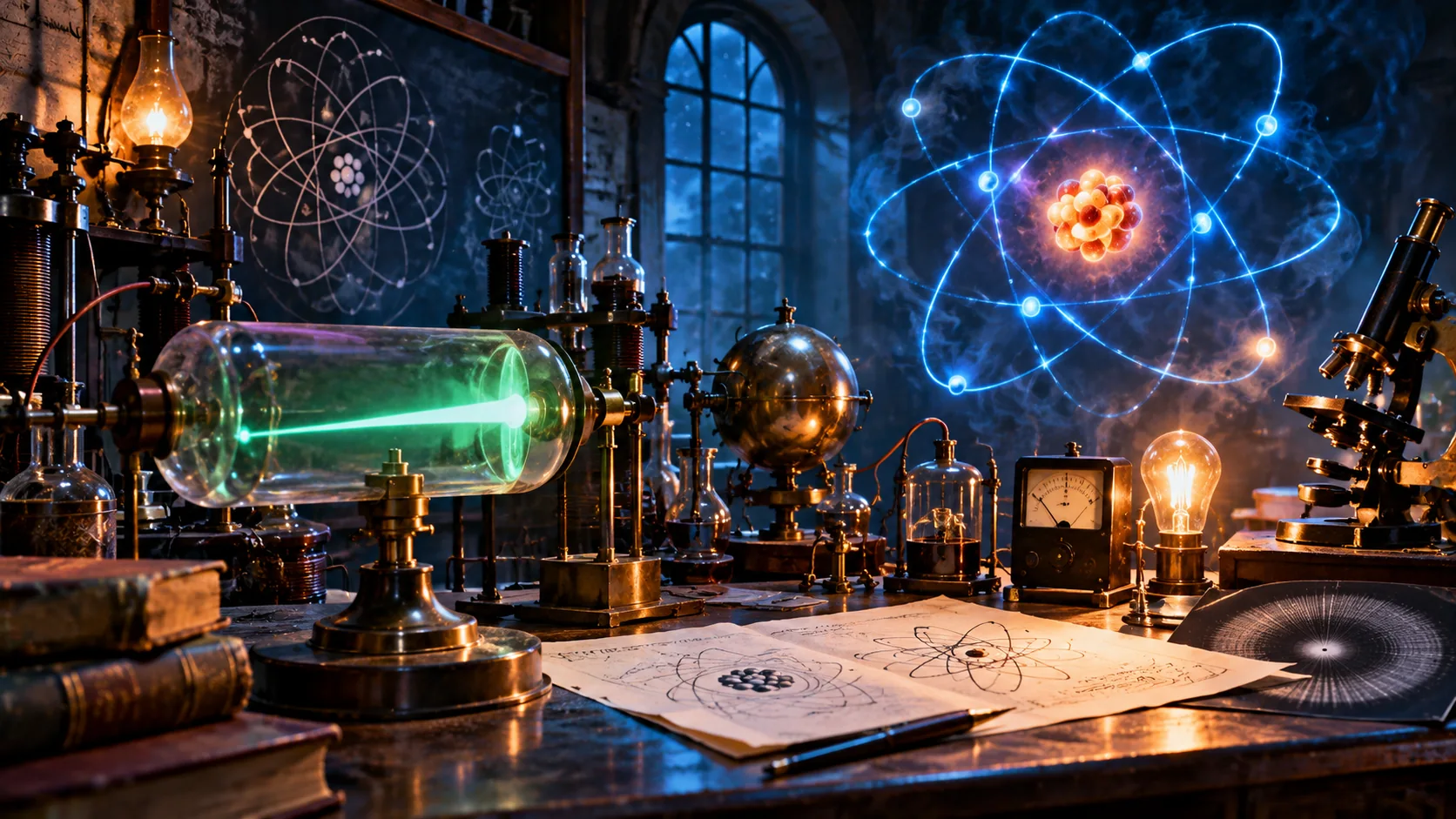
Ancient atomists imagined fundamental constituents of matter, but modern atomic theory required experimental chemistry and physics. Dalton’s work on chemical atoms, Thomson’s identification of the electron, Rutherford’s nuclear model and Bohr’s early quantum account changed the picture repeatedly. Quantum mechanics later revealed behaviour unlike classical objects. The double-slit experiment illustrates interference in quantum systems. It does not prove that human consciousness creates physical reality, despite popular claims. The mystery is scientific because experiments demand a theory beyond everyday intuition.
The Expanding Universe
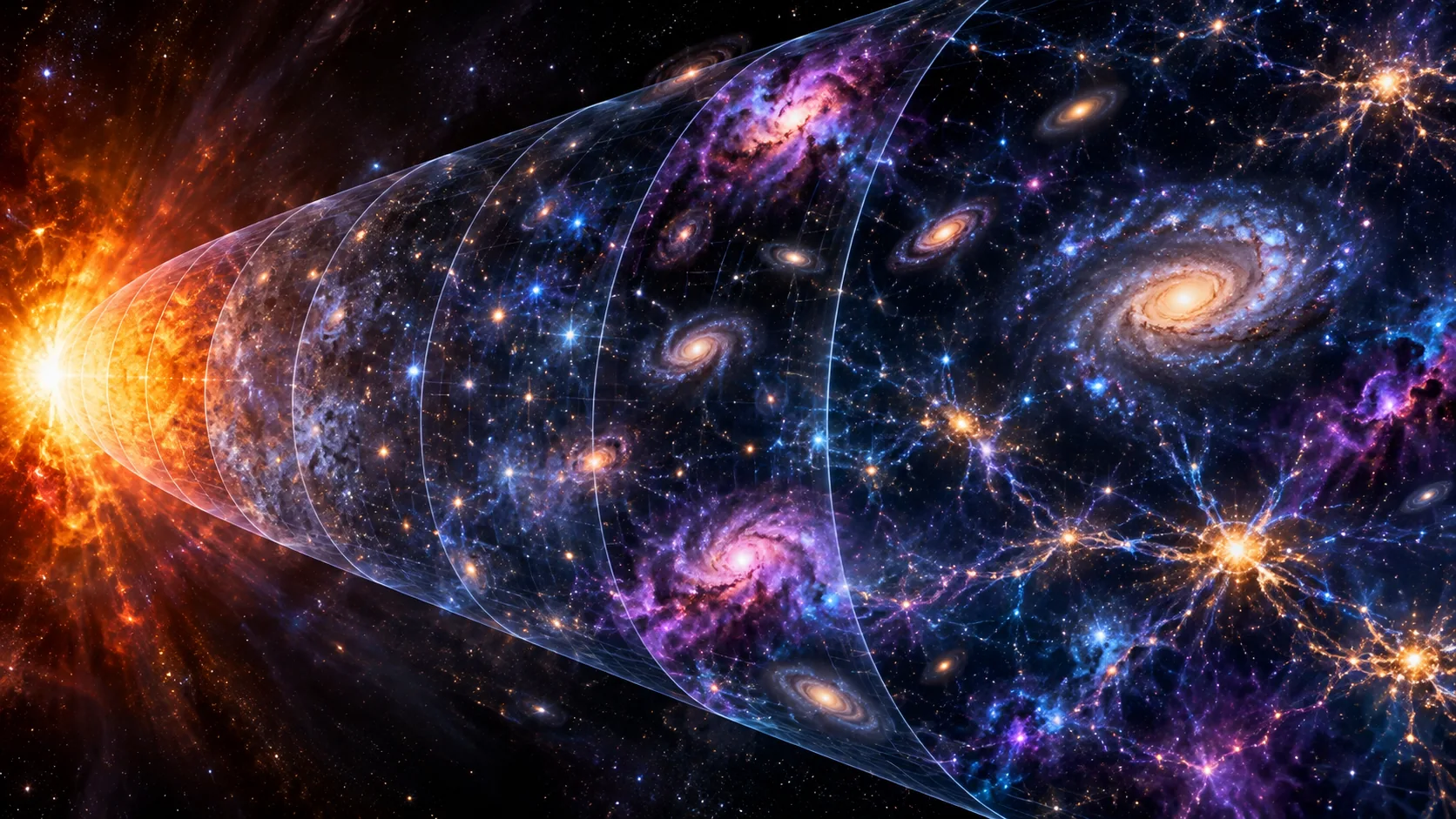
Friedmann and Lemaître explored expanding-universe solutions in general relativity. Astronomical measurements by Hubble and others helped establish cosmic expansion; later discovery of the cosmic microwave background strengthened the evidence for a hot early universe. Today, cosmologists investigate dark matter, dark energy and tensions between measurements of cosmic expansion. These are not signs that scientists know nothing. They are precise questions made possible by a body of successful observations and models.
The Matter That Refuses to Reveal Itself
Galaxy rotation, gravitational lensing, galaxy clusters and cosmological observations suggest additional gravitating matter beyond what telescopes directly see. The name dark matter describes that inference, not an identified particle. Searches continue; alternative gravity models also face tests against the full evidence. An important scientific achievement is knowing that an explanation is incomplete and designing observations that might reveal what is missing.
Life’s Instructions and the People Behind Them
Mendel’s pea experiments revealed patterns of inheritance. Later genetics established DNA’s central role in heredity. In 1953 Watson and Crick proposed the double-helical structure, building on vital experimental evidence and work by Rosalind Franklin, Maurice Wilkins and others. The discovery is also a story of collaboration, competition and unequal recognition. Scientific history must ask not only what was learned, but whose work was remembered.
Evolution: The Explanation That Kept Growing
Darwin’s 1859 On the Origin of Species presented extensive evidence for natural selection; Alfred Russel Wallace independently developed a closely related account. Genetics, fossils, developmental biology and molecular comparisons later greatly expanded evolutionary science. The origin of the first life is a different question from the evolutionary mechanisms governing living populations. An explanation can be strongly supported without solving every problem connected to its subject.
Continents on the Move
Wegener gathered evidence from continental geography, fossils and rocks, but his proposed mechanism for continental drift was inadequate. Later discoveries of seafloor spreading, magnetic patterns and plate boundaries established plate tectonics. Earthquakes, volcanoes and mountains became parts of a coherent picture. This was not simply one person’s triumphant guess: independent observations converged until the explanation became compelling.
Accident Is Not Enough
Fleming’s observation of mould inhibiting bacterial growth helped open the path to penicillin. Turning it into a practical treatment required extensive subsequent work by Florey, Chain and others. Röntgen’s investigation of unusual radiation led to X-rays. Serendipity matters, but an unexpected event becomes a discovery only through interpretation, testing, replication and sustained effort. Chance opens doors; inquiry walks through them.
The Theories Science Left Behind
Phlogiston once explained combustion; the luminiferous ether was proposed as the medium of light. Both lost their standing as evidence and better theories accumulated. Past investigators often worked intelligently with incomplete instruments and data. We should not mistake historical error for stupidity—or assume that today’s best theories are immune to revision. Correction is not science’s embarrassment. It is part of its strength.
The Human Cost of Knowing
Physics illuminated matter and enabled nuclear weapons. Chemistry and biology produced medicines while also making harmful technologies possible. Artificial intelligence may accelerate research and magnify error or inequality. Discovery is not the same as wisdom. Scientific capability raises ethical questions that cannot be settled by measurement alone: who benefits, who bears the risks, and what should humanity choose to do?
Science, Faith and Different Kinds of Questions
Religious traditions have asked about creation, order, meaning and human purpose. Islamic, Christian, Jewish, Hindu, Buddhist and other intellectual histories include diverse engagements with natural knowledge. Their relationships with science cannot be reduced to one story of permanent conflict or complete agreement. Scientific claims are tested by empirical evidence. Philosophical and religious questions may overlap with those claims or address different forms of meaning. Respect requires distinguishing methods rather than forcing false equivalence.
The Discovery Still Waiting
Somewhere a researcher is examining a result that refuses to fit. Most anomalies will be errors or ordinary effects. A few may become discoveries. Spectacular claims must survive replication, independent scrutiny and attempts to falsify them. The universe does not promise to confirm our expectations. It offers evidence, often slowly and reluctantly. The night Galileo saw Jupiter’s moons did not change the universe. It changed what people could responsibly believe about it. Perhaps the birth of scientific discovery was not the first answer, but the first durable commitment to let the world correct us.
Research Notes and References
- Galileo Galilei (1610), Sidereus Nuncius.
- Charles Darwin (1859), On the Origin of Species.
- NASA — Solar System Science
- NASA — Universe and Cosmology
- CERN — The Standard Model
- LIGO — Gravitational-Wave Research
- USGS — Earth Science and Plate Tectonics
- Stanford Encyclopedia of Philosophy — Scientific Method
Editorial principle: Established evidence is distinguished from interpretation and unresolved questions. Historical and religious traditions are represented in context. Science is provisional: when evidence changes, explanations must be revisited.
Birth Stories — Everything Has a Beginning. Every Beginning Has a Story.



