
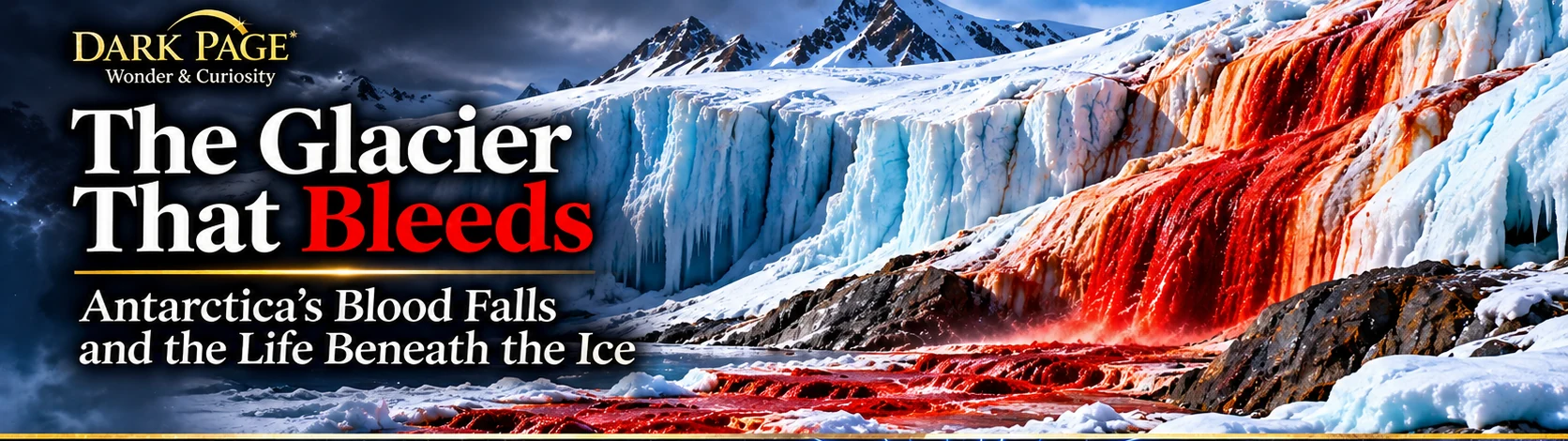

At the edge of Antarctica’s Taylor Glacier, a dark red stain spreads across ice that should be white. It looks like a wound in the frozen landscape. Yet the substance emerging from the glacier is not blood, and the most remarkable part of its story lies where sunlight cannot reach.
A red mark in a white wilderness
Blood Falls emerges near Lake Bonney in the McMurdo Dry Valleys, one of Antarctica’s most unusual environments. The red-orange deposits are created when iron-bearing, highly saline water reaches the surface and its iron reacts with oxygen. The colour is evidence of chemistry, not a biological fluid. Importantly, the discharge is intermittent rather than a permanently roaring waterfall.
Why should liquid water flow from a glacier in an environment with a mean annual air temperature around minus 17 degrees Celsius? Salt changes the freezing behaviour of water. Within Taylor Glacier, a network of brine-filled pathways can remain active in conditions that would freeze ordinary freshwater.
The invisible plumbing inside the ice
For years, scientists had clues that a reservoir of salty water existed beneath the glacier, but how that water reached the visible outlet was less certain. A 2017 study in the Journal of Glaciology combined geophysical observations to identify an active englacial hydrologic system supplying Blood Falls. This was a substantial advance: the red deposit could be connected to a hidden system of water movement inside the ice.
It would be misleading to imagine a vast open river beneath every metre of the glacier. The evidence points to a complicated brine system, including channels and connected zones of salty groundwater. The geometry and movement of that system are subjects of ongoing research.
What is in the water?
In November 2014, researchers used a clean-entry melting probe called IceMole to collect brine from a conduit within Taylor Glacier. Their subsequent geochemical study identified highly saline, iron-rich water and chemical signatures consistent with ancient seawater that had been altered through interaction with rock and glacial processes. That distinction matters: the fluid is not simply modern seawater trapped in a freezer.
The hidden habitat also interests microbiologists. Communities of microorganisms can persist in cold, salty, dark environments by exploiting chemical energy rather than relying on sunlight. Such life does not prove that organisms inhabit the ice-covered oceans of other worlds, but it offers researchers a terrestrial setting in which to investigate how life copes with severe environmental constraints.
A mystery that science has not finished
Even after researchers established the presence of an active brine system, a question remained: what causes individual releases? A 2022 study documented brine discharge during Antarctic winter using time-lapse observations. Because the events occurred in below-freezing air temperatures, the researchers argued that surface melting was unlikely to be the immediate trigger. They also reported an unexpected lack of associated seismic signals. The mechanism that initiates each episode is still not fully resolved.
Blood Falls therefore offers two different kinds of answer. The red colour has a convincing chemical explanation, and the glacier contains an active saline-water system. But the timing and mechanics of the intermittent releases still invite investigation. Solving one part of a mystery need not erase the others.
The question beneath the question
Imagine standing before that red streak at the end of the world. You would see iron staining ice. You would not see the water’s underground route, the chemical history recorded in its dissolved salts, or the microscopic lives that scientists study in this extraordinary environment.
Perhaps the most unsettling thing about Blood Falls is not that a glacier appears to bleed. It is that a place which looks motionless can conceal moving water, active chemistry and biological possibility. What else might be happening beneath landscapes we think we understand?
Photographic reference (public domain): Blood Falls photograph by Peter Rejcek / National Science Foundation. The Wikimedia Commons file page identifies it as a U.S. federal government work in the public domain. The photograph is linked here rather than copied into the WordPress media library.




