
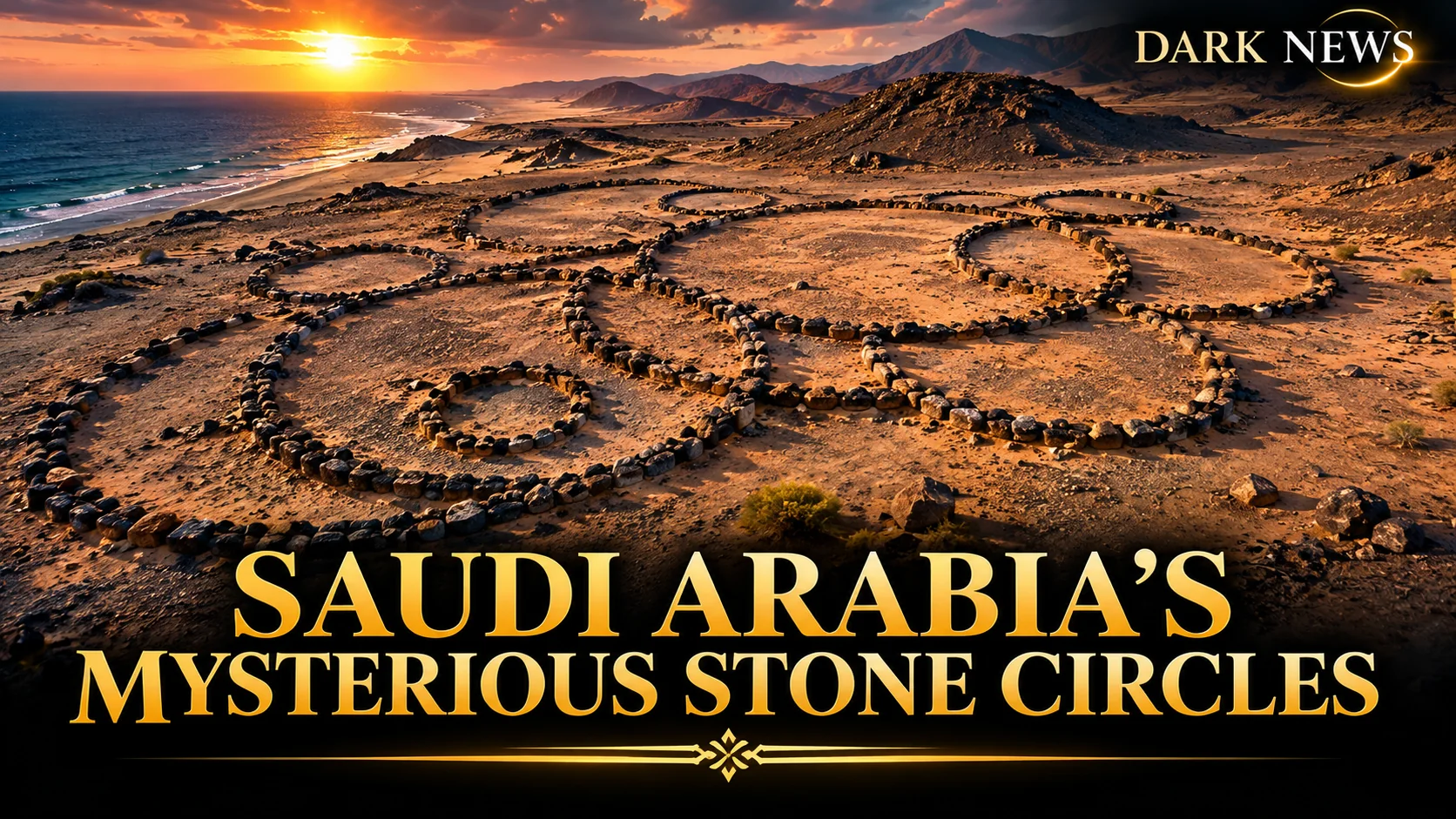

From the ground, they are difficult to recognise. From the sky, a striking pattern emerges: overlapping rings of volcanic stone laid across the landscape near Saudi Arabia’s Red Sea coast. Who built them, when—and why?
A puzzle visible from above
Aerial photographs released by the Saudi Press Agency show interlocking stone circles of varying sizes in the Hali area of Al-Qunfudhah Governorate, Makkah Province. The structures form unusual geometric arrangements using local volcanic rock. Their full pattern is far easier to see from above than while standing among the stones.
Deliberate design—but for what?
Saudi historian and researcher Dr Mohammed Al-Marhabi told SPA that the arrangement appears intentional rather than accidental. He suggested that the rings do not resemble conventional houses or burial structures and raised the possibility that they were used to track weather, changing seasons or the movement of celestial bodies. Could they have formed part of an early calendar? It is an intriguing hypothesis, but no astronomical alignment or calendar function has yet been demonstrated.
A fertile valley with a long memory
Hali lies in the Tihamah coastal region, an area with a long history of settlement and connections to Makkah. Communities living in the fertile valley would have had practical reasons to follow seasonal changes, rainfall and agricultural cycles. Yet a historically plausible need for a calendar is not evidence that these particular circles served as one.
Not every ancient circle tells the same story
Elsewhere in Saudi Arabia, archaeologists have identified circular Neolithic dwellings in AlUla dating to the sixth and fifth millennia BC. At Khaybar, the Bronze Age settlement of Al-Natah has revealed a different chapter of ancient Arabian life. These discoveries demonstrate the region’s architectural diversity—but they cannot be used to date the Hali rings or establish a shared purpose.
What must happen next?
The Hali formations have not yet been securely dated, and their builders remain unidentified. Careful site surveys, mapping, excavation where appropriate, and analysis of construction phases and associated artefacts will be needed before researchers can determine whether the circles were practical, ceremonial, astronomical or something else entirely.
Perhaps the most compelling feature of this discovery is what the photographs cannot tell us. Was this landscape designed to measure time—or are we reading a modern meaning into an ancient pattern? For now, the question remains open.
Image note: The accompanying Dark News cover is an artistic reconstruction, not an authentic aerial photograph of the archaeological site.
Sources: Arab News, 14 November 2026 (SPA reporting and photographs); HeritageDaily, 16 November 2026.



