

Dark News | 17 November 2026
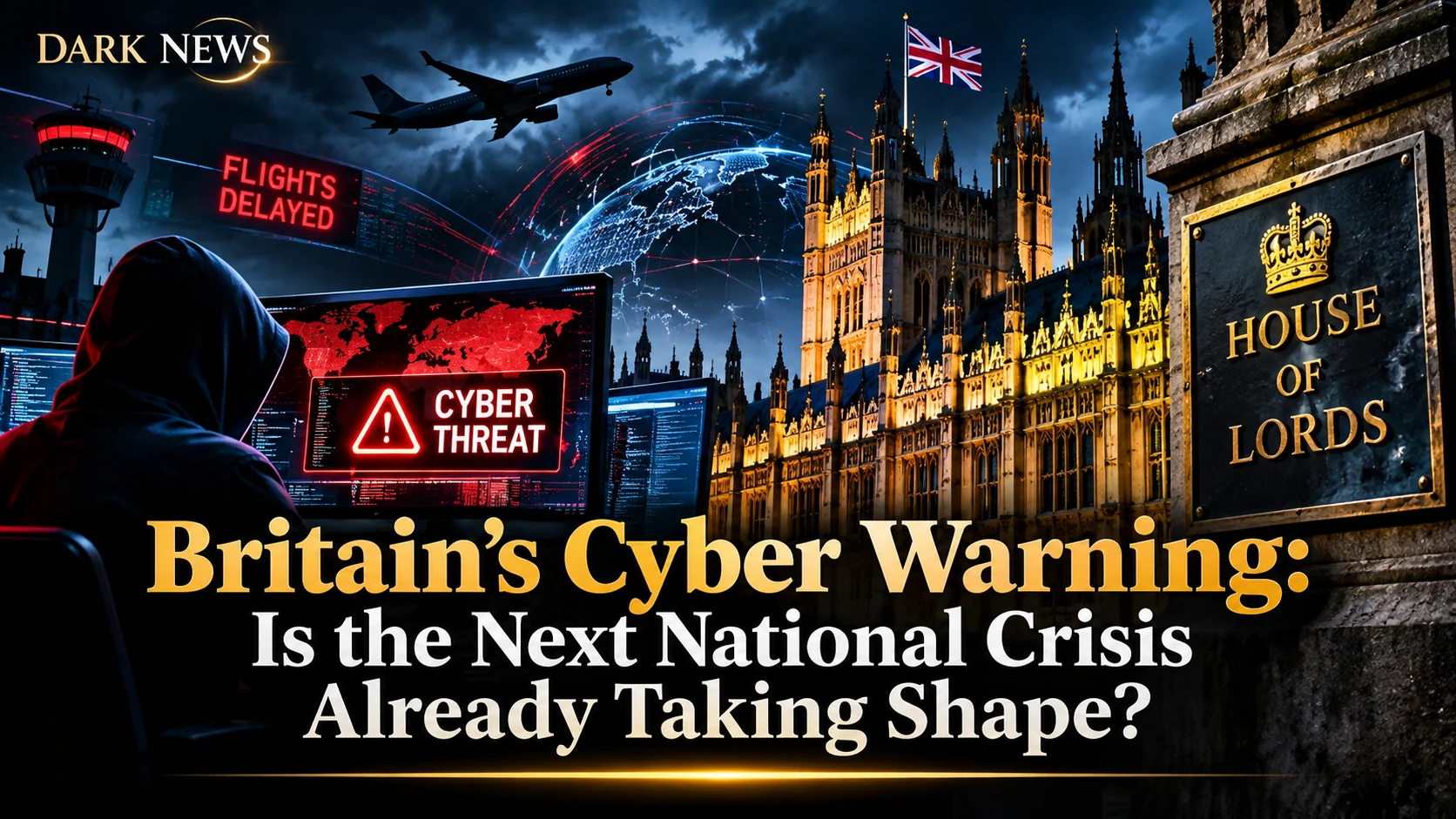
What happens when the systems holding a modern country together begin to fail—not one at a time, but together? A new report from the House of Lords National Resilience Committee warns that Britain is dangerously underprepared for interconnected emergencies. Cyberattacks are among its most prominent concerns, alongside hostile state activity, severe weather, infrastructure failures and disruptions that can cascade from one sector into another.
The cyber threat is already here
The committee’s report, Are we ready? Building a culture of resilience, published on 16 November 2026, argues that the public does not have a full picture of hostile activity directed at the United Kingdom. It highlights cyberattacks, threats to undersea cables and pipelines, and the dependence of communications, energy and supply chains on vulnerable interconnected systems. The report cites more than 90,000 attempted cyberattacks against UK defence systems annually.
Cybersecurity is an early and significant theme in the report, although the committee does not formally rank it as the single greatest threat. Its broader warning is about a “polycrisis”: several emergencies occurring simultaneously, or one failure triggering another. A digital disruption might affect transport, electricity, water, healthcare or financial services before authorities can isolate the damage.
America’s aviation shutdown: a warning, but not proof of an attack
On 13 November, the United States experienced a nationwide halt to aircraft departures after instability in the Federal Aviation Administration’s communications network. The FAA says its ageing infrastructure became unstable as data flooded the network at a rate of roughly 1,000 connection attempts every four to five seconds. Flights resumed later that evening.
The scale of the disruption raised understandable questions about cyber sabotage. Some commentators and online observers speculated that the failure might have been an attack. But speculation is not evidence. In its official explanation dated 15 November, the FAA stated that it had found no indication of a cyberattack or outside malicious actor. Investigators identified possible sources of excessive network traffic at facilities in Texas and Arkansas and continued examining the underlying cause.
That distinction matters. An accidental technical breakdown and a deliberate cyberattack can produce similar consequences for the public. The American incident demonstrates the fragility of critical infrastructure; it does not establish that hostile hackers were responsible.
What about Q-Day?
Q-Day is the hypothetical future moment when sufficiently capable quantum computers could defeat widely used forms of public-key encryption. The possibility raises serious long-term questions about the protection of sensitive communications and stored data. It is not, however, a confirmed event that has already occurred.
Dark Page’s continuing investigation asks whether growing cyber threats, ageing infrastructure and the future quantum threat should be examined together as part of a wider resilience problem. Dark Page is exploring a possible connection between the longer-term quantum threat, vulnerabilities in critical systems and the recent aviation disruption. This is a question for investigation, not an allegation that Q-Day has arrived or that a quantum-enabled cyberattack occurred. Any numerical estimate, including 60%, would require a disclosed methodology and supporting evidence before it could be presented as a measured probability.
There is currently no verified evidence linking the FAA shutdown to quantum computing. Nor does the House of Lords report establish such a connection. The legitimate question is different: are governments preparing their essential systems for several kinds of technological failure at once?
A warning about public preparedness
The committee calls for clearer public communication, better coordination across government and the private sector, updated emergency planning, practical exercises and a culture of preparedness rather than secrecy or complacency. Its central argument is that Britain must prepare for overlapping crises before they arrive.
The mystery is not whether every outage conceals an invisible attacker. It is whether the next major failure—malicious or accidental—will expose weaknesses that were visible all along.
When one crisis becomes five
Committee chair Baroness Coussins warned that Britain’s preparations remain too focused on isolated incidents. The danger is a cascading or interconnected crisis: a serious cyber incident could interrupt electricity, which in turn disrupts communications, public transport, payment systems and food deliveries. Evidence from the Alan Turing Institute described energy, transport, communications and finance as closely interconnected. The 2024 CrowdStrike outage showed how a single software failure can spread across aviation, healthcare and banking. This is a scenario to prepare for, not a prediction that such a national collapse is imminent.
Britain’s food and medicine supply chains
The report exposes a striking concentration of essential supplies. According to evidence presented to the committee, 94.5% of British retail food is supplied by nine companies operating through 131 distribution hubs. Some commodities move through just-in-time systems with only two or three days of stock. Disruption to distribution, fuel, refrigeration or payment networks could therefore have consequences far beyond the original emergency.
Medicine presents another vulnerability. Evidence cited by the committee says around 90% of the world’s 6-APA—a key precursor for penicillin-class antibiotics—is produced in China, while the closure of the UK’s last domestic plant in 2025 left no domestic fallback. This is a global precursor-production figure, not a verified claim that 80% of every penicillin ingredient used in Britain comes from China. The committee also notes existing NHS and government stockholding arrangements, while calling for stronger strategic reserves, diversified sourcing and domestic manufacturing.
Hostile states, underwater cables and emerging technology
The committee considers hostile activity below the threshold of open war, including cyber intrusion, interference and threats to critical infrastructure. The report cites Russia and Iran in the context of hostile state activity, while wider supply-chain and technology concerns also involve China. It records more than 90,000 attempted cyberattacks against UK defence systems in a year. Undersea communications cables and pipelines are another source of concern, as are emerging technologies that could intensify cyber or biological risks. These are threat assessments; they do not identify a perpetrator in the recent US aviation incident.
Seventy-two hours: what the Be Ready campaign means
The UK government’s Be Ready public guidance encourages households to prepare for disruption by keeping essentials such as drinking water, food, medicines, batteries and a battery-powered or wind-up radio. The committee welcomes clearer preparedness messaging but argues that a website and a basic 72-hour supply are not sufficient for every prolonged emergency. Not everyone can afford to stockpile, and some people will require direct support from local authorities and volunteers.
What the House of Lords wants the government to do
A dedicated minister and a single strategy: Appoint a Cabinet minister whose sole responsibility is national resilience, supported by a senior Chief Resilience Officer. Establish a coherent national strategy within six months, with responsibilities, common standards, funding and regular tests of readiness.
A booklet for every household and a multilingual app: Send practical emergency guidance to every home, drawing on Scandinavian models. Develop an app inspired by Finland’s 112 Suomi service, capable of transmitting a caller’s location to emergency services and delivering geographically relevant warnings.
Keep traditional television available: Abandon plans to switch off Digital Terrestrial Television. The committee argues that broadcast television and radio remain essential alternatives when broadband, mobile networks or other digital systems are disrupted.
Local shelters and trained volunteers: Require Local Resilience Forums to maintain registers of suitable public and private buildings that can function as emergency shelters or community hubs. Develop local volunteer registers and explore an entitlement to paid civic resilience leave so workers can participate in approved training and emergency volunteering without losing income.
Produce and store more essentials at home: Strengthen reserves of medicines, food, water and agricultural inputs; restore domestic capacity for critical pharmaceutical ingredients; diversify overseas suppliers; and require essential sectors to test how they would function during prolonged disruptions.
The recommendations raise a fundamental question: if the internet, electricity and transport failed together, could the country still communicate, distribute medicine and feed its population? The committee’s answer is that preparation must be tested across systems—not simply written into separate emergency plans.
Further parliamentary evidence: Interconnected risks and supply chains; Community resilience and volunteers; Communications and public preparedness; Parliamentary summary.
Sources: House of Lords National Resilience Committee, Are we ready? Building a culture of resilience (16 November 2026); FAA, Nationwide Ground Stop: Questions and Answers (15 November 2026).



