

Dark News · Aviation and Infrastructure
Case date: November 13, 2026. The account below draws on the FAA’s initial statement and the federal briefing of November 14.
The airliners were ready, the runways were open, and thousands of aircraft were already flying. What the United States could no longer count on that Friday afternoon was the steady flow of information between aircraft and the people guiding them. Radio communications and radar feeds became intermittent. The Federal Aviation Administration stopped departures nationwide while crews and controllers brought aircraft already in the air down safely.
By the following day, federal officials had reported a number that made the incident harder to dismiss as a broken cable: more than 1,000 connection attempts every four to five seconds. That number describes what the network was doing when it became unstable. It leaves open the question of why.

The work at a remote facility
Transportation Secretary Sean Duffy said a contractor, L3Harris, was moving an ageing copper telecommunications line to fibre and replacing a router at a remote FAA site. During the work, the router began inundating other routers with connection attempts. The resulting instability affected communications at 17 of the FAA’s 22 en route centres, according to Reuters. Those centres guide aircraft across large stretches of airspace between airports.
Copper wire carries signals. The volume of connection attempts points to the behaviour of equipment around the changeover, where a physical upgrade also involved a transition to an IP network. Duffy said officials were still determining whether they were dealing with faulty equipment or an installation error. When the work at the remote location was isolated, systems came back online. That gave investigators a starting point.
Could a cyberattack have looked like this?
A deliberate flood of traffic can make a network too busy to carry legitimate communications. Network faults can also create a flood. Cisco’s documentation describes how a switching loop can keep traffic circulating and bog down connected equipment. That is an example of how overload can arise without an attacker. The federal briefing did not establish that a switching loop caused the FAA outage.
One claim in discussion of the outage turns the connection attempts into a thousand new files. The federal account describes attempts to connect. It offers no evidence of a process rapidly copying itself, files being encrypted or malicious software spreading. Duffy said officials did not believe this was a cyberattack. The reported recovery after isolating the work supports the equipment-and-installation line of inquiry, while the briefing leaves the precise trigger unresolved.
How far should a local fault be allowed to travel?
A complete account would show which devices first registered the surge, what changed just before it began, and why the surrounding network could not contain it. Time-stamped equipment logs and a reconstruction of the changeover would help test those answers. Evidence of unauthorised changes or traffic from an unexpected source would give the cyberattack hypothesis something concrete to stand on.
For travellers, the story ended when they finally reached their destinations. For anyone who depends on a shared network, the lasting question is what happens when one routine repair sends a shock through a system that millions of people assume is divided into independent parts. How much of the country’s air traffic should ever depend on the behaviour of one remote site?
Update — November 15: The disruption continued after the system recovered
In its November 15 morning briefing, Anadolu Agency reported that FAA Administrator Bryan Bedford said the US air traffic control system was stable again, but airlines were still recovering from the nationwide ground stop. He expected approximately 4,000 to 5,000 cancellations among some 41,000 scheduled flights as airlines repositioned aircraft and crews stranded by the shutdown. The technical failure had ended, but its consequences had not.
Could the same underlying fault explain the continuing disruption? It is reasonable to ask whether the cancellations and delays were consequences of the same network failure. The available reporting does link them to the November 13 shutdown and its operational aftermath. It does not establish a separate aircraft accident caused by that fault, nor does it establish a cyberattack. Any claim connecting a distinct aviation accident to the malfunction would require independent evidence.
Miami Airport: UPS and Copa Airlines aircraft collide
On the night of November 14, a UPS Boeing 767 cargo aircraft and a Copa Airlines Boeing 737 passenger jet collided at a taxiway intersection at Miami International Airport at approximately 9:15 p.m. local time. Copa Airlines Flight 427 had arrived from Panama City, while UPS Flight 358 was preparing to depart for Bogotá. Anadolu Agency reported the collision on November 15, noting that it occurred while Miami was still dealing with delays and cancellations following the nationwide FAA ground stop.
According to ABC News, citing airport officials and the FAA, the wingtip of the arriving Copa jet struck the nose of the UPS aircraft. Two people were treated at the scene for minor injuries and did not require hospital transport. Anadolu’s earlier report, citing an initial airport statement, said no injuries had been reported. The FAA is investigating the collision.
Was the collision connected to the earlier air traffic network failure? Some observers may wonder whether the same technical malfunction contributed to the Miami incident, given how closely the two events followed one another. But timing alone is not evidence of causation. Initial FAA information instead points to a taxiway right-of-way issue: controllers had instructed the UPS crew to give way to the Copa aircraft. No published finding currently links the collision to the November 13 nationwide network outage. That possibility should remain a question, not a conclusion, unless investigators uncover supporting evidence.
Sources
- FAA statement on the November 13 ground stop
- U.S. Department of Transportation briefing, November 14
- Reuters reporting on the affected control centres
- Cisco technical reference on network loops
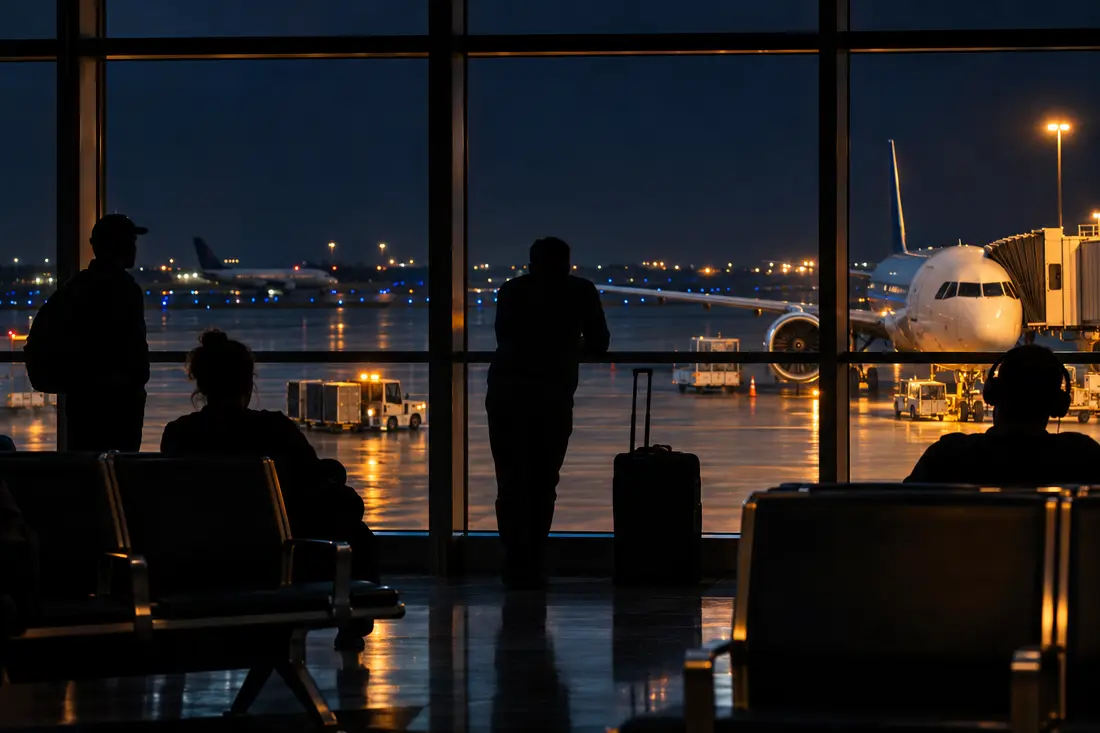
Featured image: AI-generated editorial illustration.



