

Iranian state television showed senior commanders touring a concealed missile complex. An archival record connects a Pakistani scientist’s network to Iran. What did that network actually supply, and does it explain anything in the new footage?
On 10 November 2026, Iranian state television took viewers underground. The footage showed senior military commanders Ali Abdollahi and Majid Mousavi touring a complex that Iran’s Revolutionary Guards described as a new “missile city.” Iranian media said it housed ballistic and cruise missiles and their launch systems. The broadcast showed selected sections. The location, full size and inventory were undisclosed.
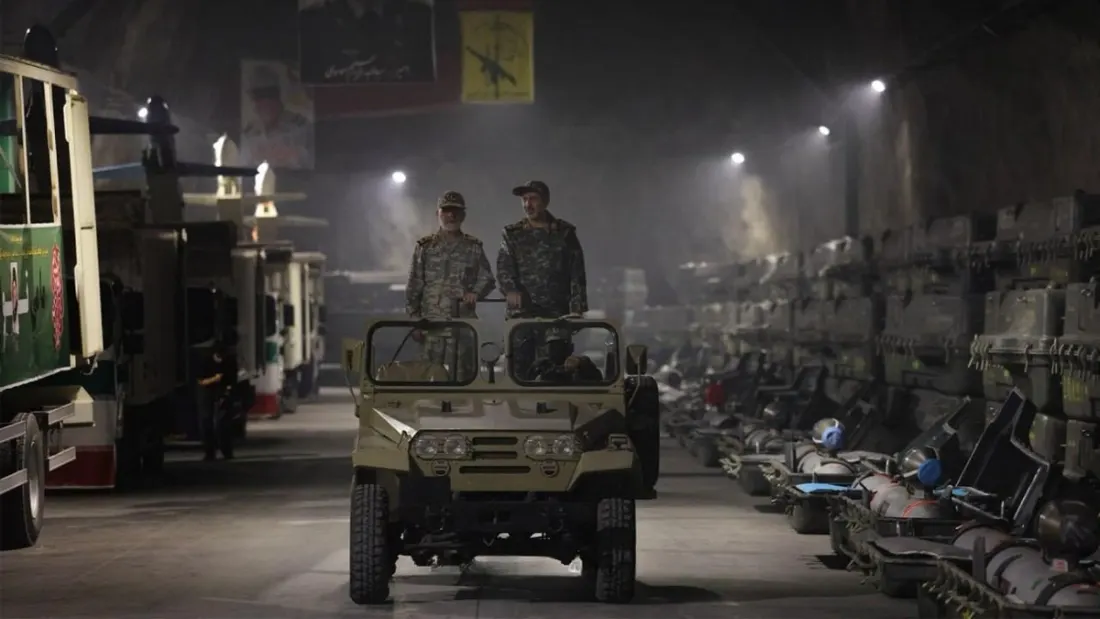
A separate clip circulated on social media as footage of the same announcement. The Egyptian outlet Masrawy examined that clip and identified it as AI-generated. The distinction matters because the official broadcast and the viral clip have different origins.
Watch the footage published by Dawn
What Abdul Qadeer Khan said on television
On 4 February 2004, Abdul Qadeer Khan appeared on Pakistani television after a government investigation into nuclear proliferation. He accepted responsibility for proliferation activities and said much of the evidence put to him was accurate. Contemporary reporting tied the investigation to transfers of nuclear expertise and equipment to Iran, Libya and North Korea. The broadcast contains no admission that Khan supplied Iran with missiles or helped build underground missile facilities.
President Pervez Musharraf pardoned Khan the next day. In 2008, Khan withdrew his confession and said he had been pressured to make it. Pakistan’s government maintained that he acted independently. The dispute over authorisation is distinct from the documentary question of what reached Iran.
What the records show reached Iran
The International Atomic Energy Agency documented dealings between Iran and a clandestine supply network involving uranium enrichment. Iran told inspectors it had obtained centrifuge drawings and sample components through a foreign intermediary around 1987. The agency later reviewed shipping documents relating to deliveries in the mid-1990s and interviewed members of the supply network. Historical research traces those dealings to the network associated with Khan.
Iran’s missile programme has its own documentary history. Research by the U.S. Congressional Research Service and the International Institute for Strategic Studies traces early acquisitions to the Iran–Iraq War and identifies North Korea as an important supplier to the early ballistic missile programme. The provenance of this particular underground facility would require evidence specific to the site.
What the camera leaves unanswered
The public record supports two findings. Iran showed a facility it identified as a new underground missile complex, and Khan’s network supplied technology to Iran’s uranium-enrichment programme. A link between the two would require evidence that Pakistani assistance went into this facility or the weapons displayed there. Neither the broadcast nor Khan’s 2004 statement supplies that link.
Sources
- Iran International reporting on the November 10 footage
- Transcript of Khan’s televised statement
- CBS News interview on Khan’s retraction
- IAEA report on Iran’s enrichment procurement
- Carnegie Endowment chronology of Khan’s network
- Congressional Research Service history of Iran’s missile programme
- IISS analysis of the Iranian missile programme



