

A government asks households to prepare for three days of disruption. A technology company sets a 2029 deadline to replace vulnerable cryptography. Both are planning for uncertainty. What, if anything, do they tell us about the arrival of Q-Day?
Imagine waking up on Q-Day. The lights still come on. Your bank balance looks the same. The children go to school. Somewhere, though, a message intercepted years ago might have become readable to someone who was never meant to see it. A breakthrough in quantum computing could announce itself that quietly.
As of 15 November 2026, there is no verified public demonstration of a quantum computer breaking the kinds of public-key cryptography that protect everyday digital communications at practical key sizes. A secret breakthrough is conceivable. Its secrecy, by itself, is no reason to believe that it has happened.
What 2029 actually means
Google announced in March 2026 that it was aiming to complete its migration to post-quantum cryptography by 2029. That is a deadline for replacing vulnerable protections. Britain’s National Cyber Security Centre has a different timetable: plan by 2028, prioritise critical upgrades by 2031 and complete migration by 2035. These schedules tell us how much work institutions think they need to do before a machine capable of breaking widely used public-key systems exists. They cannot date its arrival.
Russian work on quantum computing is real. Moscow State University and Rosatom deployed a 72-qubit prototype, reported in January 2026. A count of physical qubits alone says little about whether a machine can run a long, error-corrected computation at the scale needed to break modern cryptography. The image of a secret laboratory in Siberia makes a striking opening scene. Public reporting does not establish that such a laboratory has crossed that threshold.
A theft that can wait years to pay off
Ordinary computers store information in bits. Quantum computers use qubits, which let them approach certain mathematical problems differently. Given a sufficiently powerful and reliable machine, some of the mathematics behind widely used public-key systems could cease to protect us. That matters for both confidential communications and digital signatures, which help establish who sent a message or whether a software update is authentic.
A spy can collect encrypted traffic today and keep it for years. If the older protection is later broken, the intercepted material may become readable even after the sender has upgraded. Security researchers call this harvest now, decrypt later. The risk is greatest where the information will still be sensitive years from now. It is one reason the US National Institute of Standards and Technology published its first post-quantum cryptography standards in 2024 and issued further transition guidance in October 2026.
Why Britain asked households to keep water
On 22 October 2026, the Cabinet Office launched the first stage of a three-year preparedness campaign. Its guidance encourages households to keep three days of bottled water and non-perishable food and prepare for interruptions to power, water, phones or the internet. The announcement cites severe weather and recent disruptions. It does not link the advice to a Russian quantum breakthrough.
Water, banking, aviation and hospitals all depend on digital systems in different ways. Breaking one class of cryptography would not automatically stop the taps or erase balances. The practical consequences would depend on which systems still used vulnerable protections, what an attacker could reach and what safeguards were already in place.
Would anyone tell us?
A state that acquired such a capability might have an incentive to keep it quiet. An independently verified demonstration against a real-world key would change what we know. Until then, the practical question is how much sensitive information could outlive the protections it was given. The first consequence of Q-Day might be a message becoming readable years after everyone who sent it thought the conversation was over.
Sources
- Google’s 2029 migration target
- UK National Cyber Security Centre migration timetable
- NIST’s standards and transition guidance
- UK Cabinet Office preparedness announcement
- Reporting on Moscow State University’s quantum prototype
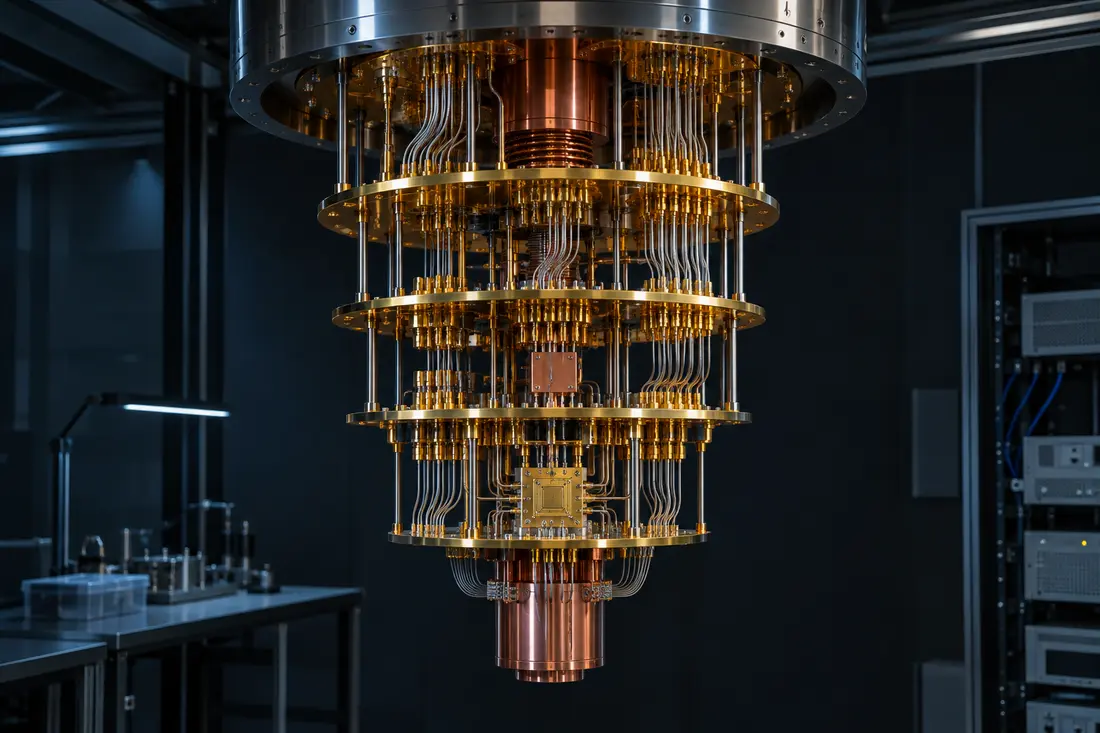
Featured image: AI-generated editorial illustration of a generic quantum computer. It does not depict a Russian laboratory.



