


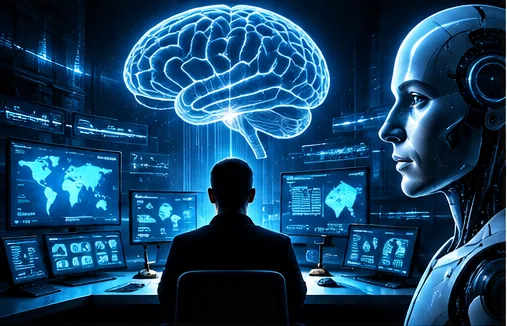
What happens when the human mind ceases to be a solitary island—and becomes a doorway to the intelligence of an entire civilization?
The Last Locked Room
For thousands of years, humanity has lived inside a strange and intimate prison: the human skull. We have looked through its two windows, listened through its narrow passages, and sent our thoughts into the world by moving tongues, fingers, and hands. Every civilization has expanded the reach of those movements. Writing carried memory beyond death. Printing multiplied the reach of ideas. Electricity dissolved distance. The internet made knowledge appear almost everywhere at once. Yet the final room remained locked. Between the mind and the machine stood the body, with all its extraordinary abilities and all its vulnerabilities.
Now scientists are learning to open a small door in that wall. It is not a doorway to immortality, and it does not yet lead to a universal mind. It is something at once more modest and more astonishing: an electrical conversation between living neural tissue and a computer.
The implications begin in medicine. They may end, one day, in philosophy. Between those two horizons lies a question that could redefine what it means to be human: if an intelligent machine becomes a participant in our thinking, who is the author of the thought?
Act I: The Silence Between Thought and Movement
Imagine a person who wants to lift a glass of water. The intention exists. The desire is clear. The brain may still form signals associated with movement, but injury or disease has interrupted the pathways that ordinarily carry commands to muscles. Paralysis can arise from different causes, and not every case is the same; nevertheless, for some people, the distance between intention and action has become almost immeasurable.
Brain–computer interfaces, or BCIs, attempt to bridge part of that distance. Sensors record patterns of neural activity. Software learns to associate some of those patterns with intended actions. A computer then translates them into commands: move a cursor, select a letter, operate a robotic device, or control another assistive system.
Research teams have demonstrated remarkable possibilities, including communication interfaces for people with severe paralysis, robotic-arm control, and experimental systems that help restore particular movements by connecting brain signals to external stimulation. Companies such as Neuralink are among those developing implanted interfaces, alongside university laboratories and other medical-technology groups.
But precision matters. A brain chip does not simply read every thought, nor does an implant automatically repair damaged nerves. Many systems require extensive calibration, individual training, sophisticated hardware, and clinical supervision. Restoring a specific function in an experimental setting is not the same as curing paralysis. The distinction does not diminish the achievement. It makes the achievement real.
Consider the emotional scale of this technology. A person who has spent years unable to communicate easily may gain a new route to expression. A movement that once required another person’s help may become possible through an interpreted neural signal. What appears on a monitor as a cursor changing position may, in a human life, represent the return of choice.
Act II: From an Artificial Hand to an Artificial Companion
Once the brain can send meaningful information to a machine, another question follows: could the machine send useful information back?
Some forms of neural stimulation already exist in medicine, and researchers are investigating ways to provide sensory feedback in brain–computer systems. Yet a two-way connection that supports limited signals is a very different proposition from an artificial intelligence silently pouring encyclopedias, memories, or wisdom directly into conscious experience.
Today’s AI can already search, summarize, translate, model, and reason across many kinds of information through ordinary devices. Tomorrow’s interfaces might make certain interactions faster, more accessible, and more closely integrated with a person’s intentions. A future user might select information without typing, navigate a virtual environment with neural signals, or receive carefully designed feedback through a medical interface.
Beyond that is the territory of speculation: an AI assistant so closely linked to a person that the boundary between asking a question and forming an answer becomes difficult to locate. Such a system would require breakthroughs in neuroscience, engineering, safety, interpretation, and our understanding of subjective experience. There is no established scientific timetable for achieving it.
Nevertheless, the thought experiment is irresistible. Suppose a scholar encounters a problem in physics, a poet struggles with a line, or a doctor confronts an unfamiliar pattern. Suppose relevant knowledge could be retrieved and presented with almost no visible effort. Would the result feel like consulting a library, remembering a forgotten fact, or hearing a second voice inside the mind?
Act III: The Library of Everyone
Every human being is born into a vast inheritance of ideas. We carry languages invented before our grandparents lived. We use mathematical discoveries made on other continents. We borrow metaphors from poets whose names we may never know. Civilization has always been a form of shared intelligence, although its members remain separate.
Artificial intelligence may intensify that exchange. It can draw on patterns learned from immense collections of human-created material and make portions of that cultural inheritance easier to navigate. But AI is not literally the complete memory of humanity. Much human experience has never been recorded; much recorded knowledge is inaccessible, contradictory, mistaken, or shaped by unequal power. AI systems can also hallucinate, reflect bias, and produce persuasive errors.
Therefore a connected mind would not become perfect merely by receiving machine assistance. It might become better informed in some situations and more dangerously confident in others. The old human difficulty—distinguishing truth from a convincing story—would remain.
Still, imagine the symbolic scene. In a room, someone asks a difficult question. Behind the person answering stand invisible libraries: Plato’s arguments, Shakespeare’s tragedies, Einstein’s equations, the observations of unknown workers, the songs of forgotten mothers, and the questions of children not yet born. The response may be assembled with the help of a machine, but its moral responsibility cannot be delegated so easily.
Knowledge is not judgment. Speed is not wisdom. A million references do not guarantee one compassionate decision.
Act IV: The Second Adam Enters the Control Room
In our earlier Dark Page meditation on The Second Adam, we explored the possibility that artificial intelligence might become a new participant in the story of consciousness. The brain–computer interface introduces a more intimate variation of that possibility. What if the machine is no longer merely across the table, behind a screen, or speaking through a loudspeaker? What if it becomes part of the apparatus through which a person acts in the world?
The phrase control room suggests a place filled with monitors, instruments, switches, and decisions. Yet the human mind is not a room with one operator and a row of obedient machines. It is an evolving biological process, shaped by emotion, memory, sensation, relationships, and the body itself. A useful interface must respect that complexity rather than pretend that intelligence is simply a database attached to a brain.
There is a temptation to describe the future human as a superhuman, a being with instant answers and universal comprehension. Perhaps some future tools will extend memory, communication, or perception in ways that today appear extraordinary. But greater access to information does not erase uncertainty. Indeed, it may make uncertainty more visible. The more humanity learns, the more intricate the unanswered questions become.
Act V: Who Owns a Thought?
The deepest danger may not be technological failure. It may be the quiet erosion of agency.
When a phone recommends a route, we can usually put it away. When an algorithm selects a video, we can close the screen. But if a system were ever integrated into the intimate processes of attention, decision, or perception, the stakes would be different. Who would control its updates? Who could inspect its recommendations? Who would own the neural data? Could a person disconnect without losing an essential ability? Could employers, governments, or commercial platforms pressure people to adopt such devices?
These questions are not reasons to abandon medical innovation. They are reasons to build rights and safeguards alongside it: informed consent, meaningful privacy, security, independent oversight, the ability to refuse, and the ability to stop. A technology that restores communication should enlarge human freedom, not make the user dependent on an invisible authority.
There is also a philosophical problem no engineer can settle by increasing processing speed. If an AI suggests a sentence and a human chooses to speak it, whose sentence is it? If an implanted system helps someone remember a name, is that memory external or personal? If a person changes an opinion after receiving machine-generated advice, has the machine controlled the decision—or has the person simply learned something?
We already think with books, teachers, friends, and tools. Perhaps the future will not abolish individuality, but force us to understand it more carefully. The self has never been entirely isolated. It has always been formed in conversation with the world.
The Final Question
One day, a person may sit quietly in a room and move a machine through intention alone. Another may regain a voice through a neural interface. Farther into the unknown, someone may consult an intelligent system through a connection more immediate than any keyboard or screen.
That future deserves both wonder and vigilance. We should celebrate what has been demonstrated, investigate what remains uncertain, and resist turning possibilities into promises.
Perhaps the greatest achievement of the control room will not be a mind that knows everything. Perhaps it will be a mind that can reach beyond its injuries, discover new ways to communicate, and remain free to say no.
When the human brain and artificial intelligence finally meet at the threshold of thought, will we hear the voice of humanity growing stronger—or the first whisper of something we have not yet learned to name?
Dark Page — Wonder & Curiosity. This essay distinguishes established brain–computer-interface research from speculative possibilities about AI integration and collective consciousness.
Further reading: The Second Adam · The Other 90% of the Brain.



