

Dark Page | Wonder & Curiosity
Eight mysterious traces. One instrument above Earth. And a question that could change our picture of the cosmos.
The Footprint in a Desert Without Footprints
Imagine standing alone in a desert so vast that its horizon seems to be the edge of existence. No roads. No houses. No human voice. You believe you are the only traveler who has ever crossed it. Then, beneath your feet, you discover a footprint.
You cannot yet say whose it is. Perhaps the wind carved it. Perhaps it belongs to an animal you have never seen. But suppose the shape is so unusual that the best instruments in the world cannot immediately explain it. Would you walk away? Or would you begin searching for the stranger?
Something remarkably like that has happened in our study of the universe. High above Earth, an instrument on the International Space Station has recorded eight extraordinary particle events whose measured properties resemble the nuclei of antihelium. The eight events are real entries in the experiment’s reported data. Their identification as genuine cosmic antihelium, however, has not been conclusively established. That difference is the doorway into the mystery, not an excuse to close it.
What if the signals are genuine? What if they are not? And what would it mean if a few invisible particles had traveled through the galaxy carrying news of a world built from the opposite kind of matter?
A Mirror Hidden Inside Nature
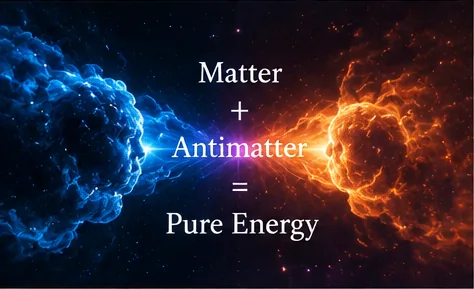
Everything familiar is made of matter: your hands, the dust on your desk, oceans, mountains, the Sun. But nature also permits antimatter. Think of it as matter’s strange mirror counterpart. The electron carries a negative electric charge. Its counterpart, the positron, carries a positive charge. Both are real, both have been measured, and antimatter is routinely studied in laboratories.
When a particle meets its corresponding antiparticle, they can annihilate, converting their energy and mass into other particles and radiation. This is not the disappearance of reality; it is one form of physical reality transforming into another.
Now imagine a Sun whose atoms are not ordinary atoms. Imagine anti-hydrogen at its heart, fusing into antihelium. Imagine planets assembled from antimatter. From a great distance, such a star might shine much like our own. Its light would not carry a label saying “I am made of antimatter.”
And here comes the unnerving reversal. To hypothetical inhabitants of such a world, their matter would be normal. We would be the strange ones. Our bodies would be the dangerous opposite. A meeting between our materials and theirs would be no ordinary encounter.
We have not discovered such inhabitants, planets, or even a confirmed antistar. Yet the physical possibility of antimatter is beyond dispute. The unanswered question is whether large natural structures made from it exist somewhere beyond our laboratories.
The Machine That Listens to Invisible Travelers
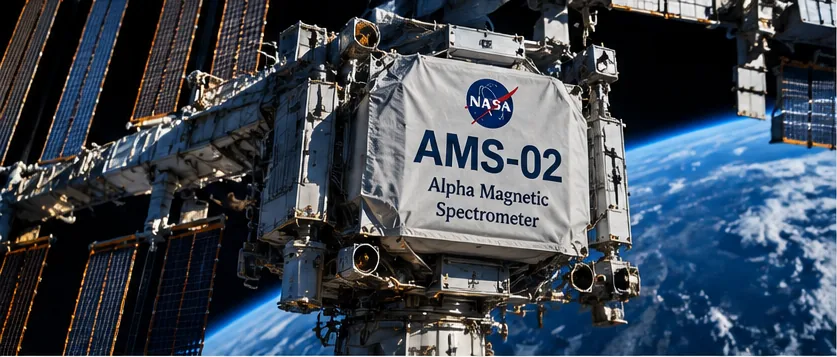
Since 2011, the Alpha Magnetic Spectrometer, known as AMS-02, has operated aboard the International Space Station. The experiment is associated with Nobel laureate Samuel Ting of MIT and a large international scientific collaboration. It watches cosmic rays: extremely energetic particles arriving from space.
They are not rays in the everyday sense of a beam of visible light. Many are tiny charged particles. A magnetic field bends their paths; detectors measure how they move, how much energy they carry and what electric charge they possess. In this way, the machine can distinguish among kinds of cosmic travelers that no human eye could see.
Billions of particles have passed through the experiment. Among its striking results is an excess of high-energy positrons compared with simple expectations, a puzzle that has inspired research into pulsars, cosmic-ray propagation and possible dark-matter processes. The positron mystery is real, but it does not prove dark matter has been detected.
Then came a more startling possibility: a tiny handful of events with the properties expected of antihelium nuclei. Reports from the collaboration’s presentations describe eight candidates: six consistent with antihelium-3 and two with antihelium-4. Those numbers are extraordinary not because eight is large, but because the background of ordinary helium is enormous and antihelium is expected to be exceedingly rare.
Yet scientists must answer an unforgiving question: did the detector really see antimatter, or did a rare measurement error make an ordinary helium nucleus look like its opposite? This is why candidate does not mean confirmed. A 2026 analysis using machine-learning techniques examined as many as twelve candidates under different selections but found no statistically significant excess over background. The search continues.
Why One Tiny Nucleus Could Disturb an Entire Cosmology
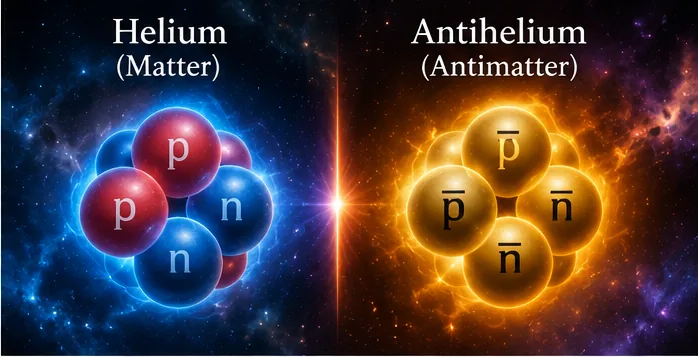
Helium is a familiar element. Its nucleus is a compact cluster of protons and neutrons. Antihelium is the mirror version: antiprotons and antineutrons bound together. Antihelium-3 has three such constituents; antihelium-4 has four.
Making a lone antiparticle in a high-energy collision is one thing. Producing several antiparticles that happen to move close enough together to form a bound antihelium nucleus is much harder. Ordinary cosmic-ray collisions can in principle do this, and scientists calculate how often it should happen. The expected rate depends on the energy, the type of antihelium, the details of particle production and the journey through space. There is no single universal “one in ten billion” probability that describes every circumstance.
The heavier antihelium-4 candidates are particularly provocative because standard secondary-production expectations are very low. If even one were robustly verified, physicists would have to ask whether conventional calculations have missed an important process or whether something unfamiliar is contributing.
Imagine that a letter arrives from a city you thought had no post office. Perhaps the address was read incorrectly. Perhaps someone sent it from a different city. But if the postmark is authentic, you must investigate where the letter began its journey.
The Great Disappearance After the Big Bang
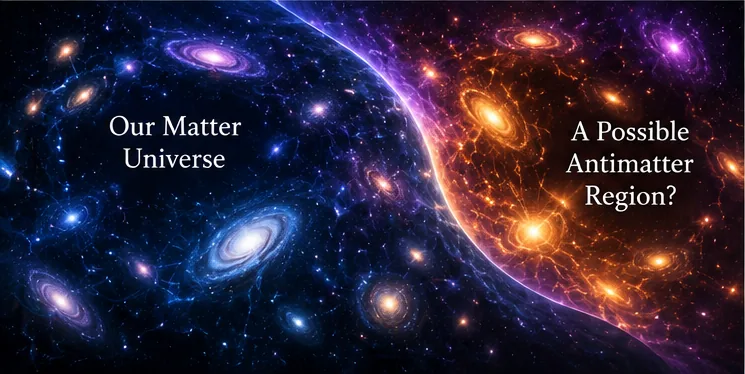
The early universe was unimaginably hot and dense. Matter and antimatter could be created and destroyed in energetic processes. Yet the visible universe today is overwhelmingly made of matter. Why did matter win?
Scientists call this the matter-antimatter asymmetry problem. The phrase is formidable; the question is almost childlike: if the laws of nature allow both kinds, why do we see so much of one and so little of the other?
Perhaps a tiny imbalance emerged in the early universe and, after widespread annihilation, left enough ordinary matter to make stars and galaxies. Researchers study possible violations of symmetries between particles and antiparticles and other mechanisms that might help explain the imbalance. No complete, universally accepted explanation has emerged.
But another possibility has long haunted theoretical discussions: could regions rich in antimatter have survived separately from the matter around them? Could there be islands, stars or clusters whose substance is the mirror of ours? Such scenarios face serious observational constraints, especially because matter meeting antimatter should produce detectable high-energy radiation at their boundaries. They are not established descriptions of the cosmos. They are questions that a genuine antihelium signal could make newly urgent.
Three Suspects—and the Stranger Called the Antistar
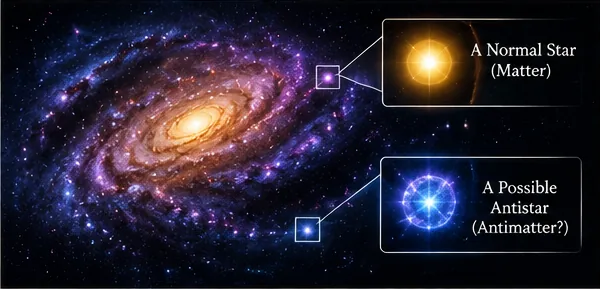
If the antihelium candidates are confirmed, investigators will need to identify their source. There is no shortage of suspects.
One is ordinary astrophysics: collisions of high-energy cosmic rays with gas might produce more antihelium than some models predict. Better calculations of how antiparticles combine into nuclei could change the expected background. Another possibility involves dark matter, the unseen component inferred from gravitational effects in galaxies and the universe. Some hypothetical dark-matter particles could annihilate or decay into products that eventually yield antinuclei. But dark matter’s microscopic identity remains unknown, and such explanations are model-dependent.
A third suspect is the primordial black hole, a hypothetical black hole formed in the early universe rather than by a collapsing star. Stephen Hawking’s work suggests black holes can emit radiation through quantum effects. Under certain assumptions, sufficiently small primordial black holes could contribute antiparticles. Whether they could account for the reported antihelium events is far from settled.
Then comes the most cinematic possibility: an antistar. In our Sun, nuclear fusion turns hydrogen into helium. In a star made from antimatter, analogous reactions could turn anti-hydrogen into antihelium. Violent stellar events might accelerate antimatter nuclei into space, sending them across immense distances toward a detector orbiting Earth.
Could such stars be hidden in the halo of our galaxy? Could ancient antimatter-rich regions have produced clusters of them? Some speculative models have explored these possibilities. No globular cluster has been demonstrated to consist of antistars. No antimatter island has been identified as the source of the AMS events. The hypothesis is compelling precisely because it offers a testable story, not because the story has been verified.
Fourteen Lights That Might Be Something Else
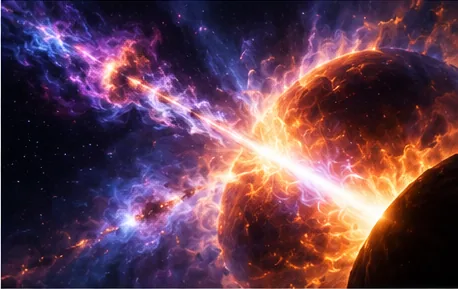
In 2021, researchers examined roughly a decade of data from NASA’s Fermi gamma-ray space telescope. They considered thousands of gamma-ray sources and identified fourteen whose characteristics could be compatible with possible antistars. If ordinary matter falls onto an antistar, matter-antimatter annihilation might create distinctive gamma-ray emission.
Fourteen sources. Fourteen invitations to wonder. But a candidate is not a discovery. Ordinary astrophysical objects, including pulsars and distant galaxies, can generate gamma rays. None of those fourteen sources has been confirmed as an antistar. The researchers’ analysis also helped constrain how common such objects could be under particular assumptions.
Think of standing on a coastline at night and seeing fourteen lights beyond the fog. Are they ships? Houses? Stars reflected on the water? Until you know the source of the light, you do not know what lies beyond the horizon. Yet you have gained something important: places to look.
What Would a Confirmed Signal Actually Prove?
Here the temptation to announce a new universe is strongest, and here precision matters most. A confirmed cosmic antihelium nucleus would be a major discovery. But it would not automatically prove an antistar, an antimatter galaxy or intelligent life. Physicists would first test whether known collisions and propagation effects could produce it. They would measure its energy and abundance, compare models, and seek independent detection by instruments using different techniques.
If standard explanations failed, more radical possibilities would deserve increasing attention. Our understanding of early-universe physics, particle formation or astrophysical sources might require revision. But the Big Bang itself would not automatically be disproved, and a single nucleus would not establish a second civilization.
The true scientific drama is not that every answer becomes certain at once. It is that one robust result can open ten questions nobody expected to ask.
The Other Side of the Mirror
Now permit the imagination to travel where the evidence has not yet arrived. Suppose, somewhere far beyond our reach, a star of antimatter shines over an antimatter planet. Suppose that planet has mountains, oceans and a sky. Suppose chemistry and time have done something astonishing there and life has emerged.
Would those hypothetical beings ask the same questions that trouble us? Would they look upward and wonder whether another world exists? Would their scientists imagine a distant place where the matter of everything is reversed? Perhaps to them we would be the impossible strangers.
This is a thought experiment, not a scientific report. No observation of antihelium, confirmed or otherwise, is evidence of anti-humans. But a serious scientific mystery can give birth to a legitimate philosophical question: how much of reality remains outside the reach of our current instruments, and how careful must we be when imagination outruns evidence?
Eight Marks in the Cosmic Sand
The most important fact is both simple and unsettling: the AMS collaboration has discussed eight events whose properties are consistent with antihelium, while their identification remains unconfirmed. These are not eight certified antihelium nuclei, and they are not eight visitors from another civilization. They are eight possible clues to a question at the foundation of modern cosmology.
There is something beautiful about this restraint. Science does not become less adventurous when it refuses premature certainty. It becomes more adventurous, because it leaves the door open to being surprised by reality rather than satisfied by a headline.
Return, once more, to the desert. The footprint is still there. You have photographed it, measured it, compared it with other marks. You have not yet proved that a stranger made it. But now you know where to begin the search.
And perhaps, in the vast desert between the stars, a tiny nucleus is asking us the most unsettling question of all:
What if the universe has been sending us a message from the other side of matter—and we are only just learning how to read it?
Sources and Scientific Context
NASA — Alpha Magnetic Spectrometer · NASA — Cosmic Ray Mysteries · Review — Cosmic-ray Antinuclei · 2026 AMS-02 Antihelium Analysis · AMS-02 Publications.
Editorial distinction: the AMS-02 collaboration has reported candidate events; as of this article’s preparation, the cosmic antihelium identification is not a confirmed discovery. Antistars and antimatter life are hypotheses, not observed facts.
Further reading: The Infinite Cosmos · Before the Big Bang.



