

DARK PAGE / COSMIC MYSTERIES / SCIENCE & PHILOSOPHY
The Cosmic Prison: Who Has Forbidden Humanity to Fly Beyond Earth?
Perhaps the sky is not a doorway but a window. Perhaps the universe has given us eyes with which to see infinity—and bodies that cannot reach it.
The Invisible Walls
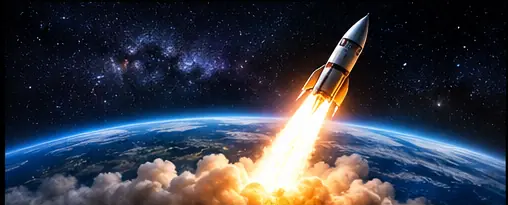
Every night, the stars make us a promise they have never agreed to keep. We look upward from our small blue world and imagine departure: the first footstep upon another planet, the first human voice beneath an alien sun, the first ship crossing the silent ocean between the stars. Yet there is something almost cruel in the arrangement of the heavens. The farther our instruments can see, the more remote our destinations become. Our telescopes have opened the gates of the visible universe; our bodies remain upon the threshold.
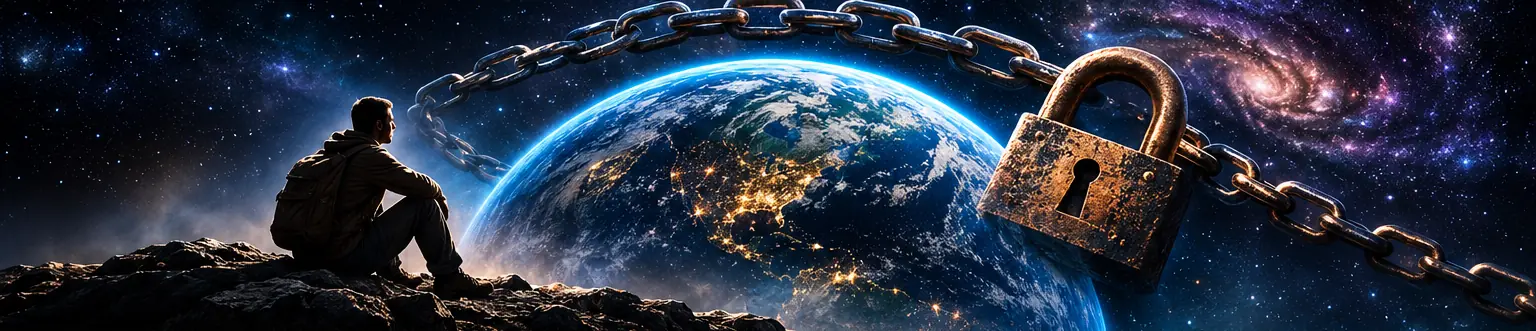
We have taught electricity to carry conversations across continents. We have split atoms, built machines that recognise patterns in language, and dispatched robotic emissaries beyond the outer planets. Human beings have indeed left Earth: astronauts have walked on the Moon, and probes are travelling through interstellar space. The prison, if it exists, is therefore not the atmosphere. It is the immensity beyond it.
Proxima Centauri, the nearest star to the Sun, is roughly 4.24 light-years away. Light itself needs more than four years to arrive. A spacecraft travelling at one tenth of light speed would need more than forty years for the journey, before accounting for acceleration or braking. The gulf between our ambition and our engineering is not measured in miles alone. It is measured in generations.
The Law That No Engine Can Outrun
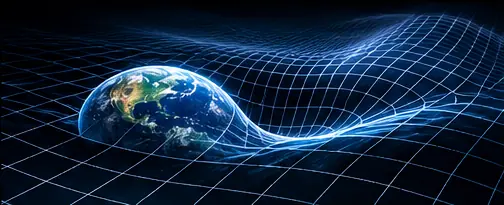
According to special relativity, no object possessing mass can be accelerated through the speed of light in a vacuum. The closer it approaches that boundary, the greater the energy required for further acceleration; reaching the limit would demand unbounded energy. It is more precise to speak of increasing energy and momentum than to say that an object’s ordinary resting mass simply grows.
But why should reality possess such a boundary? Why should the universe admit our longing to travel, only to establish a speed limit so severe that even the fastest messenger cannot bridge its vastness within a human lifetime? Physics describes the rule with extraordinary precision. Whether the rule carries any purpose is a philosophical question, not an established scientific discovery.
Even if an engine could approach relativistic speeds, a second danger would await: interstellar dust, energetic particles, radiation, the need for shielding, and the challenge of sustaining a living crew. A tiny grain encountered at an enormous relative velocity could become a devastating impact. Space is not empty in the comforting sense. It is merely empty enough to make rescue almost unimaginable.
The First Secret Door: Wormholes
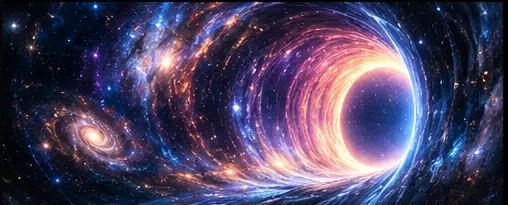
Imagine two distant points on a sheet of paper. Across the sheet they are far apart; fold the paper and they seem to meet. In the geometry of general relativity, some mathematical solutions resemble tunnels linking distant regions of spacetime. We call them wormholes. The metaphor is seductive: perhaps the traveller need not defeat distance but only discover that distance has a hidden shape.
Yet no traversable wormhole has been observed. A mathematical solution is not evidence that nature has built the corresponding structure. Many proposed traversable models require unusual distributions of energy or matter, and their stability is deeply uncertain. A tunnel may exist in an equation without ever existing as a passage for a human spacecraft.
The Second Secret Door: The Warp Drive
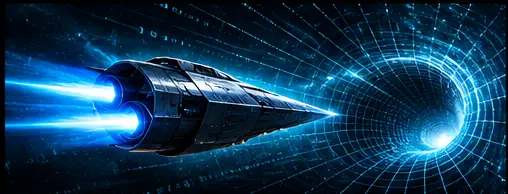
In 1994, physicist Miguel Alcubierre described a speculative spacetime geometry in which space contracts ahead of a craft and expands behind it. The vessel would remain locally within the rules of relativity while its surrounding geometry changed. In popular imagination, the stars would come toward the ship rather than the ship racing toward the stars.
But an elegant geometry is not an engine. The original concept depends on exotic negative-energy conditions, and subsequent research has not established a practical faster-than-light propulsion system. Questions about energy requirements, horizons, stability and causality remain formidable. Cosmological expansion also does not mean that an engineer can simply make a patch of space expand at will. The warp drive is a serious object of theoretical inquiry, not a demonstrated machine waiting for fuel.
The Prison of Flesh

Perhaps the most intimate bars of the cosmic cell are biological. We need air, water, warmth, food, gravity or its substitutes, and protection from radiation. Our hearts beat according to a terrestrial rhythm; our bones and muscles are adapted to a particular world. Even when a ship survives, its passengers must survive with it.
One answer is not to move faster but to endure longer: generation ships, robotic exploration, suspended-animation research, and forms of machine intelligence that might tolerate journeys beyond the span of a human life. None makes interstellar settlement easy. Nor has science demonstrated that a human consciousness can simply be uploaded into a computer. But these possibilities ask a haunting question: must the traveller remain human in the familiar biological sense?
Does Quantum Physics Hide an Exit?
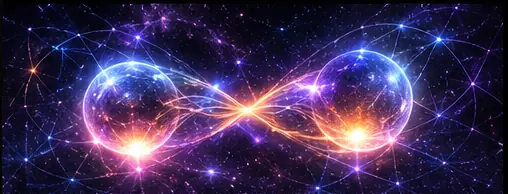
Quantum entanglement reveals correlations between separated systems that defy classical intuition. It does not, however, allow usable messages or human bodies to be transmitted faster than light. Quantum teleportation transfers quantum-state information under strict conditions and still requires ordinary classical communication. It is not the disappearance of a person here and their instantaneous reappearance around a distant star.
Future physics may transform our understanding of spacetime. But wonder must not be confused with proof. The most exciting scientific questions are precisely those for which we have not yet earned an answer.
The Darkest Possibility: Cosmic Quarantine
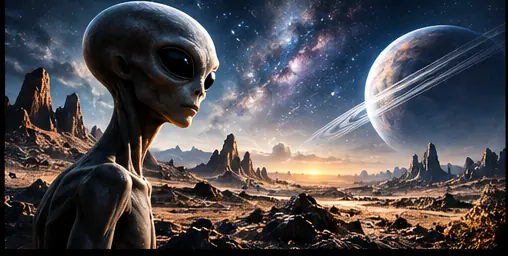
Suppose intelligence is common among the stars. Why do we see no unmistakable visitors? One imaginative answer is that immense distances separate civilisations so effectively that each inhabits its own island of consciousness. This resembles a cosmic quarantine, preventing the inhabitants of one world from easily reaching another.
It is a provocative metaphor, not evidence of an intentional barrier or a universe designed to keep civilisations apart. The silence might arise from rarity, timing, technological limits, our incomplete searches, or causes we have yet to imagine. No observation presently establishes that an unseen power has imprisoned humanity on Earth.
Three Futures Beyond the Window
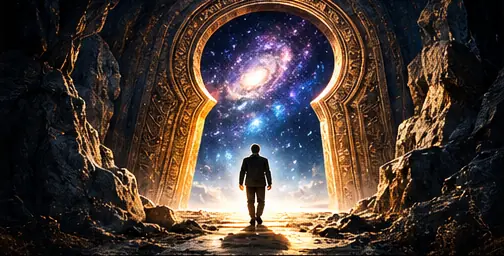
First: humanity learns patience. Robotic voyagers and perhaps future generations cross the distances that one lifetime cannot. Second: discoveries in fundamental physics reveal possibilities our present theories do not foresee—though no such shortcut has yet been demonstrated. Third: the stars remain physically distant, and our greatest voyages take place through instruments, knowledge, art and thought.
There is dignity even in the third possibility. A species that cannot hold a star in its hands may still understand how that star was born. A creature of dust can look into the ancient light of galaxies and reconstruct the history of matter. The prison metaphor may therefore conceal another truth: perhaps our greatest freedom is not movement but comprehension.
The Key We Have Not Found
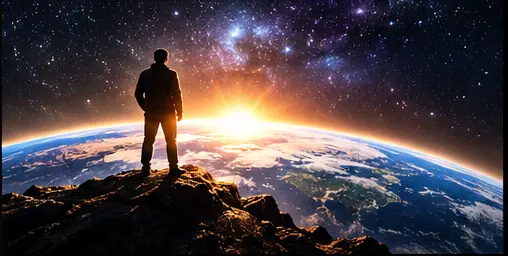
Still we return to the night sky. We are troubled not merely by the distances but by the desire to overcome them. Why should a mind fashioned upon one planet dream of the edges of the observable cosmos? Perhaps the answer is evolution, curiosity, and the restless intelligence that helped our ancestors survive. Perhaps philosophy will offer other answers. Perhaps some truths remain beyond our current language.
We do not know whether there is a secret door. We do know that every wall we have understood has changed the meaning of confinement. The stars may never belong to us. Yet their light has already entered our eyes, crossed our imaginations, and altered the story we tell about ourselves.
And perhaps that is where the first escape begins: not when the body leaves the Earth, but when the mind refuses to mistake the horizon for the end of existence.
Science note: Wormholes and warp drives remain speculative theoretical ideas; quantum entanglement does not permit faster-than-light communication. “Cosmic quarantine” is a philosophical thought experiment, not a confirmed physical mechanism.
Further reading: Albert Einstein, Relativity; Miguel Alcubierre (1994), “The warp drive: hyper-fast travel within general relativity,” Classical and Quantum Gravity; NASA, resources on interstellar distances and relativistic space travel.
Related Dark Page stories: Before the Big Bang · The Universe Without Light.



