
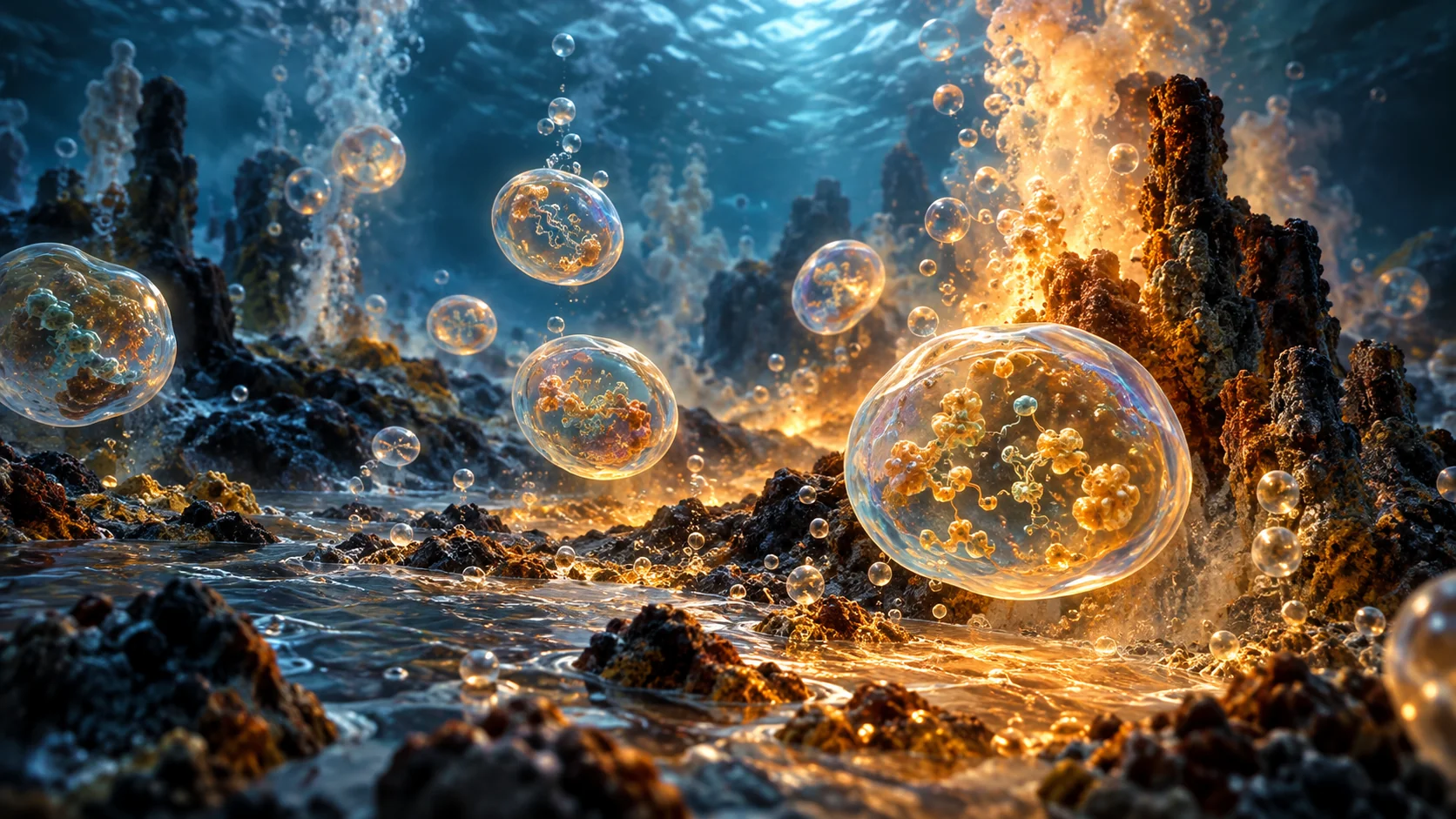


Featured image: AI-generated editorial illustration, not a historical photograph or observed scientific evidence.
Before animals, forests or bacteria, Earth was a world of minerals, water, gases and chemical reactions. Somewhere in that ancient world, systems capable of evolution emerged. How?
The mystery before evolution
Evolution explains how living populations change over generations. Abiogenesis asks an earlier question: how did nonliving chemistry give rise to the first systems capable of inheritance and evolution? Scientists have not yet reconstructed the complete historical pathway. But the unknown is not a magical “electric spark”: it is a complex sequence of chemical transitions.
The experiment that opened a door
In 1953 Stanley Miller, working with Harold Urey, exposed a mixture of water and gases to electrical discharges. Organic molecules, including amino acids, formed. The experiment did not create life, nor prove that the early atmosphere had precisely that composition. It showed that some ingredients associated with biology can arise without organisms. If molecules can form spontaneously under suitable conditions, how did they become organised enough to reproduce?
Life beneath an ancient ocean?
Hydrothermal vents provide chemical energy, minerals and gradients between different environments. Researchers investigate whether these conditions could have supported early prebiotic reactions. Others study shallow pools, wet–dry cycles and icy environments. Which setting, if any, hosted the first evolving systems? The ancient Earth left few unambiguous clues.
Did RNA come before DNA?
The RNA-world hypothesis proposes that RNA-like molecules were important early in life’s history. RNA can carry information and, in some forms, catalyse reactions. Yet major puzzles remain: how did its building blocks accumulate, how were useful chains assembled, and how did copying become sustainable? The hypothesis is influential but unproven.
The tiny bubble
Fatty molecules can assemble into membrane-like compartments. Laboratory protocells explore how a boundary might concentrate molecules and allow reactions to influence one another. But a bubble is not automatically alive. A successful origin scenario must explain the emergence of compartments, energy use, inheritance and evolution together. What came first: a membrane, metabolism or a copying molecule?
Was there a single first moment?
There may have been no sharp instant when “dead” matter suddenly switched on. Life could have emerged through gradual transitions among increasingly complex chemical systems. Even defining life is challenging: viruses evolve but require host cells to reproduce, while protocells may display some life-like properties without being fully living organisms.
Why can’t laboratories recreate it?
Scientists have built molecular components and artificial systems showing selected properties of living cells. Synthetic biology can also construct genomes using the machinery of existing cells. Neither accomplishment is the same as recreating the original emergence of independently evolving life from simple prebiotic chemistry. That historical transition has not been conclusively reproduced.
Could it happen twice?
All known cellular organisms share deep biochemical similarities, supporting common ancestry. But could multiple primitive chemical lineages have arisen, with only one ultimately surviving? And if life emerged independently on another world, would it use DNA at all? Mars, Europa and Enceladus are scientifically intriguing places to investigate habitability, but no extraterrestrial life has been confirmed.
The question that remains
Every living cell descends from earlier cells, but the chain eventually approaches a world before biology. How did chemistry become inheritance? How did inheritance become evolution? And how did evolution eventually produce beings capable of investigating their own origin?
The first living system left no written account of its birth. Its descendants are still searching for the story.
Further reading
NASA Astrobiology · NCBI scientific literature
Explore related science: Read about the universe before the Big Bang and neutrinos and the invisible universe.
Dark Page — Wonder & Curiosity




[…] related science: Read about the origin of the first living cell and ghost particles and neutrino […]