

← Back to Lost Treasures & Ancient Maps
The Amber Room could travel. Its walls looked as though they had been cast in honey-coloured light, but the amber had been worked into panels that could be lifted, packed and fitted into another palace. That made the room an extraordinary diplomatic gift in the eighteenth century. In 1941, it also made it possible for German forces to dismantle and take it.
A Prussian gift becomes a Russian room
Work on the panelling began in the early eighteenth century for Frederick I of Prussia. Amber is fossilised tree resin, and the craftsmen used its variations in colour as part of the design. A carved leaf could catch the light differently from the darker pieces around it. Mirrors and gilded ornament gave those small variations the scale of a palace interior.
Frederick William I presented the panels to Peter the Great. In the 1750s, Peter’s daughter, Empress Elizabeth, commissioned their installation in the Catherine Palace at Tsarskoe Selo. The architect Bartolomeo Francesco Rastrelli had a larger room to fill, so the original panelling was adapted and expanded. The work continued into the reign of Catherine the Great. The room later called the ‘Eighth Wonder of the World’ was the product of several reigns, workshops and journeys.
The last known display
When Germany invaded the Soviet Union in 1941, the amber was too fragile to remove safely during the evacuation of the palace. Staff tried to conceal it behind a covering. The occupying forces discovered the panelling, dismantled it and sent it to Königsberg in East Prussia, now Kaliningrad. It was put on display in the castle museum.
Königsberg is the last place where the original room is known to have been exhibited. Allied bombing in 1944 damaged the castle, and Soviet forces captured the city in April 1945. Amid the fires, evacuations and fighting, the trail of the panelling breaks. The uncertainty begins at that break in the record, long before the tunnels and shipwrecks of later treasure hunts.
What the search has turned up
Fire offers one plausible explanation: amber burns, and the castle suffered extensive damage. Another possibility is that some or all of the crates were moved before the city fell. Searches have focused on mines, bunkers and wrecks, but no documented chain of evidence has carried the missing panels from Königsberg to any of those sites.
Two objects from the prewar room did return. A Florentine stone mosaic known as Touch and Smell surfaced in Germany in 1997. In 2000, the mosaic and an eighteenth-century marquetry chest of drawers were returned to Tsarskoe Selo. Their recovery proves that individual objects from the room survived the war. It leaves the fate of the amber panelling open.
How a room was made again
Reconstruction began in 1979. Photographs gave the restorers the outline of the lost design, but black-and-white images offered limited guidance on the shades of amber and stone. The work took more than two decades. In 2003 the reconstructed room opened at the Catherine Palace, bringing back the interplay of amber, mirrors and gilt that had made the original so celebrated.
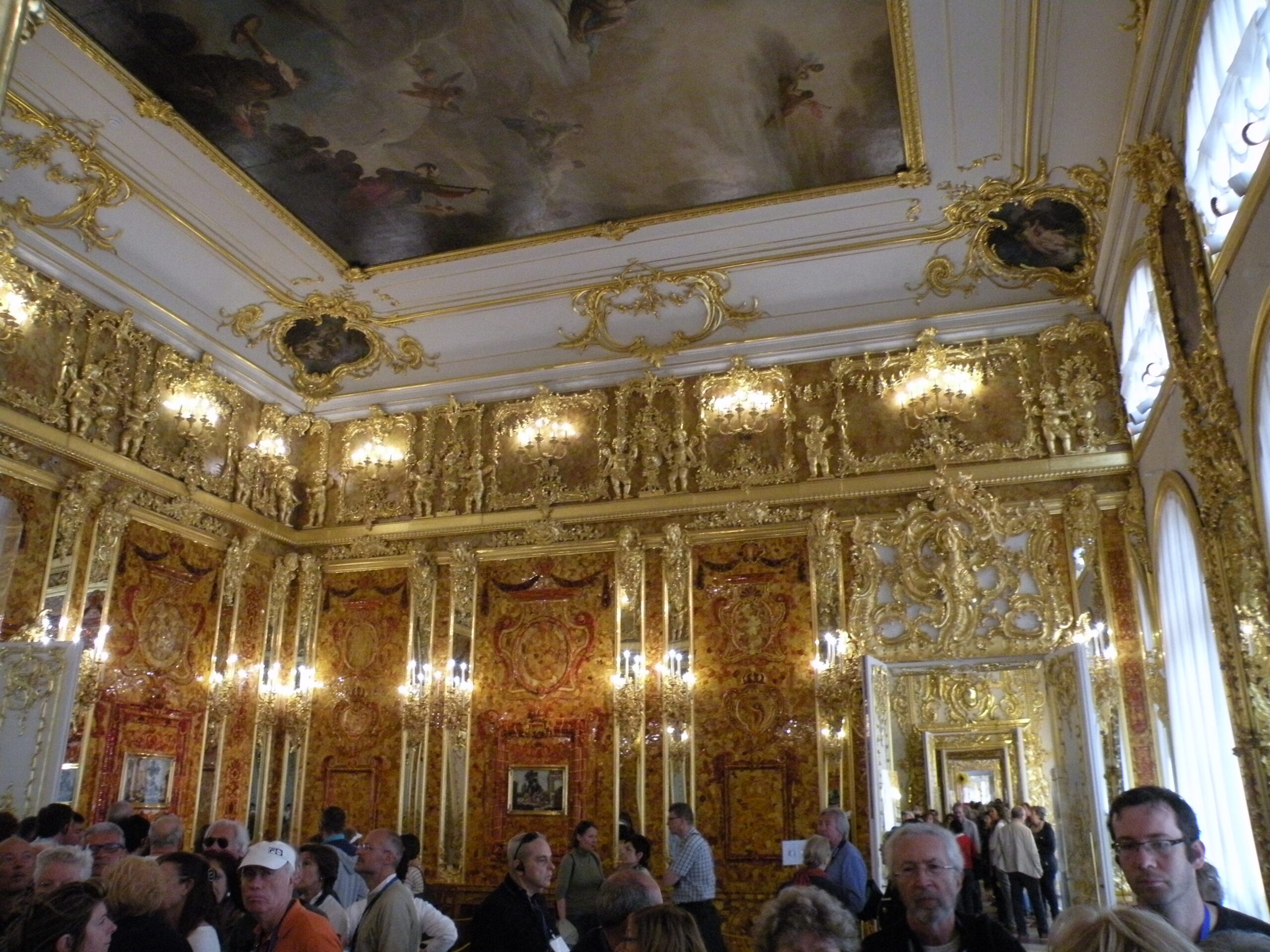
Visitors can again stand in a room where light seems to come from the walls. The objects recovered from Germany tell a different part of the story: they are pieces of the room that existed before the war. Between the reconstructed walls and those returned objects lies the unanswered question of what happened to the panels that left Königsberg’s public view.




[…] Read the complete article: The Amber Room: The Golden Chamber That Vanished → […]