

In Greenland, a Cold War installation disappeared beneath the snow. Decades later, an aircraft looking for the bottom of an ice sheet revealed the geometry of a buried past—and a question about what the future may uncover.
The White Surface
Imagine flying over a landscape that seems to have forgotten every human footprint. No roads, no rooftops, no smoke from a chimney: only the pale, immense surface of Greenland’s ice. From above, it looks like a place where history could never have happened. Yet beneath that white silence lies a set of tunnels built by people who once believed the ice might become a permanent frontier of military power.
The place is Camp Century, an American military installation constructed in 1959 beneath the northwestern Greenland Ice Sheet. It was not an ancient city, and its location was not newly discovered in 2024. Its history has been documented for decades. What changed was the clarity with which modern radar could see some of its surviving structures. The distinction matters: the extraordinary truth needs no fictional discovery attached to it.
A City Designed for the Cold
In the late 1950s, the Cold War encouraged governments to imagine strategic possibilities in places most people regarded as uninhabitable. The Arctic was not merely a wilderness on a map; it lay along routes of immense military significance. Camp Century emerged from that world. The United States Army Corps of Engineers excavated trenches into the snow and ice, creating a network of passages and facilities beneath the surface.
The base also served research purposes, but the military interest extended further. Historical and scientific accounts connect Camp Century with studies of the feasibility of placing ballistic missiles within the ice sheet, part of the broader ambition known as Project Iceworm. This was a proposed system, not a functioning underground nuclear-missile arsenal. Treating an unrealized plan as a completed deployment would turn a fascinating history into a misleading legend.
There is a particular unease in the idea of building corridors inside a glacier. Stone walls announce their resistance to time. Ice seems solid, but it is never entirely still. Under its own weight it moves and deforms; snowfall adds layers; changing temperatures alter the conditions of the surface. The same material that offered concealment also made permanence an uncertain promise.
When the Project Ended, the Story Did Not
Camp Century was abandoned in 1967. The installation did not simply vanish at the moment its occupants left. Equipment, structures and waste remained in a landscape that planners had expected to keep accumulating snow. Over the following decades, the ice buried the camp more deeply. The visible human settlement became a hidden layer inside the glacier, a kind of unintended archaeological deposit of the nuclear age.
That deposit was never harmless merely because it was out of sight. In a 2016 peer-reviewed study in Geophysical Research Letters, William Colgan and colleagues examined the possible fate of the abandoned base in a warming climate. Their concern included physical, chemical, biological and radiological waste associated with the site. The researchers modelled how a future shift from net snowfall accumulation to net ice loss could eventually allow buried material to be mobilized.
The crucial word is could. Their projection was conditional on a high-emissions scenario, and it was not a finding that the camp had already emerged or that its waste was already contaminating nearby communities. Climate research describes possibilities, uncertainties and pathways—not a countdown clock etched into the ice.
The Unexpected Radar Image
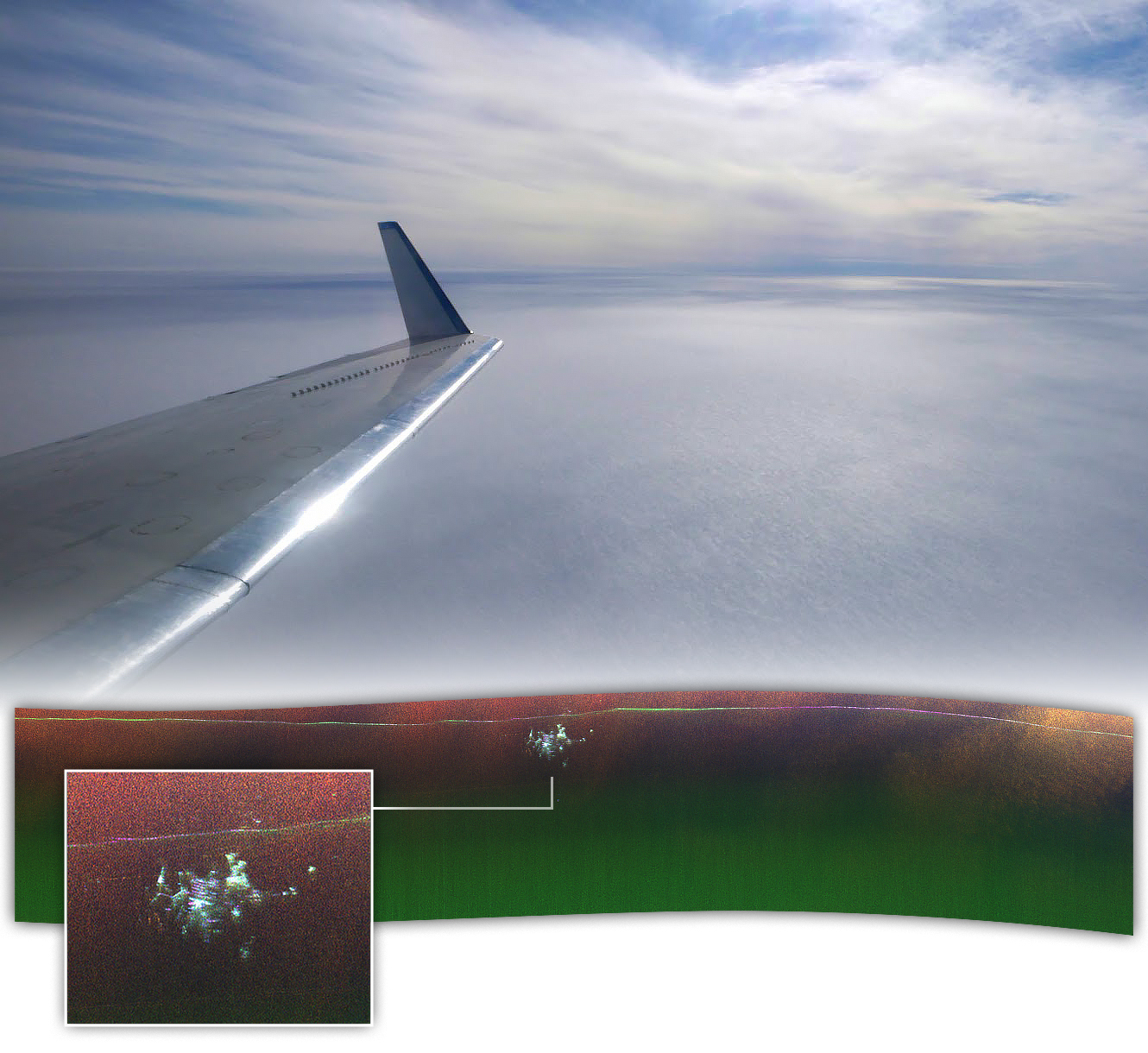
In April 2024, a NASA team flew a Gulfstream III aircraft over Greenland to test an advanced radar instrument called UAVSAR. The researchers were interested in the ice sheet’s internal structure and the boundary between ice and bedrock. Near the site of Camp Century, the radar revealed an unexpected arrangement of returns. Scientists subsequently recognized the buried installation.
Earlier airborne radar had already detected evidence of the base, generally in two-dimensional slices. The newer system observed the ice from different viewing angles and yielded a more revealing view of individual structures. When researchers compared the radar pattern with historical plans, some parallel features aligned with the old tunnels. According to NASA’s November 2024 account, the surviving structures were then at least 30 metres below the surface.
It would be tempting to describe the image as a perfect underground photograph. It is not. Radar is an instrument that measures reflections, and its geometry requires careful interpretation. In the published visualization, a distant return from the ice-bed interface can even appear positioned above the camp. The image is powerful precisely because it reveals something real while reminding us that scientific seeing is not the same as ordinary sight.
The Future Beneath the Past
Camp Century is more than a strange relic. It connects three histories that are often told separately: the Cold War, the scientific exploration of polar ice and the environmental consequences of decisions made under assumptions that later generations may not share. A military project imagined the glacier as protection. Researchers now study the same glacier as a changing system. Between those two ideas lies the uncomfortable question of who remains responsible for what was left behind.
There is no need to invent ghosts in these tunnels. The haunting is historical. People once carved a temporary city into a moving landscape, built their plans around the belief that the white roof would last, and walked away. Modern instruments can now trace their forgotten geometry. What they cannot do is settle, by imagery alone, the political and environmental obligations that survive beneath it.
The Greenland ice sheet has not surrendered Camp Century. It has merely reminded us that buried things are not necessarily finished stories.
Evidence, Image Rights & Further Reading
- NASA Earth Observatory, “New View of the ‘City Under the Ice’” (25 November 2024) — radar flight, image interpretation, historical depth and image credit.
- Colgan et al., “The abandoned ice sheet base at Camp Century, Greenland, in a warming climate,” Geophysical Research Letters (2016) — historical context, abandoned waste and conditional climate modelling.
- Smithsonian Magazine, “NASA Radar Detects Abandoned Site of Secret Cold War Project in Greenland” (2 December 2024) — historical context and the 2024 radar findings.
- NASA Images and Media Usage Guidelines — NASA imagery is generally available for factual editorial use with credit; no NASA endorsement is implied.
Editorial note: This is a historical and scientific feature, not a report of a newly discovered city in 2026. The photograph and radar composite document an actual 2024 scientific flight. Claims about future waste exposure are scenarios, not observed current events.
Further reading: The Svalbard Seed Vault · Project A119.




[…] reading: Camp Century beneath the ice · The Carroll A. Deering […]
[…] reading: Camp Century beneath the ice · The Carrington […]