
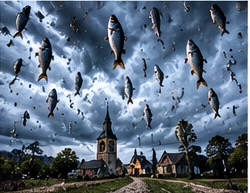

A literary retelling of a reported event or enduring legend. Atmospheric scenes are reconstructed, not eyewitness transcripts.
The afternoon sky over Bath County, Kentucky, is bright and apparently empty. People are working outdoors when small pieces of strange material begin to fall. There is no rain cloud overhead and no obvious source. The ground, moments earlier ordinary, becomes the scene of a question nobody expected to ask.
The story reached newspapers in an age when an unusual report could travel far faster than any scientific investigation. Some readers imagined a biblical omen; others searched for an animal source. The fragments were examined and discussed, but nineteenth-century descriptions of tissue were not always consistent or conclusive. The incident gathered explanations almost as quickly as it gathered attention.
A bird-based explanation has a grim practicality. Vultures may disgorge the contents of their stomachs when startled, and a group in flight could scatter material over a wide area. That possibility is not as theatrical as flesh appearing from nowhere, but it has the advantage of relying on known animal behaviour. Without an intact chain of evidence from the original samples, certainty remains difficult.
The strange shower lasted only a short time, yet the image seems to resist fading. There is something almost dreamlike about a sunny day interrupted by material that belongs neither to weather nor to the expected landscape. It reminds us that nature can produce scenes that sound invented even when a historical report lies behind them.
The event was reported in 1876 and later became known as the Kentucky Meat Shower. Witnesses described flesh-like fragments scattered across the area. Newspapers carried the account, and attempts were made to identify the material.
Imagine the first person bending to inspect a fragment. Others gather, each offering a different explanation. Someone looks towards the trees; another searches the open sky. A sample is collected and carried away, as though the mystery might be solved by putting a piece of it beneath a lens.
Accounts of the tissue examination varied, and sensational claims about human remains are not settled findings. One proposed natural explanation involves vultures regurgitating material in flight, a behaviour that can occur when the birds are disturbed.
The case is strange enough without an invented curse. It reveals how a brief natural event can become nearly impossible to reconstruct once the witnesses have gone and the samples are scattered.
More than a century later, the image remains vivid: a clear sky, a quiet field and an unexpected shower that turned an ordinary day into a story told around the world.
Further reading: The Dancing Plague of 1518 · The Great Emu War.



