
Wave or Particle? The Experiment That Split Reality in Two
A tiny electron arrives at a screen as a single dot. Send thousands of electrons, one at a time, through a carefully arranged pair of slits, and the dots build a…
DARK PAGE / THE UNSEEN / QUANTUM MYSTERIES
WAVE OR PARTICLE?
The Question That Split Reality in Two
What if the world is neither the solid place we imagine nor the ocean of waves we picture—but something our language has never learned to name?
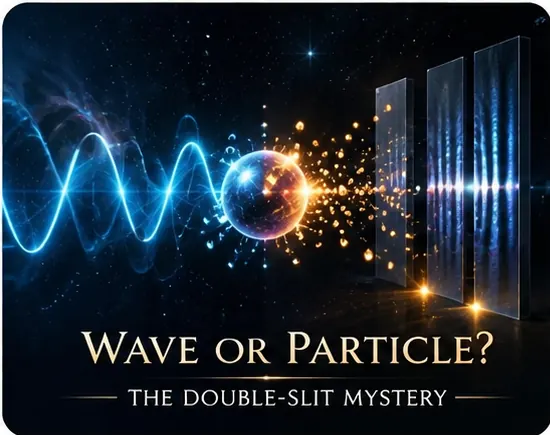
One electron. Two slits. One dot on the screen. And a pattern no ordinary particle should draw.
01 / THE QUESTION
What Is It That We Are Actually Seeing?
A tiny electron arrives at a screen as a single dot. Send thousands of electrons, one at a time, through a carefully arranged pair of slits, and the dots build a pattern that looks like waves interfering. Each detection is localized; the distribution of detections is not. How can nature speak two languages in one experiment?
The answer is not that an electron secretly changes from a little marble into a water wave whenever someone looks. Quantum objects are described by quantum states that yield wave-like interference and particle-like detection events. Neither everyday metaphor tells the whole story.
02 / TWO OPENINGS INTO THE UNKNOWN
The Double-Slit Experiment
Picture a source, a barrier with two narrow openings, and a detecting screen. With both slits open and no usable information about which slit the particle took, repeated detections can accumulate into bright and dark interference fringes—even when particles are sent individually. The probability amplitudes associated with the two alternatives combine.
If the experimental setup makes reliable which-path information available, interference is reduced or lost. The crucial change is physical interaction and entanglement with a detector or environment—not a human mind staring at the apparatus. A detector can register a path even when no one reads its data.
03 / A CENTURIES-OLD ARGUMENT
Newton, Huygens and Einstein
Isaac Newton advocated a corpuscular account of light. Christiaan Huygens developed a wave theory; later interference experiments made the wave picture compelling. In 1905, Albert Einstein explained the photoelectric effect using quantized packets of light energy. Today we call them photons.
Photons have zero rest mass, whereas electrons have nonzero rest mass. Both can show interference and localized detection. A photon is not simply a classical particle with a little ripple attached, and an electron is not a tiny billiard ball following a hidden classical trajectory in every interpretation.
04 / THE PATH NO ONE CAN DRAW
Did the Electron Pass Through Both Slits?
In standard quantum mechanics, an electron prepared for the double-slit experiment is represented by a state with contributions from both alternatives. That description predicts interference. Saying it literally travelled along two ordinary, simultaneously visible paths can be misleading: the theory does not assign the same classical trajectory to every unmeasured event.
The mathematical pattern is clear; the underlying picture is contested. Some interpretations do assign trajectories, while others resist asking for a definite path before measurement. What the experiment decisively establishes is the interference of quantum alternatives.
05 / THE ACT OF MEASUREMENT
Does Looking Create Reality?
The popular slogan says, ‘When we watch, the electron becomes a particle.’ But consciousness is not required. A measurement is a physical process in which a system becomes correlated with a device or its surroundings. Such correlations can destroy the phase coherence needed for interference, a phenomenon called decoherence.
A single detector click is definite in our experience. Why one particular result occurs—and whether wave-function collapse is a fundamental process or only a feature of a chosen description—is part of the measurement problem. The double-slit experiment does not show that the Moon disappears when nobody looks.
06 / MANY ANSWERS, ONE EXPERIMENT
Four Ways to Read the Mystery
Copenhagen-style approaches emphasize experimental contexts and the probabilities of measurement outcomes. Many-worlds interpretations describe an evolving universal quantum state with branching, decohered outcomes; they do not require a new universe to be manufactured by each human decision. Bohmian mechanics combines definite particle positions with a guiding wave, at the cost of nonlocal features.
Information-centered interpretations explore the role of knowledge, relations and probabilities, but the statement ‘the universe is made of information’ is not an experimentally established replacement for physics. These interpretations generally agree on standard laboratory predictions; separating them experimentally is difficult and remains an active topic.
07 / THE UNASKED QUESTION
What Happens If We Erase the Clue?
Quantum-eraser experiments deepen the puzzle. If a setup makes path information distinguishable, interference is lost; suitable measurements and postselection can reveal interference in correlations between subsets of results. But no message is sent backward in time, and an observer cannot choose today to rewrite an already recorded past.
The lesson is stranger and more precise than magic: what can interfere depends on which quantum alternatives remain indistinguishable in the relevant measurement statistics.
08 / FROM ATOMS TO PEOPLE
Are You a Wave When Nobody Watches?
Every atom in your body obeys quantum mechanics. Yet a person is not an isolated electron. Constant interactions with air, light, warmth and surrounding matter rapidly suppress observable interference between dramatically different everyday states. That is why tables, faces and human bodies behave so reliably in classical ways.
To say ‘I am a wave of possibility’ can be beautiful poetry. To claim that an unobserved human literally spreads through a room like a single electron in a double-slit apparatus would go beyond what the experiment establishes. Wonder is richer when metaphor and measurement are allowed to remain distinct.
THE LABORATORY IN YOUR MIND
Five Questions That Refuse to Stay Still
QUESTION 1
If an electron leaves a dot, where was its wave?
QUESTION 2
If a detector records a path but nobody reads it, what exactly has changed?
QUESTION 3
Can an experiment answer a question we did not know how to ask?
QUESTION 4
Is a quantum state a description of reality, or of what we can predict about reality?
QUESTION 5
When you look at yourself, do you discover who you are—or change what you become?
When No One Is Watching
The universe does not need our eyes to exist. Yet the way we ask questions of it changes which features can become visible. We do not force an electron to feel embarrassed. We choose an arrangement in which different possibilities either interfere or leave distinguishable traces.
Perhaps the deepest shock is not that nature is two things at once. Perhaps it is that nature refuses to be reduced to the two things our imagination already understands.
When you look into the quantum world, are you seeing what is there—or learning what a question allows you to see?
Scientific Context & Further Reading
Single-particle interference is experimentally established. Conscious observation is not required for decoherence. Interpretations of measurement remain debated; claims about human consciousness creating physical reality are not established by double-slit experiments.
Nobel Prize in Physics 2022 — Entangled Photons · Stanford Encyclopedia of Philosophy — Quantum Mechanics · Stanford Encyclopedia — Decoherence



