
Schrödinger’s Cat — Alive and Dead? The Box That Challenged Reality
The cat was never meant to settle the mystery. It was meant to make the mystery impossible to ignore.…
DARK PAGE / THE UNSEEN / QUANTUM MYSTERIES
SCHRÖDINGER’S CAT
Alive and Dead? The Box That Challenged Reality
A sealed box. A quantum event. A cat that became the most famous question in physics.
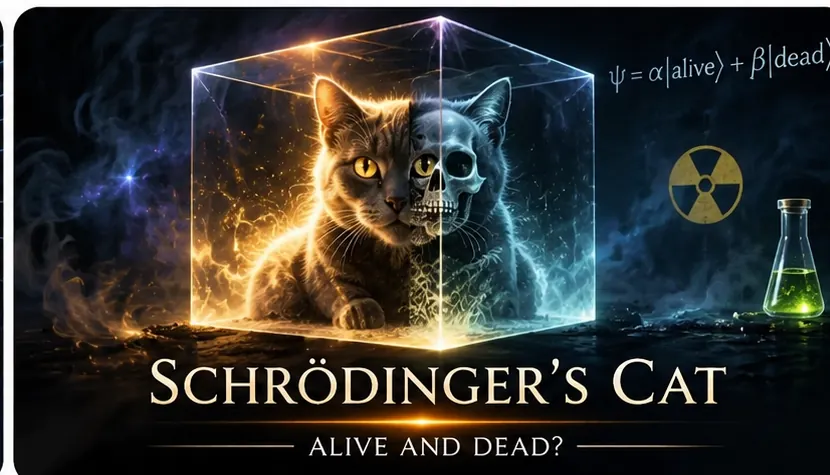
The cat was never meant to settle the mystery. It was meant to make the mystery impossible to ignore.
01 / THE CAT THAT NEVER ENTERED A LABORATORY
Alive, Dead—or a Question About Measurement?
Imagine a sealed box containing a cat, a radioactive atom, a detector and a mechanism that releases poison if a decay is detected. The atom has a certain probability of decaying during a specified interval. Quantum theory can describe the undecayed and decayed possibilities in a superposition.
If we apply the quantum description to the entire isolated apparatus, the state can include branches correlated with a living cat and a dead cat. That is the disturbing point of Schrödinger’s thought experiment—not a claim that anyone actually performed this experiment on a cat, nor proof that real cats literally inhabit two observable conditions at once.
02 / INSIDE THE SEALED BOX
How the Thought Experiment Works
The apparatus is imagined to be closed and isolated. If the radioactive atom decays, a detector triggers a mechanism; if it does not, the mechanism remains inactive. Quantum mechanics describes the atom’s possible outcomes using amplitudes rather than a classical coin with a predetermined face.
When the atom, detector and cat interact, their states become correlated. Treating the whole system as quantum-mechanical leads to the puzzle: why do we experience one definite outcome? Opening the lid reveals a result, but it does not establish that a human gaze created the result.
03 / THE MICROSCOPIC AND THE EVERYDAY
Where Does Quantum Strangeness End?
Electrons, photons and atoms can exhibit interference and superposition. Experiments have also demonstrated quantum interference in increasingly complex molecules and superposition-like behavior in engineered mesoscopic systems. There is no universally accepted size threshold at which quantum laws simply stop applying.
The difference is that large, warm systems interact with their surroundings extremely rapidly. These interactions make interference between macroscopically distinct alternatives extraordinarily hard to observe. A cat is not a magically exempt object; it is an immensely complicated quantum system in an environment.
04 / THE OBSERVER PROBLEM
Does Someone Have to Look?
The word ‘observer’ has encouraged a persistent misunderstanding: that consciousness is required to make quantum events real. In ordinary experiments, a detector can record an outcome without a person present. Interaction with the environment can suppress observable interference through decoherence.
Decoherence helps explain why the classical world appears stable and why different macroscopic alternatives cease to interfere. It does not, by itself, settle every version of the measurement problem—especially why a particular outcome is experienced rather than another. No established experiment shows that a human mind must collapse a wave function.
05 / WIGNER’S FRIEND
Who Observes the Observer?
In another famous thought experiment, a scientist inside a laboratory performs a quantum measurement while an outside observer treats the entire laboratory as a quantum system. Different descriptions appear to assign different kinds of states to the same event.
The scenario raises questions about the consistency of observers’ accounts and the meaning of measurement. Modern Wigner’s-friend-inspired proposals have deepened the discussion, but they do not demonstrate that people literally become both conscious of opposite outcomes in everyday life.
06 / THREE WAYS TO READ THE CAT
Collapse, Many Worlds and Hidden Variables
Collapse-based interpretations treat measurement as yielding one outcome, though approaches differ on what exactly counts as collapse. Many-worlds interpretations retain a universally evolving quantum state, with decohered branches corresponding to different outcomes. Bohmian mechanics assigns definite particle configurations guided by a quantum wave.
These approaches can reproduce much of the same experimental evidence while offering different accounts of what the mathematics means. The cat is famous because it exposes an interpretive problem—not because scientists have experimentally proved one particular interpretation correct.
07 / WHAT SCHRÖDINGER INTENDED
A Warning, Not a Celebration
Erwin Schrödinger introduced the cat scenario in 1935 while examining the conceptual difficulties of applying quantum superposition to macroscopic objects. He helped build quantum mechanics and questioned aspects of how its measurement rules were understood.
His cat was meant to make a problem impossible to ignore. It was not a prediction that a household pet could be found literally half-alive and half-dead, and the success of quantum mechanics does not mean every provocative reading of the cat has been confirmed.
08 / THE BOX WE CARRY
Where Physics Ends and Metaphor Begins
We all know what it means to feel caught between possible futures: courage and hesitation, departure and return, hope and fear. The unopened box can be a powerful metaphor for choices we have not made and lives we have not yet attempted.
But a person deciding to change their life is not performing a quantum measurement on their own identity. The metaphor belongs to literature and philosophy; the scientific experiment belongs to the study of quantum states and measurements. Each can illuminate the other without being confused for proof.
09 / THE LAST QUESTION
What Happens When the Box Opens?
The cat asks a deceptively simple question: how does a world described by quantum possibilities become the world of definite experiences? Decoherence explains part of the transition, but interpretations disagree about what, if anything, more is required.
Perhaps the most enduring lesson is not that reality waits for our eyes. It is that the universe is more subtle than the categories—alive or dead, wave or particle, possibility or fact—with which we try to contain it. And the question remains: what exactly changes when an outcome becomes known?
QUESTIONS FROM INSIDE THE BOX
Six Questions That Remain Open
QUESTION 1
Does an observer need to be conscious to measure anything?
QUESTION 2
If a quantum state describes many outcomes, why do we experience one?
QUESTION 3
Is decoherence the answer—or only part of it?
QUESTION 4
Where does the quantum description of an apparatus end?
QUESTION 5
Can two observers describe the same measurement differently?
QUESTION 6
What do we really mean when we call an outcome ‘real’?
The Box Within Us
Sometimes the closed box is a metaphor for a life postponed. We wait for permission to begin, for a stranger to tell us who we are, for certainty to arrive before we act. Schrödinger’s cat cannot tell us how to live. But the image reminds us that unanswered questions can be worth opening.
Is the box closed because reality is uncertain—or because we are afraid to discover what is inside?
Scientific Notes & Further Reading
Schrödinger’s cat is a thought experiment, not a real experiment involving a cat. Conscious observation is not established as necessary for quantum measurement. Decoherence explains the suppression of interference but does not resolve all interpretive questions.
Stanford Encyclopedia — Quantum Mechanics · Stanford Encyclopedia — Decoherence · Stanford Encyclopedia — Many-Worlds Interpretation



