
The Arrow of Time — Is Time’s Flow an Illusion or Reality?
An egg falls and breaks. Tea cools. A child grows old. We remember yesterday but not tomorrow. In everyday life, time seems to possess an arrow that points only one…
DARK PAGE / THE UNSEEN / COSMIC PARADOXES
THE ARROW OF TIME
Is Time’s Flow an Illusion—or Reality?
An egg breaks. A memory forms. A universe expands. Why does tomorrow never arrive before yesterday?
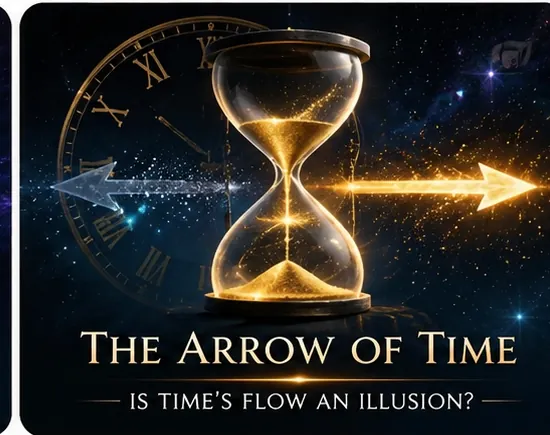
The mathematics often permits a journey in either direction. Life remembers only one.
01 / THE ONE-WAY RIVER
The Question That Time Refuses to Answer
An egg falls and breaks. Tea cools. A child grows old. We remember yesterday but not tomorrow. In everyday life, time seems to possess an arrow that points only one way. Yet many of the equations that describe microscopic motion work almost equally well when the direction of time is reversed.
How can a world governed largely by time-symmetric rules produce a life in which yesterday never returns? This is the arrow-of-time problem: not simply whether clocks tick, but why physical processes so overwhelmingly distinguish past from future.
02 / THE BROKEN EGG
Why the Pieces Do Not Fly Back
Imagine filming an egg breaking on a kitchen floor, then running the film backward. The reverse sequence looks absurd: shell fragments gather, yolk rises and the egg becomes whole. Yet for idealized microscopic dynamics, an extraordinarily precise reversal of all relevant motions could retrace the evolution.
The obstacle is statistical, not a blanket prohibition on reverse motion. There are vastly more microscopic arrangements compatible with a dispersed egg than with a neatly intact one. The spontaneous reconstruction of an ordinary broken egg is so fantastically improbable that we never expect to see it.
03 / THE MEANING OF ENTROPY
More Than a Measure of Disorder
Entropy is often called ‘disorder,’ but the word can mislead. In statistical mechanics, entropy is related to how many microscopic configurations are compatible with a system’s macroscopic description. In thermodynamics, it also governs the direction of spontaneous heat flow and the limits of useful work.
For an isolated system, total entropy does not decrease in ordinary macroscopic processes; the second law is statistical in its microscopic foundations. Local order can increase—living organisms grow, crystals form, stars assemble—while the entropy of the wider system rises. The arrow is not a rule that everything must always look messier.
04 / THE EQUATIONS WITHOUT AN ARROW
Newton, Einstein and a Subtle Exception
Much of classical mechanics and electromagnetism permits time-reversed solutions under appropriate reversals of motion and fields. Einstein’s relativity also treats time as part of spacetime, but that does not mean people can freely travel backward along it or that all histories are physically accessible.
There is an important qualification: some weak-interaction processes violate time-reversal symmetry, as demonstrated in particle physics. Therefore the statement ‘every fundamental law is time-symmetric’ is false. Still, these microscopic violations do not by themselves explain the vast thermodynamic arrow we experience.
05 / THREE ARROWS
Heat, Memory and the Expanding Cosmos
The thermodynamic arrow describes the typical increase of entropy toward what we call the future. The psychological arrow describes our memories and records of the past rather than the future. Making and maintaining records involves physical processes that take place in a thermodynamic world.
The cosmological arrow points to the universe’s observed expansion. Expansion and entropy increase are related through cosmic history, but they are not identical: a contracting universe would not automatically make broken eggs reassemble or memories run backward. The exact relation between cosmology and the arrow of time remains an open question.
06 / THE DEEPEST BEGINNING
Why Was the Early Universe So Special?
The early universe was hot, dense and remarkably smooth on large scales. A hot gas might sound high-entropy, but gravity changes the story: a nearly uniform distribution of matter can have very low gravitational entropy compared with a clumpy universe containing black holes.
The ‘Past Hypothesis’ is the idea that the universe began in an exceptionally low-entropy macrostate. If that boundary condition is accepted, entropy increase becomes understandable statistically. But why the universe had such a special beginning is one of the deepest unresolved problems in cosmology.
07 / COULD TIME RUN BACKWARD?
The Difference Between an Equation and a World
A reversed movie is not a realistic blueprint for making a human grow younger. Reversing a macroscopic process would require extraordinarily fine control of the environment and the microscopic degrees of freedom involved. Tiny disturbances quickly ruin the reversal.
Some physical theories admit time-reversed solutions; this does not establish that our universe can reverse its history, that memories can be sent into yesterday, or that the future is already written. These are distinct questions about dynamics, boundary conditions and the philosophy of time.
08 / IS THE PRESENT SPECIAL?
The Block Universe and the Feeling of Flow
Relativity challenges the idea of one universal present shared by all observers. This motivates philosophical pictures such as the ‘block universe,’ in which events are understood as parts of a four-dimensional spacetime. Other approaches interpret becoming and the passage of time differently.
No experiment has established that the feeling of time flowing is merely an illusion, nor does the mathematics of relativity alone settle whether the future is fixed. The distinction between physical descriptions and lived experience remains an active philosophical debate.
09 / THE LAST MOMENT
What Makes a Moment Precious?
The universe may obey equations that do not privilege the direction we feel. Yet the record of a childhood, the cooling of a cup of tea, and the light from a distant star are all part of an asymmetric history. We live among traces left by what has happened, not postcards delivered from what has yet to occur.
Perhaps time’s deepest mystery is not that it carries us toward the future. It is that the cosmos began in a condition that made a future distinguishable from a past at all. If the laws allow so many possibilities, why did our universe choose a history with memories?
THE QUESTIONS TIME LEAVES BEHIND
Six Questions for the Future
QUESTION 1
If the equations can be reversed, why can’t the shattered glass?
QUESTION 2
Is entropy a property of nature, or of how we describe it?
QUESTION 3
Why do we remember the past and anticipate the future?
QUESTION 4
Would a shrinking universe reverse the direction of time?
QUESTION 5
Was the Big Bang an extraordinarily special beginning?
QUESTION 6
Does relativity describe a fixed future—or only the geometry of events?
Are You Moving Through Time?
Perhaps the image of time as a river tells us more about human life than about the structure of the universe. Our memories make a shore behind us; our hopes illuminate a horizon ahead. The physics is more precise than the metaphor, but the metaphor reminds us why the question matters.
Is time carrying you forward—or is the story of your life how the universe learns the difference between before and after?
Scientific Notes & Further Reading
The second law is statistical; entropy is not simply ‘mess.’ Time-reversal symmetry has known exceptions in weak interactions. Cosmic expansion does not automatically determine the thermodynamic arrow. Whether time literally ‘flows’ remains debated.
Stanford Encyclopedia — Thermodynamic Asymmetry in Time · Stanford Encyclopedia — Time · Stanford Encyclopedia — Being and Becoming in Modern Physics



