

A literary retelling of a reported event or enduring legend. Atmospheric scenes are reconstructed, not eyewitness transcripts.
Suppose there were a screen on which yesterday could be watched. Not a recording made by a camera, but the past itself: a lost city, an ancient conversation, a face no living person has seen. The temptation would be almost impossible to resist.
The Chronovisor legend acquired its force from the authority surrounding its supposed inventor. Ernetti was a Benedictine priest with interests in music and ancient traditions. In later accounts, the device seemed to promise not merely a view of forgotten history but a way to settle questions that had troubled humanity for centuries. If the past could be watched, the storyteller suggests, debate might become unnecessary.
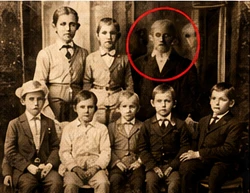
But a machine that can display events from centuries ago would require extraordinary evidence: working apparatus, reproducible tests and independent observers able to verify the results. The story offers none of these. A purported image associated with the legend has been challenged, and the technical descriptions never matured into a demonstrable invention.
Still, the emotional logic of the tale is easy to understand. Think of the lost performance no one recorded, the voice of an ancestor whose words survive only in a letter, or the final hour of a vanished civilisation. The Chronovisor promises to return them all. Its power lies in that promise, not in an established technology.
Father Pellegrino Ernetti became associated with stories of a machine called the Chronovisor. The device was said to capture traces of earlier events and display them to an observer. In the most dramatic versions, it revealed scenes from antiquity and sacred history.
Picture a dark room filled with instruments. A viewer leans towards the screen, waiting for an image to sharpen. The noise settles, shapes appear, and a vanished century seems to enter the present. Such scenes belong to the legend, not to a verified demonstration.
No independently tested working device or credible technical record has established the Chronovisor’s existence. Claims that authorities confiscated it and hid it away remain part of the story rather than documented fact.
Yet the legend persists because it speaks to a profound desire. Historians want to see what records omit. Families want one more glimpse of the people they have lost. The machine promises to make memory visible and to turn uncertainty into an image.
The Chronovisor is most haunting as an idea: somewhere, perhaps, time has kept a copy of everything. The tale offers no proof, only the beautiful and unsettling possibility that the past has never truly gone silent.
Further reading: The Versailles Time Slip · The Voynich Manuscript.



