

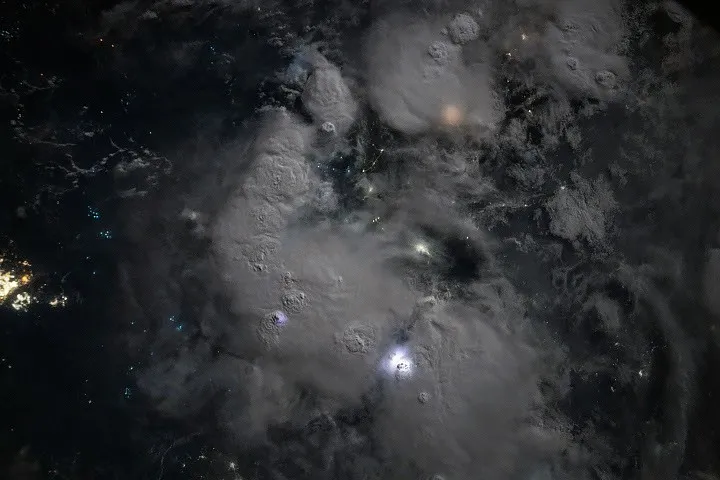
From the ground, lightning appears beneath a cloud. From orbit, the cloud itself can seem to light up.
An International Space Station photograph taken on 28 October 2026 shows storms over the South China Sea, along with surrounding city and marine lights. NASA featured it on 17 November. Lightning illuminates parts of the cloud tops, including towering structures associated with powerful updrafts.
The image records several kinds of light in one view. NASA identifies some offshore clusters as likely fishing boats and other scattered points as likely gas flares. Those interpretations should retain their uncertainty.
The photograph’s power lies in the changed viewpoint. Familiar weather becomes a system spread across a large region. What do we miss when every storm is seen only from below? Orbit supplies a different view, while explaining each bright point still requires context and supporting observations.
Source: NASA report and supporting research. Event and release dates are distinguished above.
Explore Dark News · Related: How a 3D map reveals individual trees



