
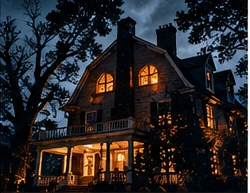

A Dark Page narrative inspired by a historical account or enduring legend. The scenes are literary reconstructions, not eyewitness transcripts.
The house stood on a quiet Long Island street, its windows reflecting the winter light. A new family could have seen a place to begin again: rooms to furnish, a kitchen to fill with voices, a door that could finally be closed against the outside world. Yet this address carried a history that no fresh coat of paint could conceal.
In 1974, six members of the DeFeo family were murdered there. That tragedy was real, and its gravity should never be lost beneath the later legend. The following year George and Kathy Lutz moved into the property with their children. They would later say that the house became unbearable and that they left after twenty-eight days.
In the story told afterwards, familiar spaces changed their character. A hallway seemed colder than it should. A noise arrived from an empty room. Night after night, the family came to expect another disturbance, and expectation itself became a source of dread. In such a place, a staircase is no longer simply a staircase: it is the route towards the sound everyone wishes they had not heard.
The children needed reassurance. The adults needed sleep. Every ordinary problem—an unfamiliar house settling, a door moving, an unexpected smell—could be interpreted through the knowledge of what had happened before. The longer the family stayed, the more the building’s history seemed to occupy the present.
After their departure, the account escaped the house. It became a book, then a film, then a symbol recognised around the world. The image of the windows became a shorthand for haunted domestic life. Critics disputed the supernatural claims and questioned details of the story; supporters continued to find the family’s account compelling.
The darkest truth about Amityville is the documented loss of six lives. The haunting belongs to a contested narrative built around that history. As a story, however, it asks a question that reaches beyond ghosts: can a home ever feel entirely new when everyone who enters already knows the terrible thing that happened there?
Further reading: The Enfield Poltergeist · The Hollywood Roosevelt Hotel.



