

Birth Stories — Part Nineteen | Everything Has a Beginning. Every Beginning Has a Story.
Before the first tree, before the first animal, before the first cell capable of seeing light, there was a question waiting in the chemistry of a young planet: could matter become something that made more of itself? Life’s beginning is the most intimate mystery in natural history. Every heartbeat, forest, bacterium and whale belongs to its consequences. Yet science cannot point to a particular ocean, day, or molecule and say with certainty: here life began.
A Planet That Had to Become Habitable
The universe is about 13.8 billion years old. Our solar system formed roughly 4.6 billion years ago, and Earth about 4.54 billion years ago. The early planet was shaped by impacts, volcanism, changing atmospheres and the gradual development of oceans. Its history was not simply an uninterrupted rainstorm lasting millions of years; the timing and sources of Earth’s water remain active subjects of research. Ancient zircon crystals suggest liquid water may have existed remarkably early, even while conditions were often violent.
For life to emerge, chemistry needed ingredients, energy, environments that could concentrate molecules, and ways for complex structures to persist. Water is a powerful solvent, but the mere presence of water does not guarantee life. The oldest convincing traces of life are billions of years old, with widely discussed evidence around 3.5 billion years and older proposed signatures that remain disputed. We do not know exactly when the first living systems appeared.
What Counts as Life?
A flame consumes fuel, grows and spreads, yet we do not call it an organism. A virus carries genetic information and evolves, but depends on host cells to reproduce. Most familiar life uses cellular organization, metabolism, heredity and evolution, although no single definition resolves every borderline case. The origin-of-life problem is therefore partly a problem of transitions: how could nonliving chemistry develop increasingly reliable boundaries, energy use, information storage and reproduction?
The earliest living systems need not have looked like modern bacteria. They may have been simpler, perhaps composed of interacting molecules and membrane-like compartments before the sophisticated machinery of today’s cells existed. Scientists use the term abiogenesis for the natural emergence of life from nonliving chemistry. It is a research field, not a completed account of a witnessed event.
LUCA Was Not the First Living Thing
All known cellular life shares fundamental features: genetic information, a broadly common genetic code, ribosomes and related molecular machinery. These connections point toward shared ancestry. Researchers call the most recent common ancestor of all living cellular lineages LUCA, the Last Universal Common Ancestor. LUCA was not necessarily the first organism, nor necessarily a single isolated cell. Earlier lineages could have existed and left no surviving descendants.
The tree of life is also more intricate than a neat family tree. Microbes exchange genes across lineages, and ancient symbioses transformed the ancestry of complex cells. Humans and chimpanzees share a very recent evolutionary ancestor compared with the ancestor shared by humans and bacteria. Popular percentages comparing human DNA with a cat’s or banana’s are often misleading because the answer depends on which genes, sequences and methods are compared. Shared molecular systems are stronger evidence of kinship than a sensational single percentage.
Could Life Have Begun at the Seafloor?
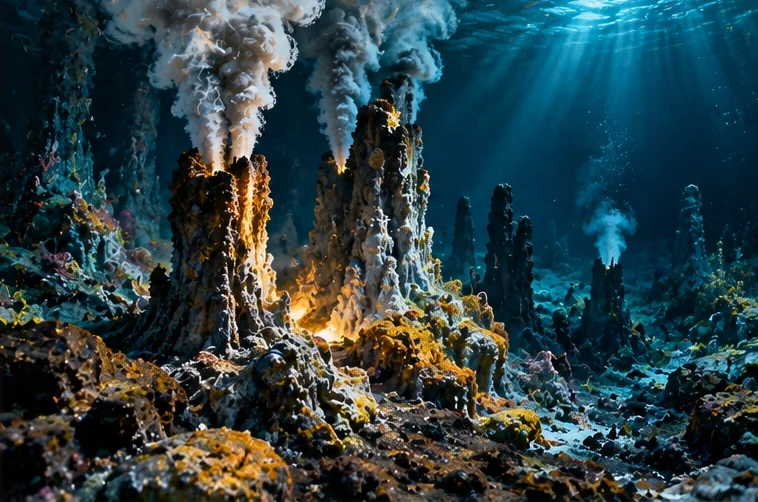
One prominent hypothesis locates important early steps near hydrothermal vents, where water and rock interact, producing chemical gradients and energy-rich compounds. Alkaline vents, in particular, may have offered mineral compartments and naturally occurring differences in acidity that could help drive chemistry. Such settings are attractive because they combine energy, catalysts and protected spaces. But researchers have not demonstrated that a vent produced the first living cell.
Other proposals involve shallow pools that repeatedly wet and dry, volcanic environments, mineral surfaces, icy settings, or combinations of habitats. Wet–dry cycles can help link certain building blocks into larger molecules; minerals may catalyze reactions; ultraviolet light can drive some chemical pathways while destroying others. There may never have been one exclusive birthplace or one chemical trick. Several environments could have contributed to a long transition.
The Spark That Made Molecules, Not Life
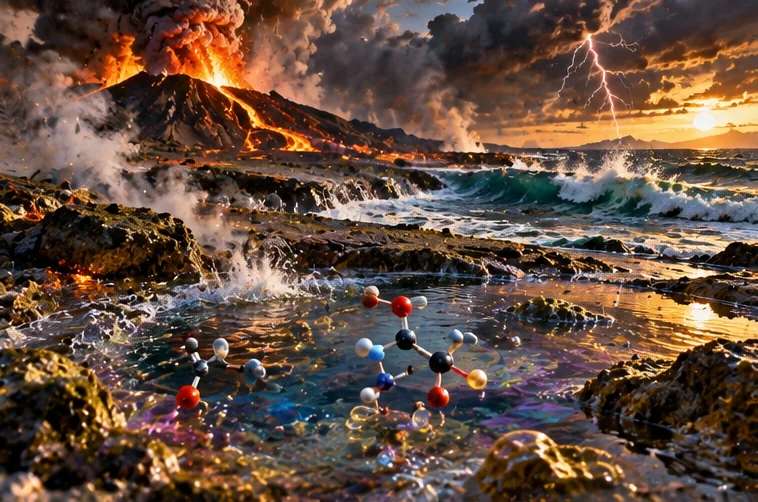
In 1953 Stanley Miller, working with Harold Urey, circulated gases and water through an apparatus exposed to electrical sparks. Amino acids and other organic compounds formed under the experimental conditions. The result was historic: some building blocks associated with biology could arise through nonbiological chemistry. It did not demonstrate that lightning created life, and the precise mixture of gases used was not a proven reconstruction of Earth’s early atmosphere.
Later research has explored many routes to organic molecules, including chemistry involving minerals, ultraviolet light, meteorites and hydrothermal systems. Organic compounds have also been found in extraterrestrial material. Their presence is fascinating, but amino acids are not themselves organisms. A bag of bricks is not a house; molecules must somehow acquire organization, continuity and heritable variation.
An RNA World—or Something Before It?
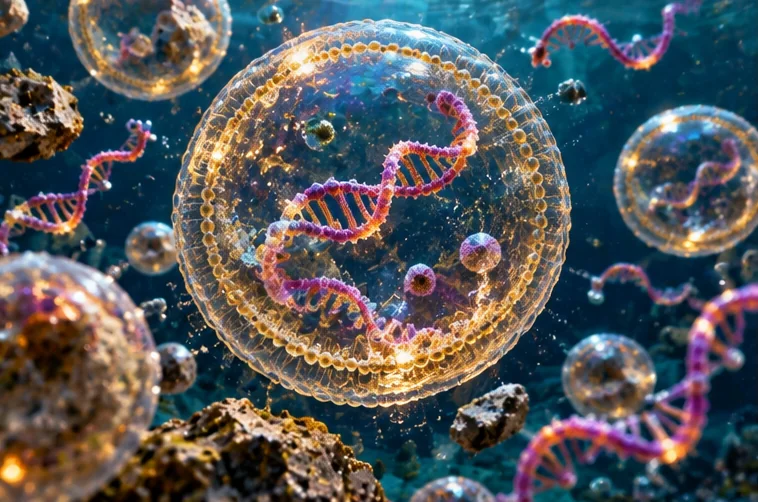
The RNA-world hypothesis proposes that RNA-like molecules once played both informational and catalytic roles before the familiar DNA–RNA–protein system became established. Some RNA molecules can catalyze reactions, lending plausibility to the idea. Yet researchers still face major questions about how early RNA or related polymers formed, survived and replicated under plausible conditions.
Other models emphasize self-sustaining networks of chemical reactions, early membranes, or coevolution between metabolism and genetic molecules. These are not necessarily mutually exclusive. The key breakthrough may have been a system that could produce imperfect copies, allowing differences to be inherited and selected. At that point, chemistry would begin acquiring a history of its own.
When Life Changed the Air
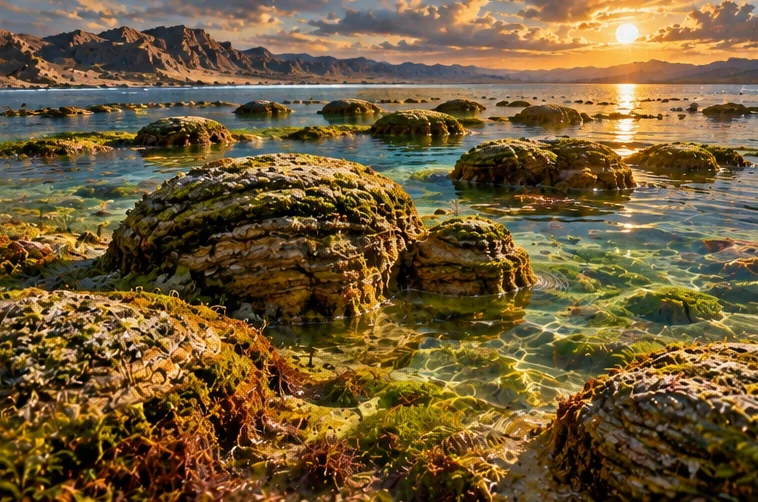
Early organisms lived in a world with very little free oxygen compared with today. Photosynthesis evolved in more than one form. Some microorganisms used light without releasing oxygen. Later, ancestors of cyanobacteria evolved oxygenic photosynthesis, which uses water and releases oxygen. Its origins likely preceded the Great Oxidation Event around 2.4 billion years ago, when oxygen began accumulating substantially in Earth’s atmosphere.
Oxygen transformed planetary chemistry and eventually supported high-energy metabolisms in many organisms. It was also hazardous to numerous anaerobic forms of life. The ozone layer developed through atmospheric processes involving oxygen, helping shield the surface from some harmful ultraviolet radiation. The atmosphere we breathe is therefore partly a biological achievement—made over immense periods, not by one sudden exhalation.
The Cell Within a Cell
Complex eukaryotic cells evolved through deep evolutionary changes, including endosymbiosis: an ancestral cell incorporated a bacterium that eventually became the mitochondrion. The photosynthetic chloroplasts of plants and many algae arose through another ancient symbiotic event involving cyanobacteria. These relationships reveal that evolution is not only competition. Cooperation and the merging of formerly independent organisms helped build new biological possibilities.
Multicellularity arose independently in several groups, and some multicellular organisms existed well before the first animals. The diversification of animal life during the Cambrian Period, beginning about 539 million years ago, was spectacular but did not produce every living species in twenty million years. Evolution continued through branching lineages, ecological interactions and mass extinctions. Vertebrates moved into terrestrial environments gradually; mammals already existed alongside dinosaurs; birds are the dinosaur lineage that survives today.
The Catastrophe That Did Not End Life
About 66 million years ago, an asteroid impact near the Yucatán Peninsula helped trigger a mass extinction that eliminated non-avian dinosaurs and many other organisms. Yet countless lineages survived. Mammals subsequently diversified into many ecological roles, and one branch of primates eventually produced our species, Homo sapiens, in Africa roughly 300,000 years ago.
If Earth’s 4.54-billion-year history were compressed into twenty-four hours, our species would appear only in the final several seconds, not at 11:58 p.m. We are extraordinarily recent participants in a story that had already been unfolding for almost the entire day. Evolution did not plan for us; it is a process in which inherited variation, selection, drift and other mechanisms shape populations across generations.
Evolution Is Not a Ladder
Charles Darwin’s On the Origin of Species, published in 1859, developed the theory of evolution by natural selection. Its central insight was not that organisms change because they consciously need to improve. Heritable variations arise, and some become more common because of their effects on survival or reproduction in particular environments. Chance, migration and genetic drift also matter.
A giraffe’s long neck did not arise because an individual stretched upward and passed its effort to its offspring. Human brains did not enlarge because evolution foresaw books or computers. Evolution has no fixed destination. Bacteria are not failed humans; they are among the planet’s most successful and adaptable organisms. The diversity of life is a branching bush, not a staircase with humanity on top.
Reading the Molecular Record
In 1953 James Watson and Francis Crick proposed the double-helical structure of DNA, drawing crucially on experimental evidence from Rosalind Franklin, Maurice Wilkins and others, as well as earlier discoveries. The achievement transformed genetics, but DNA’s role in heredity had a longer scientific history. The Human Genome Project announced a reference sequence in 2003; later advances filled important gaps, including a substantially complete human reference in 2022 and increasingly diverse genomic references.
Human genomes contain roughly three billion DNA base pairs in a single haploid set, but DNA is not a simple list determining every personality trait or illness. Genes interact with development and environment; many traits are influenced by numerous variants. Genetic tests can help study ancestry and some disease risks, yet they cannot predict every future outcome or reduce a person’s identity to a molecular code.
Life at the Edges of Possibility
Microorganisms inhabit hot springs, ice, deep rock and chemically extreme environments. Deep-sea ecosystems can be supported by chemical energy rather than sunlight. But not every extreme environment hosts every kind of organism, and reports of animals living at a given depth or temperature require species-specific evidence. The remarkable point is not that life ignores physical limits. It is that evolution has explored many different limits.
Beyond Earth, scientists investigate Mars, icy moons such as Europa and Enceladus, and planets orbiting distant stars. Evidence of past water, subsurface oceans or organic chemistry makes some locations scientifically compelling. None constitutes a confirmed discovery of extraterrestrial life. We still know only one world where life certainly exists.
Have Scientists Created Life?
In 2010 researchers associated with J. Craig Venter reported a bacterial cell controlled by a chemically synthesized genome. This was a major achievement in synthetic genomics, but it used an existing recipient cell and its cellular machinery. It was not the creation of a complete organism from nonliving chemicals. Researchers also construct protocells, synthetic biological systems and embryo models that help reveal developmental processes, but these achievements should not be confused with having solved abiogenesis.
The work raises genuine ethical questions about safety, governance, ownership, environmental release and the boundaries of research. Philosophical and religious perspectives may ask what it means to create life; science asks what mechanisms can be demonstrated. Those conversations need not be collapsed into a single answer.
One Living Planet, One Shared Responsibility
Life has survived enormous changes, but survival at the level of the biosphere does not protect every species, ecosystem or human community. Habitat destruction, pollution, climate change and overexploitation can erase lineages that took millions of years to evolve. Protecting biodiversity is not a promise that life itself can never disappear; it is a commitment to preserve the richness and resilience of the only living world we know.
Imagine a drop of water beneath a microscope. Cells move, exchange materials, divide and respond to their surroundings. Their chemistry belongs to a history older than mountains, forests or nations. The molecules in our bodies have passed through other organisms and environments; the oxygen we breathe is continually renewed through planetary cycles, not simply a breath stored unchanged for billions of years.
We cannot yet reconstruct the first living system. We cannot say whether life began only once on Earth, or whether other beginnings left no descendants. We do know that all known cellular life is connected through deep evolutionary history. The question of life’s birth remains open—and that openness is part of its wonder.
Everything has a beginning. Somewhere, long before memory, chemistry began to carry inheritance forward. Billions of years later, one of its descendants is asking how it happened.
Sources and Further Reading
- NASA Astrobiology
- Encyclopaedia Britannica — Origin of Life
- Encyclopaedia Britannica — Miller–Urey Experiment
- Encyclopaedia Britannica — Evolution
- National Human Genome Research Institute — Human Genome Project
- Nature — Origin of Life Research
- NASA — Solar System Exploration
Editorial note: Dates and models of life’s origin are uncertain. This essay distinguishes experimental results from hypotheses and does not claim that science has already recreated the first living organism.



