

Birth Stories — Part Seventeen | Everything Has a Beginning. Every Beginning Has a Story.
Long before a bird crossed the sky, before a wolf followed a scent through snow, before a child looked into the eyes of a dog, the oceans contained living things unlike anything we know from ordinary experience. They had no fur, feathers, or familiar faces. Yet within their descendants lay the possibilities of jaws and wings, shells and skeletons, senses and societies.
The birth of animals was not the instant when life first moved. Microorganisms had been moving and feeding long before animals existed. Nor did animals appear on a planet populated only by plants: the microbial world came first, and the history of true plants unfolded along its own evolutionary branches. Animals emerged from ancient eukaryotic ancestors and developed an extraordinary variety of ways to sense, consume, and respond to the world.
We are part of that story. Humanity is not standing outside the animal kingdom, watching it. We are one of its branches.
What Makes an Animal?
Animals are multicellular eukaryotes that generally obtain energy by consuming organic matter. Their cells lack the rigid cell walls characteristic of plants, and their development involves distinctive patterns of cell organization and communication. Many animals move at some stage of life, but movement is not the defining test. Adult sponges remain attached to surfaces. Corals build colonies. Some animals spend most of their lives in one place.
Sponges are especially revealing. They have no brain or conventional nervous system, yet they coordinate cellular activity and filter particles from water. They demonstrate that an animal need not possess a face, a heart, or a pair of legs. Scientists continue to debate some of the deepest branches of the animal family tree, including the relative positions of sponges and comb jellies.
The First Animal Worlds
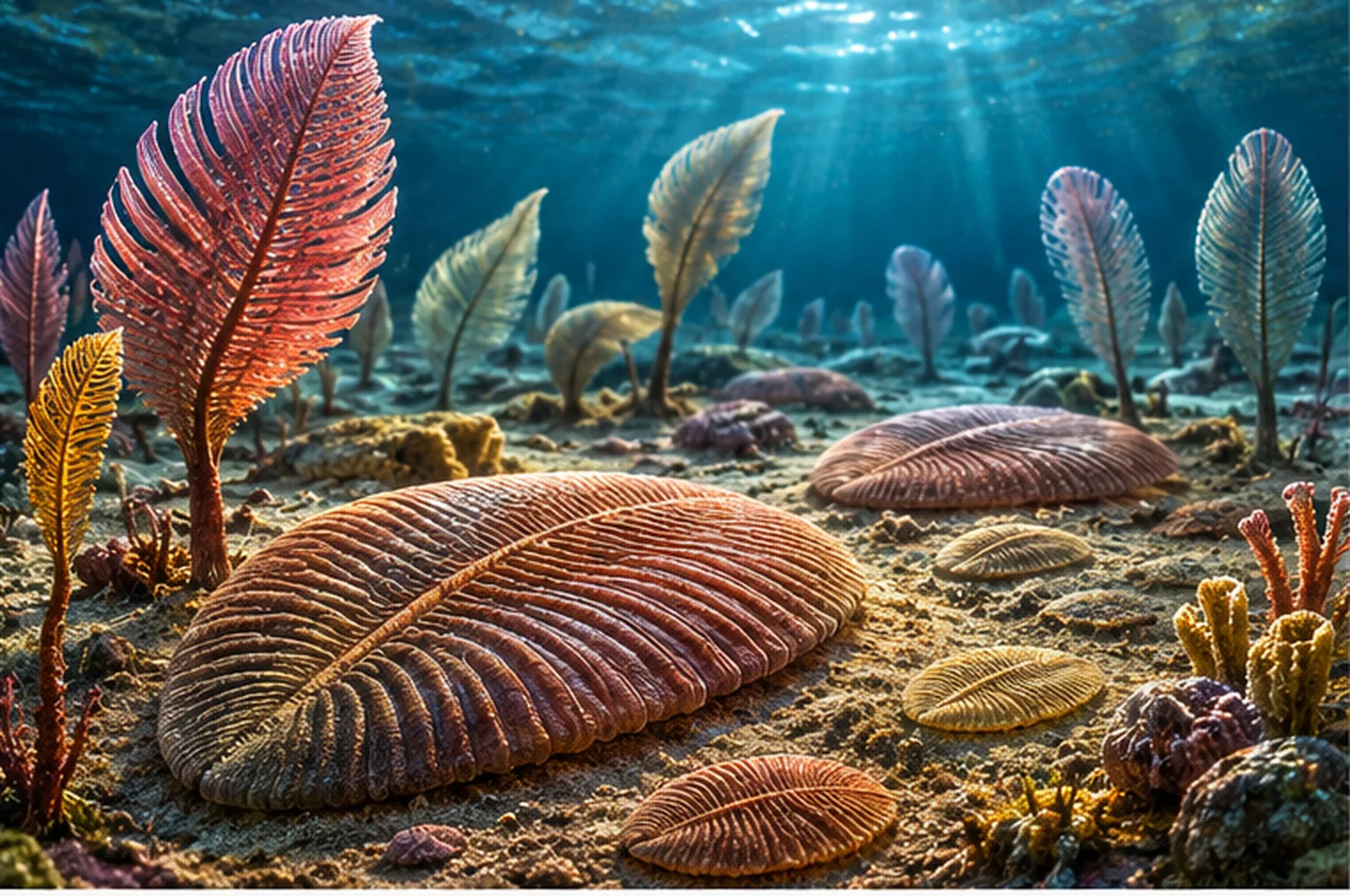
Life was present on Earth billions of years before animals. The earliest evidence for animals is more difficult to interpret. Molecular estimates suggest deep Precambrian origins, while fossils provide increasingly persuasive evidence of diverse animal or animal-like organisms in the late Precambrian, especially the Ediacaran Period, approximately 635–539 million years ago.
The Ediacaran seas hosted soft-bodied forms whose relationships to modern animals are sometimes uncertain. Some looked like fronds, discs, or quilted surfaces. Their strange shapes remind us that evolution did not move in a straight line toward the creatures familiar today. Entire experiments in body design appeared, flourished, and disappeared.
Jellyfish and their relatives belong to ancient animal lineages, but it would be misleading to say that today’s jellyfish species have survived unchanged for 650 million years. Lineages evolve even when some basic body plans persist. The ocean preserves ancestry, not perfect copies.
The Cambrian Explosion: An Evolutionary Opening
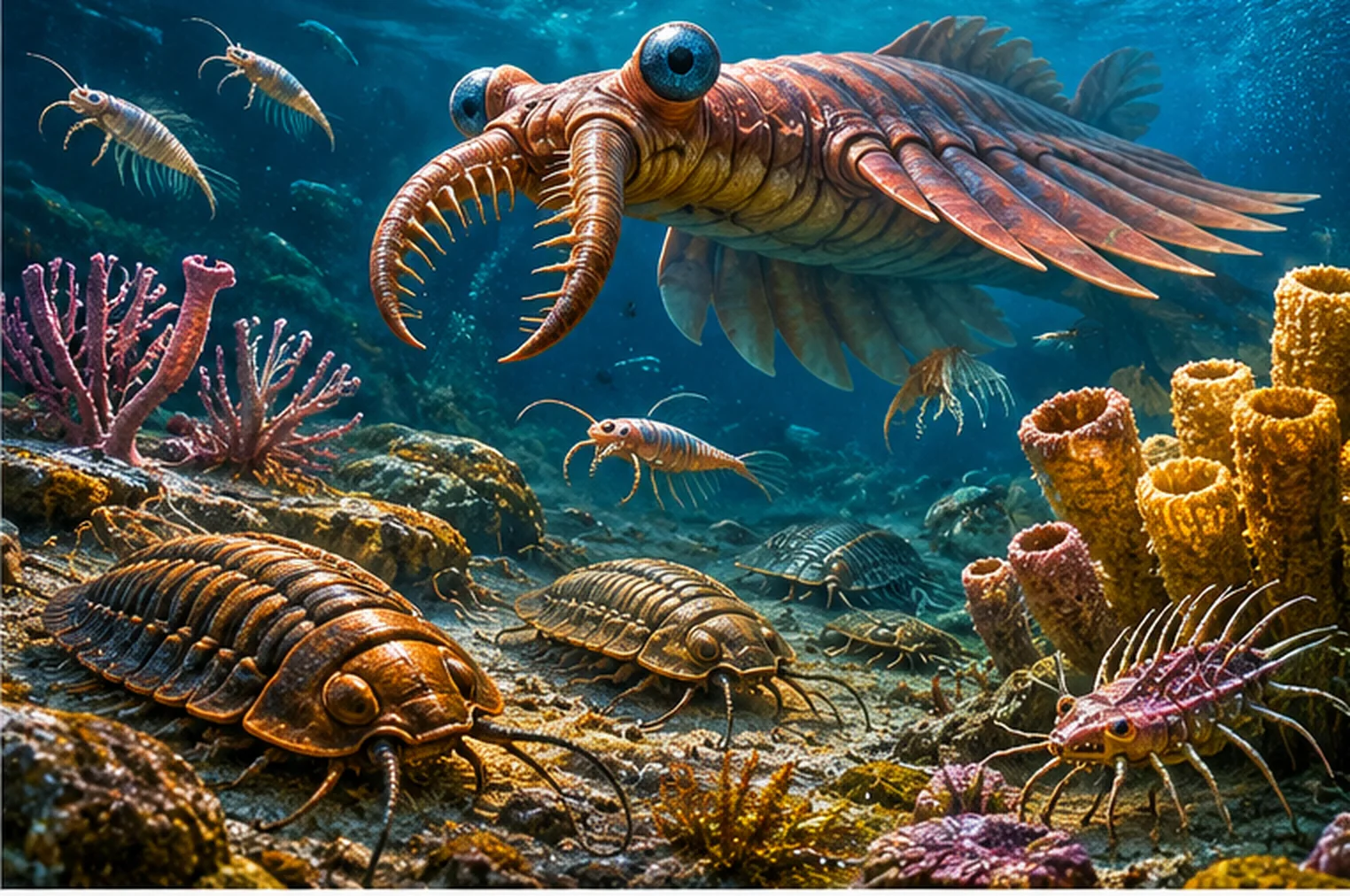
Beginning around 539 million years ago, the Cambrian Period saw an extraordinary diversification of animal forms and ecological relationships. Fossil sites such as the Burgess Shale in Canada and Chengjiang in China reveal creatures with complex eyes, jointed appendages, armor, grasping structures, and unfamiliar body shapes.
The phrase Cambrian explosion describes a dramatic pattern in the fossil record, not a literal overnight event. Major evolutionary changes unfolded over millions of years, with roots extending into earlier periods. Many important animal groups became recognizable, but it is too simple to say that every major modern animal type originated within one short interval.
Trilobites, among the most celebrated Cambrian animals, possessed sophisticated compound eyes in some species, often with lenses made of calcite. Their mineralized bodies fossilized readily, giving us a rich record of creatures that once walked the seabed. Predators and prey were evolving in response to one another; the ocean was becoming a more complicated arena of survival.
The Long History of Backbones
Early chordates and vertebrate relatives appear in Cambrian deposits, although the precise relationships of some fossils remain debated. Over time, vertebrates diversified into jawless fishes, jawed fishes, and many later lineages. The vertebral column was not handed to humans by one identifiable “first fish.” It evolved through a branching history shared by countless descendants.
Jaws transformed feeding possibilities. Fins enabled new forms of movement. Sensory systems helped animals navigate environments that could be dark, turbulent, or full of danger. Evolution did not aim toward human anatomy. It produced many successful solutions to different ecological problems.
From Water to Land
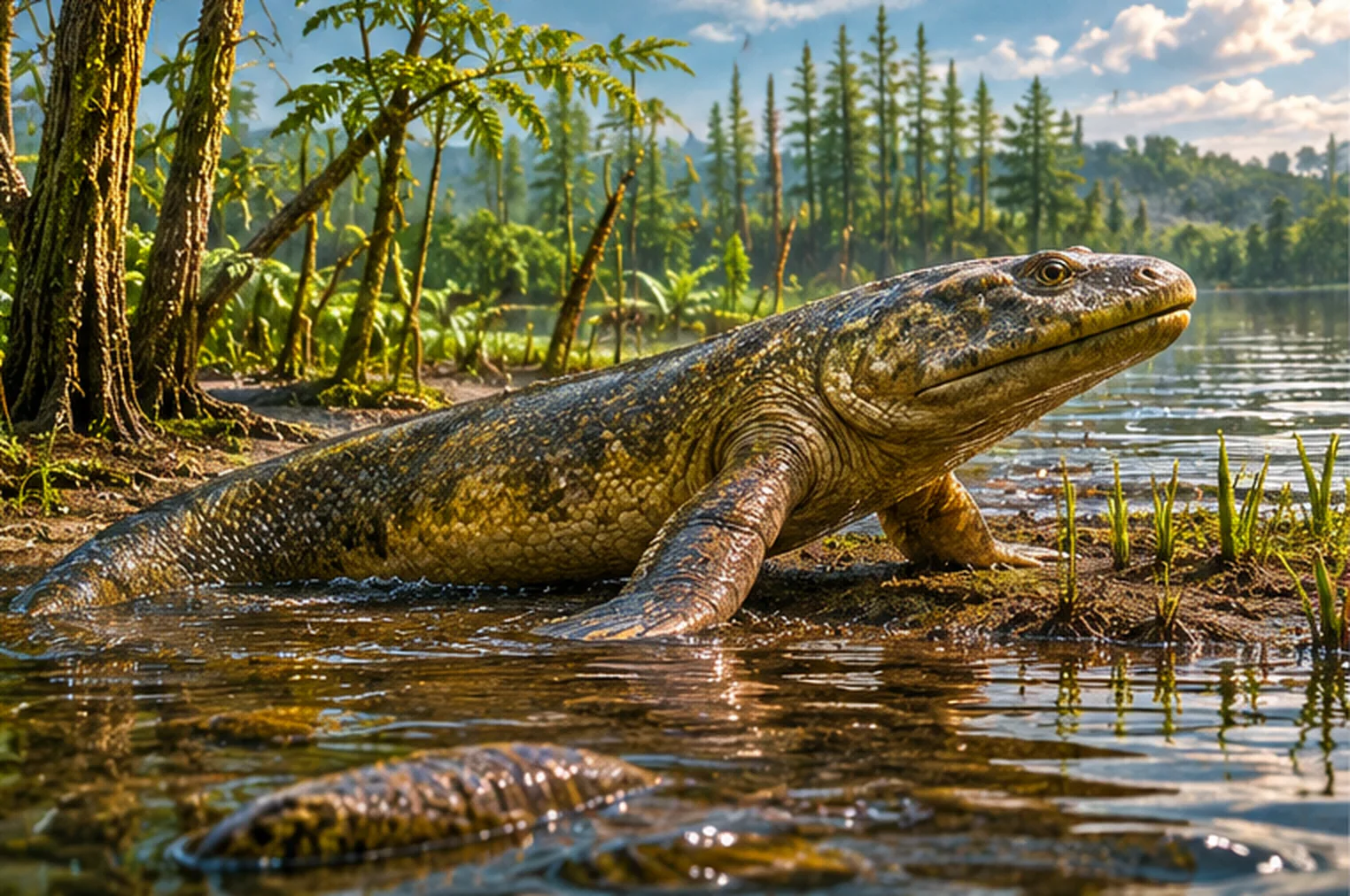
The movement of animals onto land happened more than once. Arthropods—including ancestors of modern insects, spiders, and millipedes—were among the early terrestrial pioneers. Vertebrates followed a different route. During the Devonian, certain lobe-finned fishes evolved features that would become important in the origin of four-limbed vertebrates, or tetrapods.
Tiktaalik, a roughly 375-million-year-old fossil from Arctic Canada, is a famous example of a form combining fish-like characteristics with a mobile neck, robust ribs, and fin bones capable of supporting some weight. It was not necessarily the direct ancestor of every land vertebrate, and it was not simply a fish that stood up one day and decided to walk. It illuminates a gradual evolutionary transition.
Early tetrapods lived in environments where water and land overlapped. Later lineages evolved reproductive adaptations that reduced dependence on water. The amniotic egg, in particular, helped ancestors of reptiles, birds, and mammals reproduce in a wider range of terrestrial habitats.
Dinosaurs: A World That Lasted
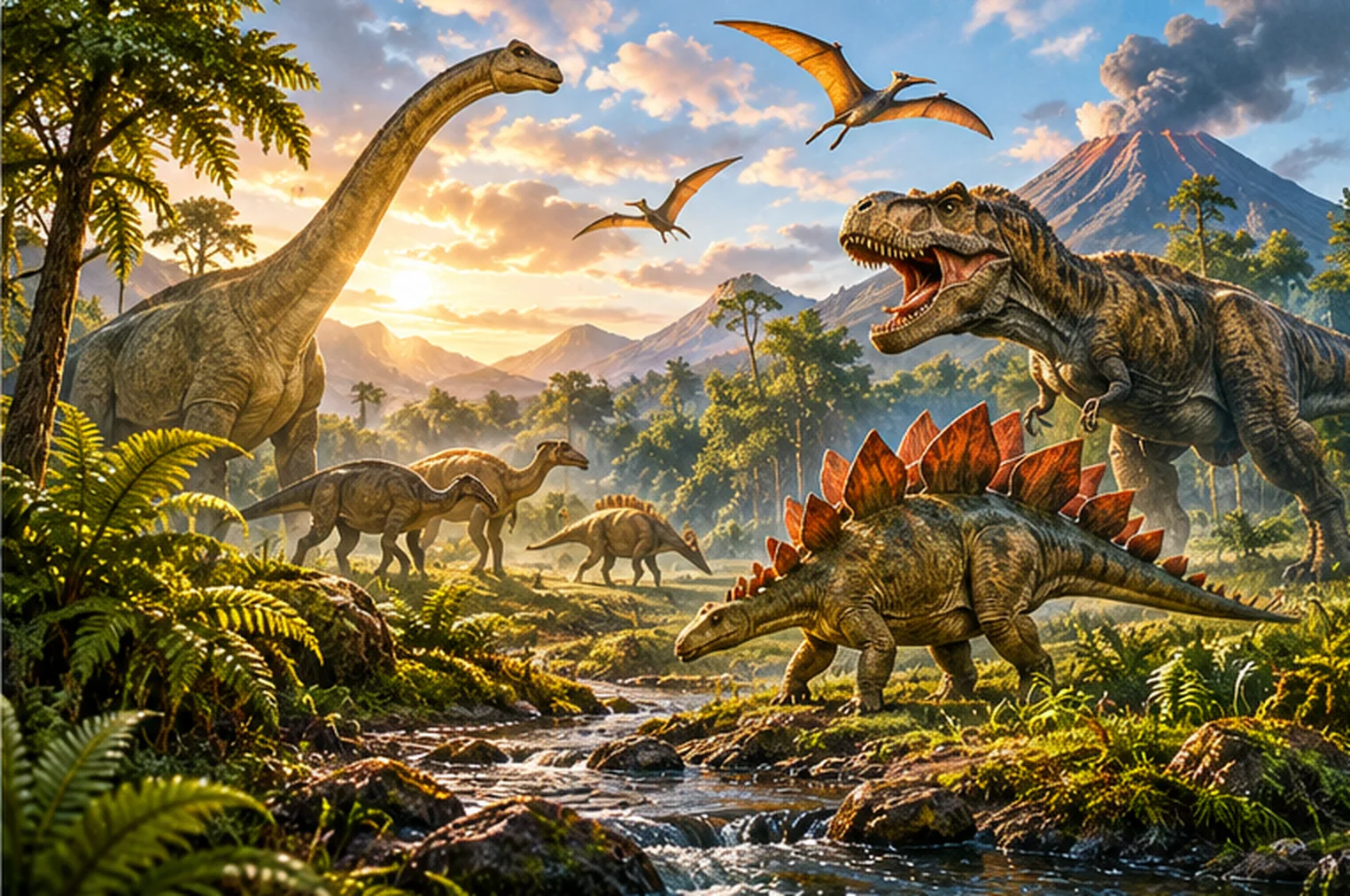
Dinosaurs arose in the Triassic Period, roughly 230 million years ago, and non-avian dinosaurs persisted until the end of the Cretaceous about 66 million years ago. They were not a single kind of monster. They included small, agile predators; armored herbivores; horned species; enormous long-necked sauropods; and the feathered ancestors of birds.
Some sauropods reached astonishing dimensions. Argentinosaurus is often listed among the largest known dinosaurs, but its estimated length and mass remain uncertain because its fossils are incomplete. The animal kingdom’s history is filled with impressive records, yet precise numbers can create a false sense of certainty when scientists are reconstructing extinct bodies from fragments.
Dinosaurs also shared the planet with other animals. Early mammals existed alongside them for well over a hundred million years. They were not invented by the catastrophe that ended the Cretaceous.
The Day the Sky Darkened
About 66 million years ago, a large asteroid struck near what is now Mexico’s Yucatán Peninsula, forming the Chicxulub impact structure. The impact contributed to a global environmental crisis involving dust, aerosols, fires in some regions, and severe disruption of climate and food webs. Evidence also points to major volcanic activity during this broader interval, and scientists continue to investigate the interactions of these pressures.
The end-Cretaceous mass extinction eliminated the non-avian dinosaurs and many other lineages. A commonly cited estimate is that roughly three-quarters of species disappeared, though estimates and effects varied across groups. The claim that sunlight was completely blocked for exactly two years is more precise than the evidence permits.
But dinosaurs did not vanish entirely. Birds are living dinosaurs, descended from theropod ancestors. Every sparrow on a wall is part of the lineage that survived.
Mammals Were Already Waiting
Early mammals and their close relatives evolved long before the asteroid impact. Many were small, and some occupied nocturnal niches, but the idea that every mammal of the dinosaur age was a mouse-like creature is wrong. Fossils reveal varied diets, sizes, and lifestyles.
After the extinction of non-avian dinosaurs, surviving mammalian lineages diversified into many ecological roles. Over tens of millions of years, descendants became bats, whales, elephants, cats, primates, and countless other forms. Evolution did not produce all of these from one surviving mouse. They share a much older, branching ancestry.
Whales illustrate how surprising that branching can be. Their ancestors were terrestrial mammals. Over evolutionary time, some lineages returned to aquatic life, developing streamlined bodies, modified limbs, and extraordinary diving adaptations. The blue whale is the largest animal known to have lived, but sensational comparisons about its heart being exactly the size of a car or its heartbeat being heard at a fixed distance should not be treated as universal measurements.
Birds: Dinosaurs in the Air
Feathers evolved within dinosaur lineages before the emergence of modern birds, and their early functions may have included insulation, display, and other roles. The Late Jurassic fossil Archaeopteryx, about 150 million years old, combined feathers and wings with features such as teeth and a long bony tail. It is a crucial fossil, not necessarily the first bird or a direct ancestor of all living birds.
Birds subsequently diversified into a vast range of forms. Ostriches became powerful runners. Hummingbirds evolved extraordinary hovering flight. Peregrine falcons can achieve spectacular speeds in steep hunting dives, although reported record figures depend on measurement conditions. The variety matters more than any single record: evolution has turned the basic avian body into a swimmer, a scavenger, a singer, a hunter, and a long-distance navigator.
Intelligence Has Many Shapes
Animal cognition does not form a simple league table with humans first and dolphins second. Dolphins display complex social behavior and learning, but brain size alone cannot rank intelligence across species. Corvids can solve difficult problems; parrots can learn sophisticated associations; octopuses manipulate objects and explore their surroundings; elephants show intricate social relationships.
Different nervous systems evolved to solve different problems. A migratory bird’s navigation, a bat’s echolocation, and a bee’s capacity to learn floral cues are forms of biological expertise. Measuring all of them by how closely they resemble human thought misses much of what makes animal minds remarkable.
The Partnership Between Humans and Animals
Humans have lived with animals as predators, prey, competitors, companions, and partners. Dogs evolved from ancient wolf populations through a domestication process whose precise location and timing remain debated. Genetic and archaeological evidence places this relationship deep in prehistory, potentially earlier than the earliest widely accepted dog burials.
Sheep, goats, pigs, and cattle were domesticated in different regions and periods, often in connection with the development of farming. Horses were later central to transport, warfare, and pastoral cultures, though the history of their domestication is more complicated than one date or place. Cats formed relationships with humans around agricultural settlements where stored grain attracted rodents; early evidence extends beyond Egypt, including the eastern Mediterranean.
Domestication was not always a gentle friendship. It also involved control over animal movement, reproduction, and labor. Modern relationships with pets can bring affection and companionship, while livestock systems raise serious questions about welfare and environmental impact. The history of living together contains tenderness and exploitation in unequal measure.
Animals Around the World
The animal kingdom cannot be told through a handful of familiar mammals. Coral reefs support intricate networks of fish and invertebrates. African savannas host large herbivores and predators. The Amazon and Congo Basin contain extraordinary diversity. Australian marsupials reflect a distinctive evolutionary history. Polar seas sustain animals adapted to extreme cold. Deep oceans hold creatures that survive without sunlight by depending on unusual food webs.
South Asia, too, contributes distinctive species and habitats, including the Indus river dolphin, markhor, and snow leopard. Their importance lies in their ecological history and conservation needs, not in national symbolism alone. Wildlife crosses borders that humans draw on maps.
Extinction: The Silence After a Species
Extinction is a natural part of evolution, but human activities are now accelerating losses through habitat destruction, overexploitation, invasive species, pollution, and climate change. A widely cited global assessment estimated that around one million animal and plant species face extinction risk, many within decades, unless the drivers of biodiversity loss are addressed. This is not a count of animals already extinct, nor does it support the confident claim that exactly 150 animal species disappear every day.
The dodo disappeared from Mauritius in the seventeenth century after human arrival brought hunting and introduced animals that damaged its habitat and nests. Its precise final date is uncertain. The northern white rhinoceros is functionally extinct, with no surviving males after Sudan’s death in 2018, but it is a subspecies; the southern white rhinoceros still survives. These distinctions matter because conservation begins with knowing what has actually been lost and what remains.
When a species disappears, the loss can extend beyond one recognizable creature. Pollination, seed dispersal, grazing, predation, and nutrient cycling can all be affected. Ecosystems are networks, not collections of isolated exhibits.
Can Extinction Be Reversed?
Genetic technologies have revived interest in so-called de-extinction. In 2025, a biotechnology company announced animals described publicly as revived dire wolves. The claim generated substantial scientific criticism: editing living canids to display selected traits associated with an extinct species is not the same as reconstructing an authentic extinct lineage with its complete genome, ecology, and evolutionary history.
Even if future techniques recreate some lost characteristics, they cannot easily restore vanished habitats or the relationships a species once had with other organisms. Conservation biology therefore emphasizes preventing extinction, protecting habitat, and maintaining viable populations. It is usually far easier to protect a living species than to attempt to recreate it after it is gone.
Why Saving Animals Means Saving Ourselves
Human wellbeing depends on functioning ecosystems. Wild animals help pollinate plants, disperse seeds, control some pest populations, recycle nutrients, and maintain food webs. Fish and other animals support livelihoods and food security. Yet the case for protecting animals need not rest entirely on what they provide us. Other living creatures have their own evolutionary histories and ecological roles.
Conservation can work. Protected areas, habitat restoration, restrictions on harmful trade, community stewardship, and careful reintroductions have helped some populations recover. Success is neither automatic nor evenly distributed. It requires sustained attention to local people, ecological evidence, and the pressures that caused decline in the first place.
The Animal Looking Back
Imagine standing beside the sea at dusk. A bird circles overhead. A crab moves across wet sand. Far below the surface, animals filter water, hunt, hide, and reproduce. Each belongs to a lineage that survived countless environmental changes. Some branches are ancient; others are relatively recent. None was waiting for humanity to arrive and give its existence meaning.
We share with these creatures an evolutionary inheritance, the need for energy, and a place within Earth’s interdependent systems. We are distinctive in many ways, but distinction is not separation.
The birth of animals is not simply the story of life learning to move. It is the story of life becoming astonishingly diverse—of bodies and senses, competition and cooperation, survival and loss. The most important question may not be how animals became like us. It may be whether we can learn to live responsibly among them.
Everything has a beginning. The animal kingdom began long before our names and nations. Its future now depends, in part, on the choices of one unusually powerful animal: us.
Sources and Further Reading
- Encyclopaedia Britannica — Animal
- Encyclopaedia Britannica — Cambrian Explosion
- Encyclopaedia Britannica — Tiktaalik
- Encyclopaedia Britannica — Dinosaur
- US National Park Service — Chicxulub Impact
- IPBES — Global Assessment of Biodiversity and Ecosystem Services
- IUCN Red List of Threatened Species
- Encyclopaedia Britannica — Birds
Editorial note: Evolutionary dates and species estimates are approximate. Contested claims about animal cognition, fossil ancestry, extinction rates, and genetic “de-extinction” are distinguished from established evidence.



