

Birth Stories — Part Ten | Everything Has a Beginning. Every Beginning Has a Story.
Imagine a storm over a prehistoric valley. Lightning splits the sky; a child clings to an elder; somewhere beyond the firelight, a family mourns someone who will never return. Did the storm have a will? Where did the dead go? Why was a new child born into the world? We cannot know the first person who asked these questions. We cannot even know whether fear, gratitude, wonder, grief, or a sense of the sacred came first. But the human search for meaning is far older than the names of the religions we know today.
Religion has no single discoverable birthday. Its history is not a simple procession from fear to many gods and then to one God. It is a branching, overlapping history of stories, rituals, communities, experiences, ethical systems, and claims about realities beyond ordinary perception.
Before Written Scripture
Archaeologists find evidence of ancient burials, ornaments, pigments, and symbolic behavior. Burials at Qafzeh in present-day Israel date to roughly 100,000 years ago; some contained objects that may have had symbolic significance. At Shanidar Cave in Iraq, Neanderthal burials have provoked debate about deliberate treatment of the dead. The once-famous claim that flowers were intentionally placed in a Shanidar grave is contested: pollen could have arrived through other processes. Neither burial nor flowers, even if deliberate, prove a belief in an afterlife. They tell us that death mattered, and perhaps that relationships extended beyond the moment of dying.
Rock art, figurines, and monumental gathering places raise similarly fascinating questions. Were they sacred? Social? Political? Artistic? Often we cannot separate those categories because the people who created them left no explanations. At Göbekli Tepe, in present-day Türkiye, large carved stone enclosures were built by communities living around the transition to agriculture. The site suggests complex communal activity before the emergence of the familiar city-temple world. But it does not reveal a single original religion.
Many Ways of Encountering the Sacred
In countless societies, land, ancestors, animals, rivers, mountains, and celestial bodies have held spiritual meaning. Scholars sometimes use terms such as animism, ancestor veneration, and shamanic traditions, but no one label captures the variety of Indigenous religions. Many such traditions remain living faiths, not fossils of an earlier stage of humanity. They include distinct teachings and practices among African peoples, Aboriginal and Torres Strait Islander communities, Native American nations, Arctic societies, and others.
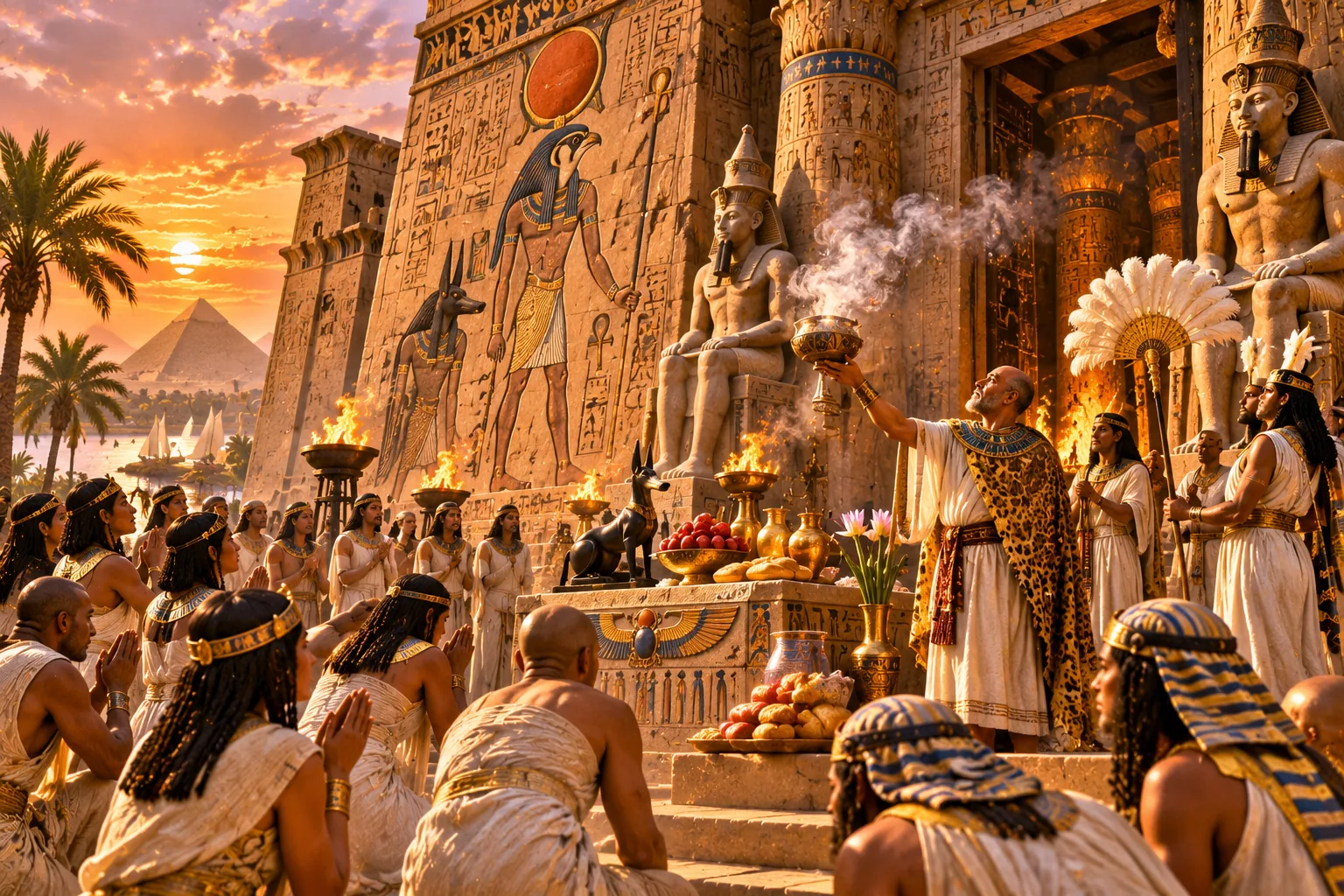
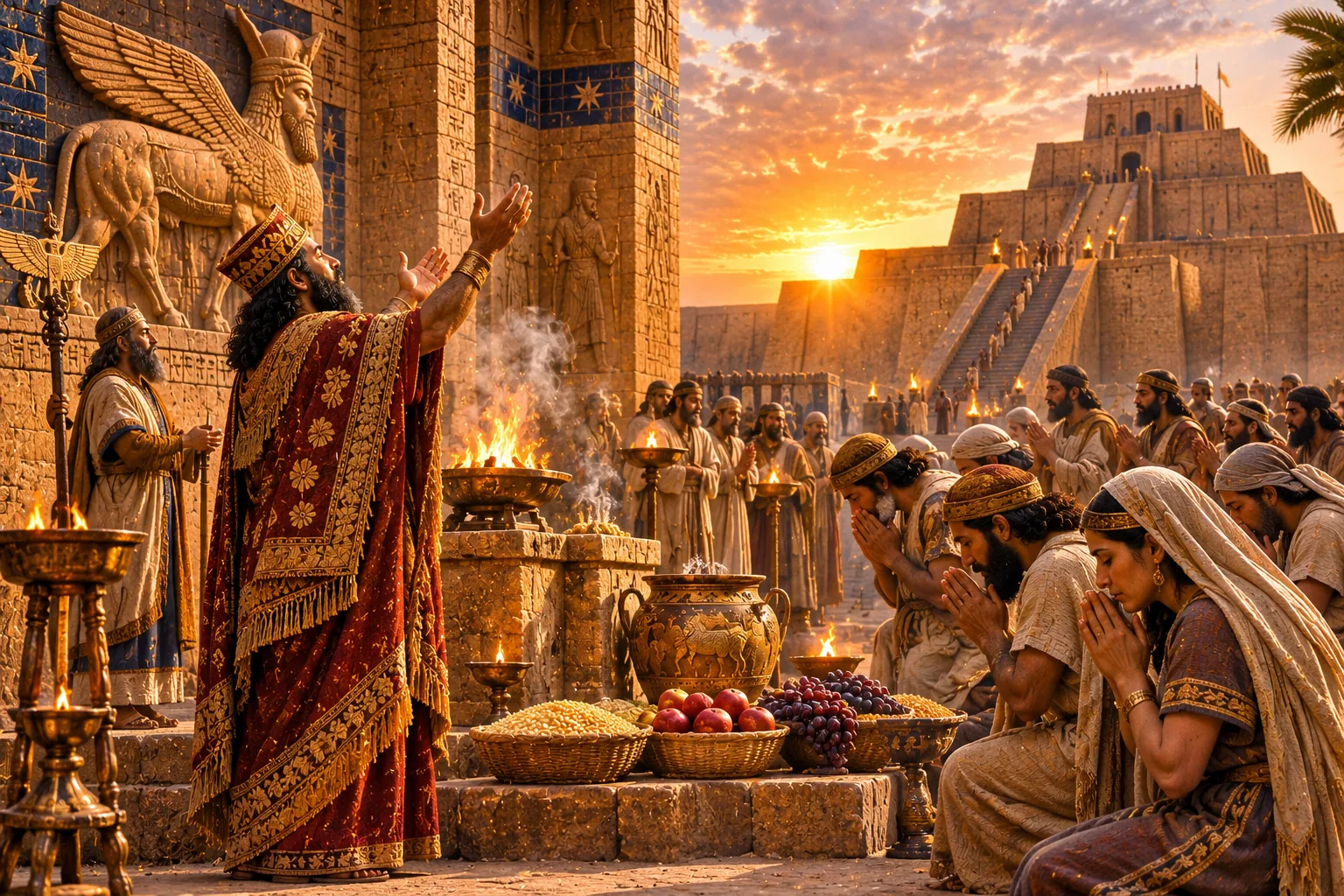
Ancient Mesopotamian cities supported temples, priesthoods, festivals, and elaborate pantheons. Ziggurats were raised platforms associated with temple complexes; their symbolism and use varied. In ancient Egypt, divine kingship, funerary texts, and the worship of deities such as Ra, Isis, and Osiris intertwined with politics and daily life. Pyramids expressed royal power and ideas about death, but their construction figures are uncertain, and Egyptian religion cannot be reduced to one belief about the pharaoh.
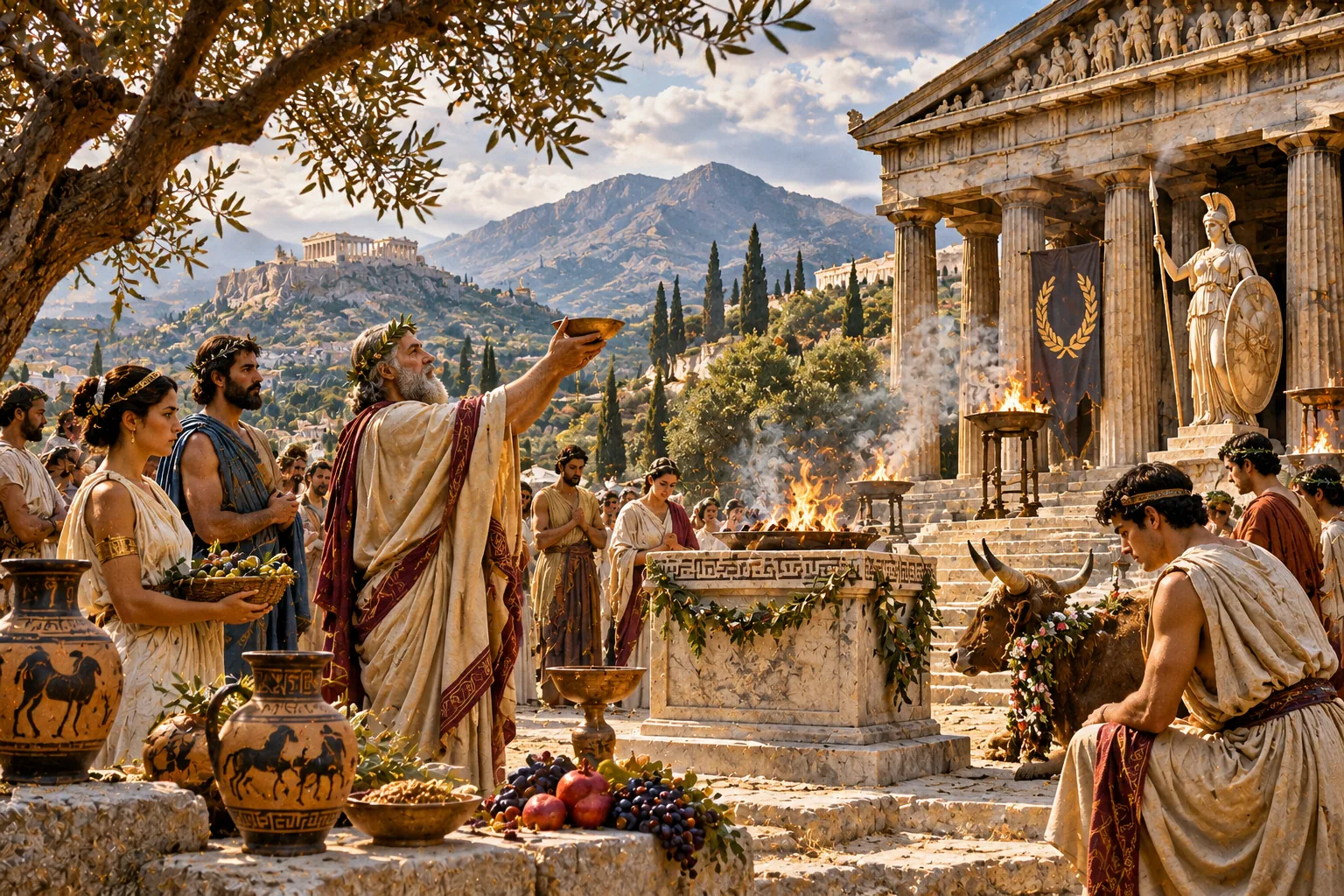
Greek and Roman traditions likewise contained diverse divine stories, civic rituals, household practices, philosophical criticism, and changing forms of worship. Religion was not merely an answer to natural phenomena. It shaped calendars, law, belonging, art, and power.
One God, Many Histories
Monotheism did not arrive in a single universally agreed historical moment. Ancient traditions distinguished devotion to one deity, belief in a supreme deity, and the assertion that only one God exists. The historical development of Israelite religion and Jewish monotheism unfolded over centuries, and scholars debate its stages.
Within Jewish, Christian, and Islamic religious memory, Abraham occupies a central position as a figure of faith and devotion to God. His life is narrated and understood differently across these traditions. Historians cannot independently establish a precise date for his life or treat the scriptural accounts as a simple modern chronology.
Judaism developed through the religious history of ancient Israel and Judah, the formation and interpretation of sacred texts, exile, return, and later rabbinic traditions. The Torah is foundational; the Hebrew Bible and subsequent Jewish scholarship contain a much wider intellectual world. The Ten Commandments belong to the biblical account of the covenant at Sinai, but it would be inaccurate to date the entire religion to one year or claim that all later law descends directly from those commandments. Jewish life has also long been sustained through study, prayer, communal institutions, law, and ethical debate.
The Religions of South Asia
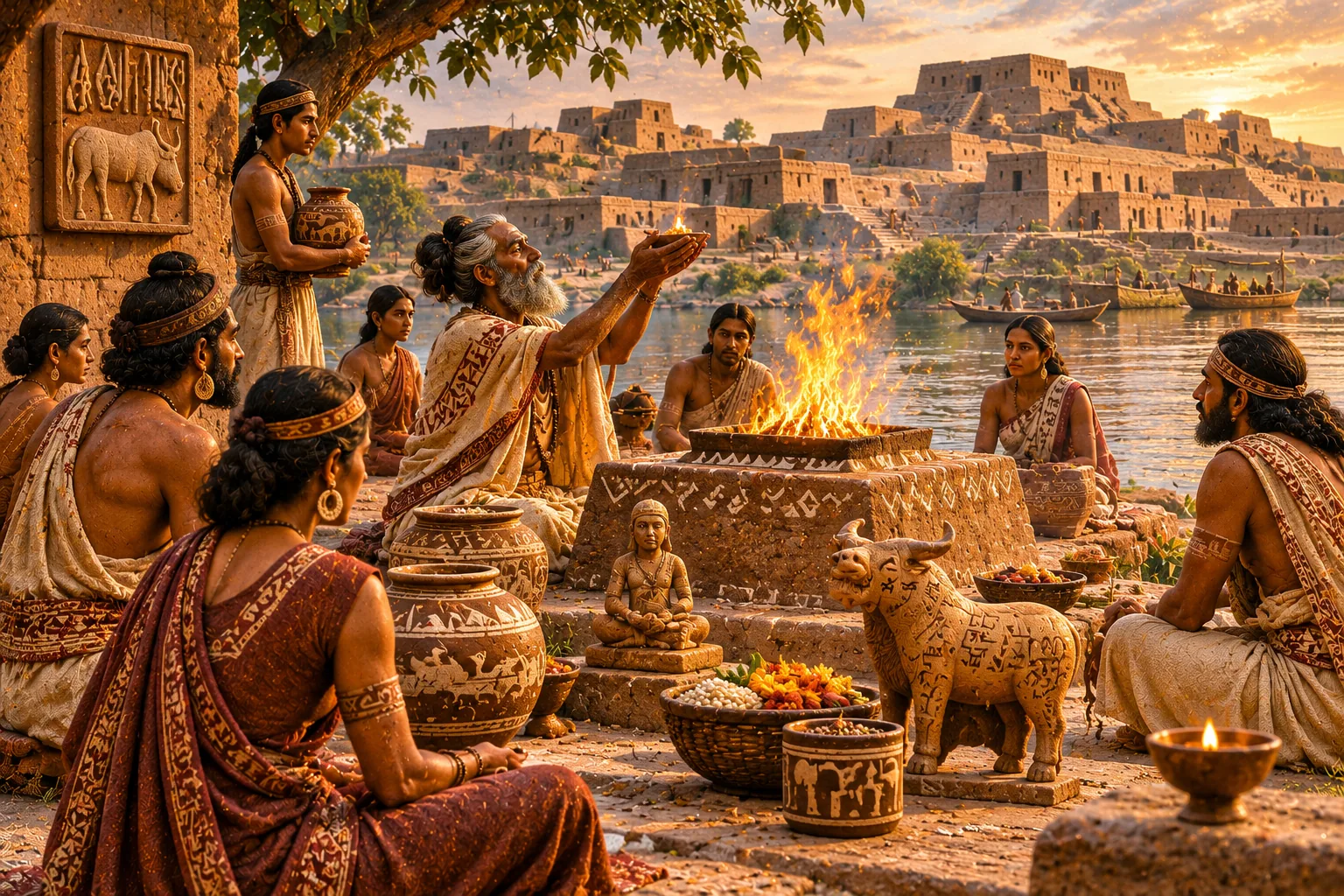
The traditions grouped today under the name Hinduism developed over many centuries. The Vedas are among their oldest surviving sacred texts, composed and transmitted orally before being written down; their dating is debated, with major portions generally associated with the second and first millennia BCE. Hindu traditions differ widely in philosophy, ritual, and devotion. Some emphasize one ultimate reality, Brahman; some center devotion to particular deities; others approach the divine in different ways. The popular claim that Hinduism simply teaches worship of a fixed number of millions of gods obscures this diversity.
Ideas of karma, rebirth, liberation, and dharma have been understood in many different ways across South Asian thought. Buddhism emerged from the teachings associated with Siddhartha Gautama, the Buddha, whose lifetime is commonly placed in the fifth century BCE, though dates remain debated. Its traditions examine suffering, impermanence, the causes of dissatisfaction, ethical conduct, and paths to liberation. Buddhism is not adequately summarized as merely the command to eliminate every desire; its teachings distinguish forms of craving from wholesome intentions and compassionate action.
Jain traditions place extraordinary emphasis on ahimsa, or nonviolence, alongside disciplined ethical and spiritual practice. Jainism’s history should not be presented as if it were invented suddenly by one teacher in the sixth century BCE; Mahavira is revered as a great teacher within a longer sacred lineage.
China, Japan, and the Search for Harmony
Confucius, traditionally dated 551–479 BCE, helped shape an ethical and educational tradition concerned with humane conduct, relationships, ritual, and good government. Confucianism has been interpreted as philosophy, religious tradition, and social ethic, sometimes all at once. Daoist traditions developed through diverse texts, practices, and communities; the Dao De Jing is associated with Laozi, whose historical identity and dates are uncertain. Daoism explores ways of living in relation to the Dao, often translated as the Way.
In Japan, Shinto encompasses varied practices concerning kami, shrines, purification, place, and community. It did not spring from one founder or one fixed ancient scripture. Across East Asia, religious life has often involved participation in multiple traditions rather than exclusive membership in only one.
Zoroaster and the Question of Good and Evil
Zoroastrianism, associated with the teachings of Zarathustra or Zoroaster, is among the world’s oldest enduring religious traditions. Scholars disagree substantially about when its founder lived. Its teachings emphasize truth, moral choice, and the struggle against destructive forces. Fire has an important ritual role as a symbol associated with purity and divine light; Zoroastrians are not accurately described as simply worshipping fire. Its history has influenced and interacted with wider Iranian and neighboring religious worlds.
The historian Karl Jaspers popularized the term Axial Age for an era of major intellectual and religious transformations across several regions in the first millennium BCE. The idea remains influential but debated: the changes did not happen everywhere simultaneously, nor were all traditions born in one dramatic century.
Christianity and Islam
Christianity emerged in the first century CE among Jewish communities in Roman-ruled Judea and the wider eastern Mediterranean. Christians understand Jesus of Nazareth as the Christ, and most Christian traditions affirm his divinity, though doctrines and practices vary. His teachings and the early Christian movement are known through texts written and transmitted within communities of faith. Christianity spread through networks of believers, teachers, merchants, and institutions. The Edict of Milan in 313 CE helped establish legal toleration for Christianity within the Roman Empire; Christianity became the empire’s official state religion later, under Theodosius I in 380.
Islam arose in seventh-century Arabia. According to Muslim belief, the first Qur’anic revelation came to the Prophet Muhammad in 610 CE. The Qur’an is Islam’s sacred scripture, and the five pillars—profession of faith, prayer, almsgiving, fasting, and pilgrimage—are central in Sunni accounts of religious practice, while Muslim traditions differ in emphasis and theological interpretation. Islamic societies grew across extensive regions through a combination of political expansion, trade, scholarship, migration, and preaching. Their histories cannot be reduced to conquest alone, nor can religious belief be equated with every action of a ruler claiming its authority.
Both Christianity and Islam developed diverse schools of thought, spiritual traditions, artistic forms, and institutions. They have inspired charity, learning, and reform, and have also been invoked amid conflict and coercion. Historical inquiry must attend to both without pretending either a single uniform community or an uncomplicated record.
Newer Traditions and Living Communities
Sikhism emerged in the Punjab through Guru Nanak (1469–1539) and the teachings of the Sikh Gurus. Its traditions affirm the oneness of God, remembrance of the divine, honest work, and service. The Guru Granth Sahib is the eternal Guru in Sikh belief. The practice of langar, a shared free community meal, embodies ideals of equality and hospitality.
The Bahá’í Faith arose in nineteenth-century Iran and emphasizes the unity of humanity and the progressive unfolding of religious revelation. New religious movements have also emerged in many other settings, responding to social change, revelation claims, reform, and the search for belonging.
No credible global register can give an exact count of all religions. The often-repeated figure of 4,200 depends heavily on how denominations, local traditions, and movements are classified. Population estimates also vary by date and methodology. Christianity and Islam are the world’s largest religious groupings, while substantial populations identify with Hindu, Buddhist, folk, and other traditions. Many people identify with no religion; that category includes atheists, agnostics, spiritual seekers, and people who hold religious beliefs without institutional affiliation. Nonreligion is not itself one single belief system.
Belief, Doubt, and the Freedom to Choose
Religious traditions are not identical. They disagree about God, ultimate reality, revelation, rebirth, salvation, moral authority, and what happens after death. To say that every religion teaches precisely the same thing would erase the very ideas that make each distinctive. Yet many communities also cultivate compassion, generosity, restraint, truthfulness, hospitality, and concern for the vulnerable—sometimes through different reasons and sometimes with important exceptions.
Religion has given rise to temples, mosques, churches, synagogues, monasteries, shrines, music, poetry, hospitals, and schools. It has also become entangled with empire, exclusion, persecution, and violence. Skeptical and nonreligious traditions have contributed their own ethical arguments, communities, and critiques of power. The historical challenge is not to declare all beliefs equally true or false. It is to understand what people believe, why it matters to them, and how those convictions shape life.
Freedom of religion or belief includes the freedom to practice, change, question, or decline religious affiliation. That principle matters because conviction without freedom can become coercion, while freedom without respect can leave communities vulnerable.
The Unfinished Question
Science can investigate how storms form, how organisms evolve, how brains process experience, and how ancient people lived. It does not automatically settle every philosophical or theological question about ultimate meaning. Religious and nonreligious thinkers disagree over which questions can be answered, and what counts as evidence. Those disagreements are part of humanity’s intellectual history.
Return to the ancient night sky. We cannot say the first believer was frightened, or that the first prayer was spoken beside a grave. Such scenes are imaginative possibilities, not recovered facts. What survives is the question: what does it mean to be alive in a world larger than our understanding?
For some, the answer is found in worship. For others, in philosophy, human relationships, contemplation, or a refusal to claim certainty. The history of beliefs and religions is therefore not one story with one ending. It is the record of humanity repeatedly reaching beyond what it knows, building communities around what it holds sacred, and learning—sometimes painfully—to live among people who answer differently.
Everything has a beginning. The search for meaning may be as old as the human capacity to wonder.
Sources and Further Reading
- Smithsonian Human Origins — Burial and symbolic behavior
- UNESCO — Göbekli Tepe
- Encyclopaedia Britannica — Religion
- Encyclopaedia Britannica — Judaism
- Encyclopaedia Britannica — Hinduism
- Encyclopaedia Britannica — Buddhism
- Encyclopaedia Britannica — Zoroastrianism
- Encyclopaedia Britannica — Christianity
- Encyclopaedia Britannica — Islam
- Pew Research Center — Global religion research
Editorial note: Religious teachings are attributed to their traditions. Ancient dates and archaeological interpretations are qualified where evidence is uncertain. This feature describes beliefs without endorsing or dismissing their supernatural claims.



