

Birth Stories — Part Nine | Everything Has a Beginning. Every Beginning Has a Story.
A civilization does not begin when the first palace rises above the dust. It begins much earlier, in acts too small for monuments: a stranger welcomed to a fire, a child taught to remember a story, a family sharing food through a difficult winter, a community agreeing that a promise matters. The first cities made these relationships visible in stone, brick, streets, and written records. But the ability to live together was already ancient.
Our story therefore begins not with a king, but with a question: how did a species of vulnerable, imaginative humans build societies capable of surviving beyond any single lifetime?
Before Cities, There Were Communities
Homo sapiens emerged in Africa roughly 300,000 years ago, within a complex history of human evolution. Other human species also made tools and displayed sophisticated behavior. It would be misleading to imagine one sudden moment, 70,000 years ago, when modern humans abruptly acquired language, art, and imagination. Archaeological evidence instead suggests varied developments across many regions and periods.
Ancient burials, pigments, ornaments, carved objects, and cave paintings offer glimpses of symbolic lives. The spectacular paintings at Lascaux in France, created around 17,000 to 21,000 years ago, are among the best-known examples, but they are neither humanity’s earliest art nor proof of a single original religion. We do not know precisely what their makers believed. What we do know is that people were creating meanings that could be shared.
Kinship, cooperation, ritual, and collective memory predate the earliest written states. The word civilization is often used for large, urban, institutionally complex societies; it must never be used to imply that communities without cities were less human or incapable of rich cultures.
The Long Agricultural Transformation
Beginning around 12,000 years ago, and at different times in different places, humans increasingly cultivated plants and managed animals. The Fertile Crescent was one important center of early agriculture, but crops and farming traditions also developed independently in East Asia, New Guinea, Africa, and the Americas. Rice, wheat, millet, sorghum, maize, and potatoes each belong to different histories of experimentation.
Agriculture did not instantly replace hunting and gathering, nor did settlement always wait for farming. Some communities became relatively settled before they relied primarily on domesticated crops. Farming could support larger populations and specialized crafts, but it also brought new burdens: harder labor, infectious diseases, unequal access to land, and dependence on harvests. Civilization was not a simple staircase from hardship to comfort.
At Göbekli Tepe in present-day Türkiye, monumental stone structures dating to the tenth and ninth millennia BCE reveal elaborate communal activity among people living near the transition to farming. At Çatalhöyük, a much later Neolithic settlement in Anatolia, densely packed houses reveal another way of living together. These sites complicate the comforting idea that temples, villages, and social complexity appeared in one fixed sequence.
Mesopotamia: A City Learns to Remember
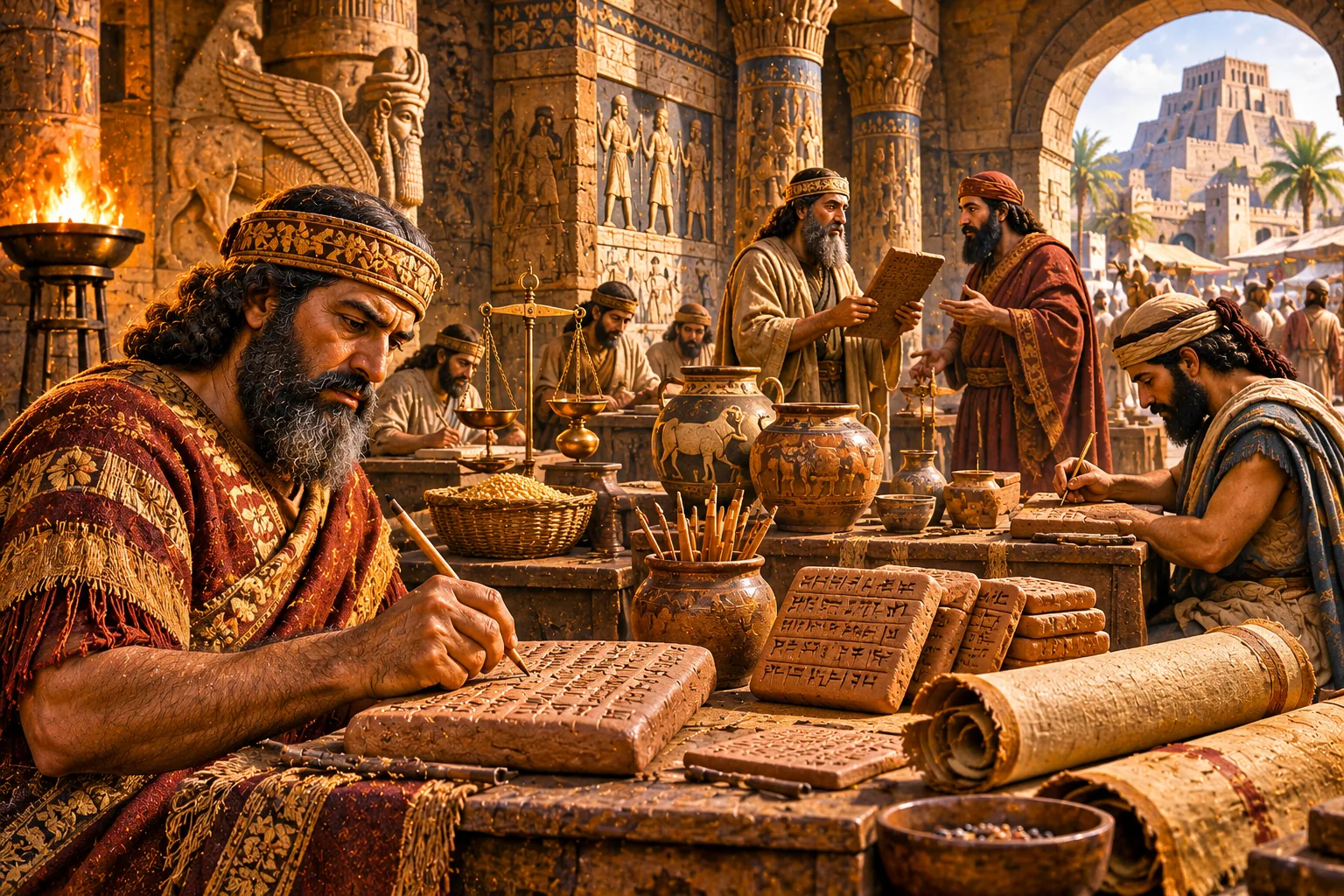
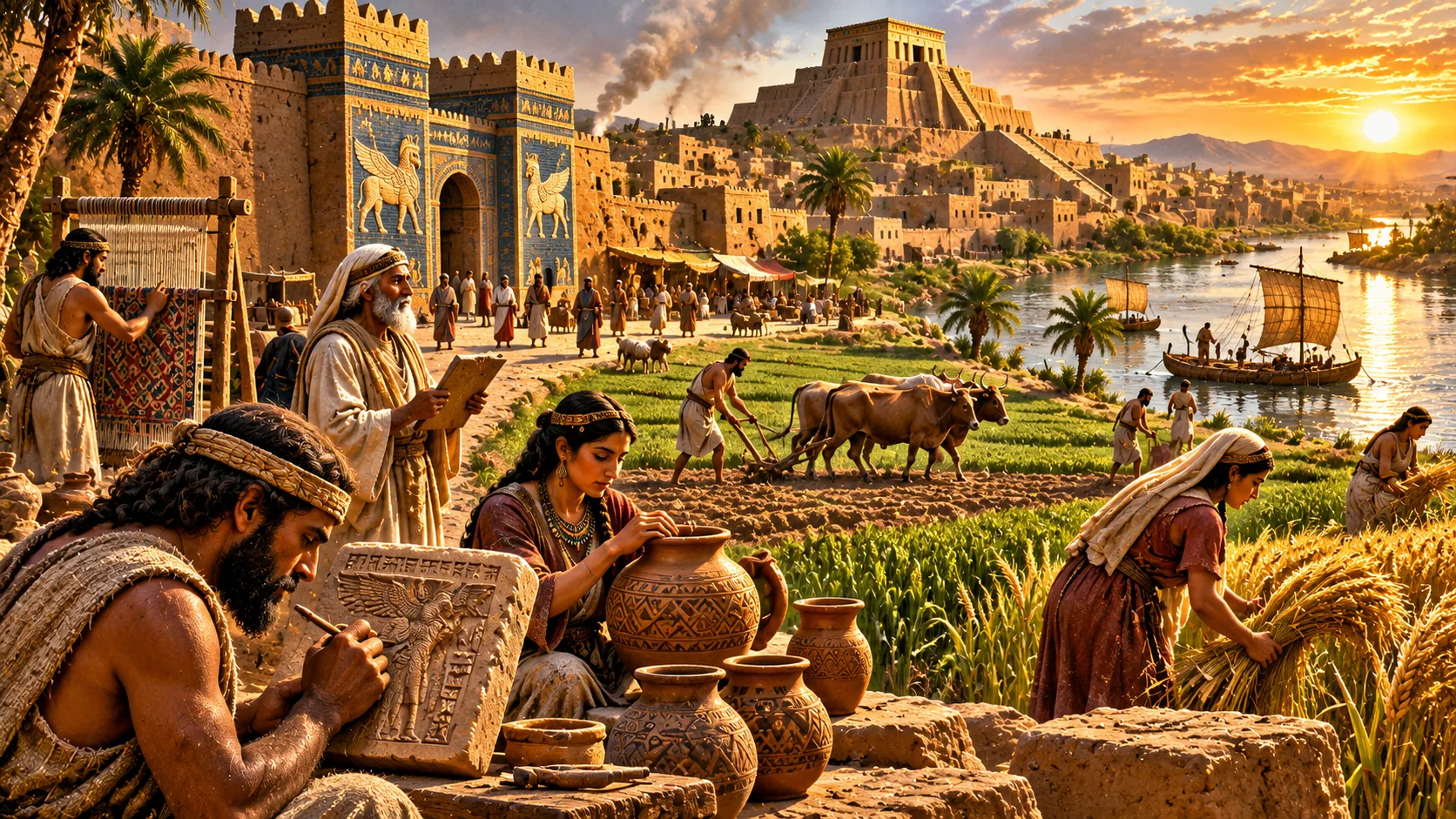
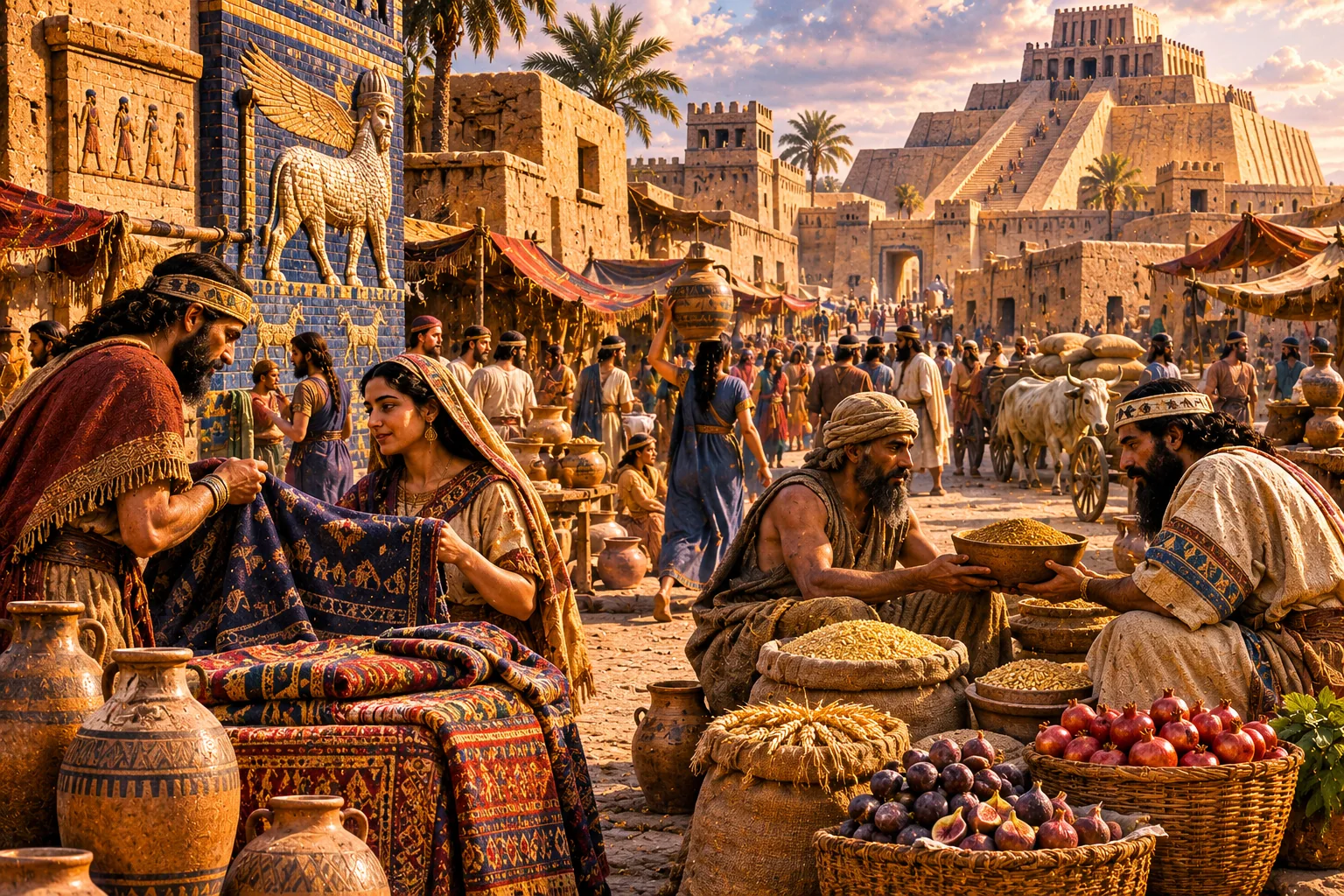
By the fourth millennium BCE, cities such as Uruk were growing in southern Mesopotamia, between the Tigris and Euphrates. Irrigation, trade, specialized work, temples, and administration connected large populations. Writing emerged in part from the practical need to record goods, labor, and obligations. The earliest proto-cuneiform tablets were not philosophical manifestos. Many were accounts. Yet accounting changed history: a transaction could survive its witnesses.
Mesopotamia did not invent every feature of civilization, nor was Uruk necessarily the first settlement deserving the name city. Its significance lies in the extraordinary evidence it preserves for early urban institutions. The wheel, too, developed through complex technological histories rather than one identifiable act of invention.
King Hammurabi of Babylon ruled in the eighteenth century BCE. His famous law collection was neither the first written law code nor proof that kings themselves were legally equal to everyone else. Earlier Mesopotamian legal texts survive. The stele matters because it publicly expressed royal claims about justice, order, and punishment—however unequal the rules could be. Civilization had learned to write down its expectations; it had not yet solved the problem of fairness.
Egypt: A River Becomes a Kingdom
Along the Nile, ancient Egypt developed political institutions and cultural traditions that endured, with profound changes, for millennia. Political unification is conventionally placed around 3100 BCE and associated with rulers such as Narmer, though the process was more complicated than one decisive event.
The Great Pyramid of Khufu at Giza, built in the third millennium BCE, rose to an original height of about 146.6 meters. Its precise workforce and construction timetable remain debated. The familiar image of vast armies of enslaved people building it is not supported by the evidence in that simplistic form; archaeological finds point to organized labor communities with provisioning and specialist skills. The pyramid demonstrates engineering, administration, belief, and the ability of a state to mobilize resources. It also invites a harder question: who carried the costs of monumental ambition?
Egyptian writing, mathematics, medicine, calendars, and funerary practices reveal a society deeply concerned with time, order, and what might survive death. The Nile nourished the kingdom, but the civilization was made by human choices about how to use its gifts.
The Indus: Cities Without Deciphered Voices
Across parts of present-day Pakistan and northwestern India, the Indus or Harappan civilization flourished during its mature urban phase, approximately 2600–1900 BCE. Mohenjo-daro and Harappa reveal carefully built streets, standardized bricks, drainage systems, weights, and far-reaching exchange networks. Mohenjo-daro’s Great Bath remains one of the most striking structures of the ancient world.
Here history encounters a tantalizing silence. The Indus script has not been convincingly deciphered. Scholars still debate the nature of political authority, religious practice, and social organization. The absence of unmistakable royal palaces on the Egyptian model does not prove that there were no rulers, nor that the society was wholly egalitarian. It tells us that its institutions were organized and represented differently—or that crucial evidence has not survived.
Changing river systems, environmental pressures, and transformations in trade and settlement may all have contributed to the decline of its great urban centers. The people did not simply disappear. Cultural and population continuities outlived the cities.
China and the Art of Continuity
Early Chinese civilization grew through several regional cultures. The Xia dynasty belongs partly to later historical tradition and remains difficult to align securely with archaeology. The Shang dynasty, documented through bronze objects and oracle-bone inscriptions in the second millennium BCE, provides much firmer evidence of early Chinese kingship and writing. Later Zhou traditions shaped political thought, including ideas about legitimate rule.
Confucius, who lived from 551 to 479 BCE, asked how education, ritual, ethical conduct, and responsible leadership could sustain society. Chinese civilization would also contribute transformative technologies, including papermaking, printing, the compass, and gunpowder, developed across many centuries. The Great Wall is not one uninterrupted structure built at a single moment; it is a network of fortifications from different periods.
The lesson of China is not that civilization never changes. It is that institutions can reinvent themselves while preserving a sense of historical continuity.
Africa Beyond the Nile
Any story that moves directly from Egypt to Greece leaves too much of Africa in shadow. Nubian and Kushite kingdoms developed south of Egypt, with their own political, religious, and artistic traditions. The kingdom of Aksum in the Horn of Africa became an important power in Red Sea trade during the first millennium CE. Later, cities and trading networks flourished across the Sahel and along the Swahili coast. Great Zimbabwe, with its monumental stone architecture, testifies to the sophistication of societies in southern Africa.
These were not marginal footnotes to someone else’s history. They were civilizations with their own trajectories, exchanges, conflicts, and achievements. The map of human ingenuity has always been larger than the map of the empires most frequently described in textbooks.
Greece, Rome, and the Argument About Power
In ancient Greece, independent city-states experimented with different political systems. Democratic reforms in Athens are often associated with Cleisthenes around 508/507 BCE, but participation was restricted: women, enslaved people, and resident foreigners were excluded from political citizenship. Greek philosophy, drama, historical writing, and scientific inquiry left an enduring legacy, while Greek societies also depended on labor and inequalities often overlooked in celebratory accounts.
Rome developed complex legal traditions, roads, water infrastructure, and forms of administration across a vast empire. In 212 CE, the Constitutio Antoniniana extended Roman citizenship to most free inhabitants of the empire, with important qualifications. Roman achievements traveled alongside conquest, enslavement, and extraction. The famous saying that all roads lead to Rome captures imperial centrality, not a literal description of every road.
What later generations inherited was not one unbroken ideal. It was an archive of arguments about law, citizenship, empire, and the limits of power.
The Americas Before European Conquest
Across the Americas, societies developed complex cities, agriculture, astronomy, political institutions, and monumental architecture independently of Eurasian empires. The Maya built sophisticated mathematical and calendrical traditions and a network of changing city-states. The Mexica, often called Aztecs, established Tenochtitlan in the fourteenth century; its canals, markets, and urban scale impressed later observers. Population estimates vary widely and should not be treated as exact counts.
In the Andes, the Inca state connected mountainous territories through roads, administration, and remarkable stonework. Machu Picchu, built in the fifteenth century, remains a powerful example. These societies were not waiting to become civilized when Europeans arrived. Colonization brought catastrophic epidemics, violence, dispossession, and transformations that cannot be reduced to a tale of technological superiority.
Islamic Civilizations and the Meeting of Worlds
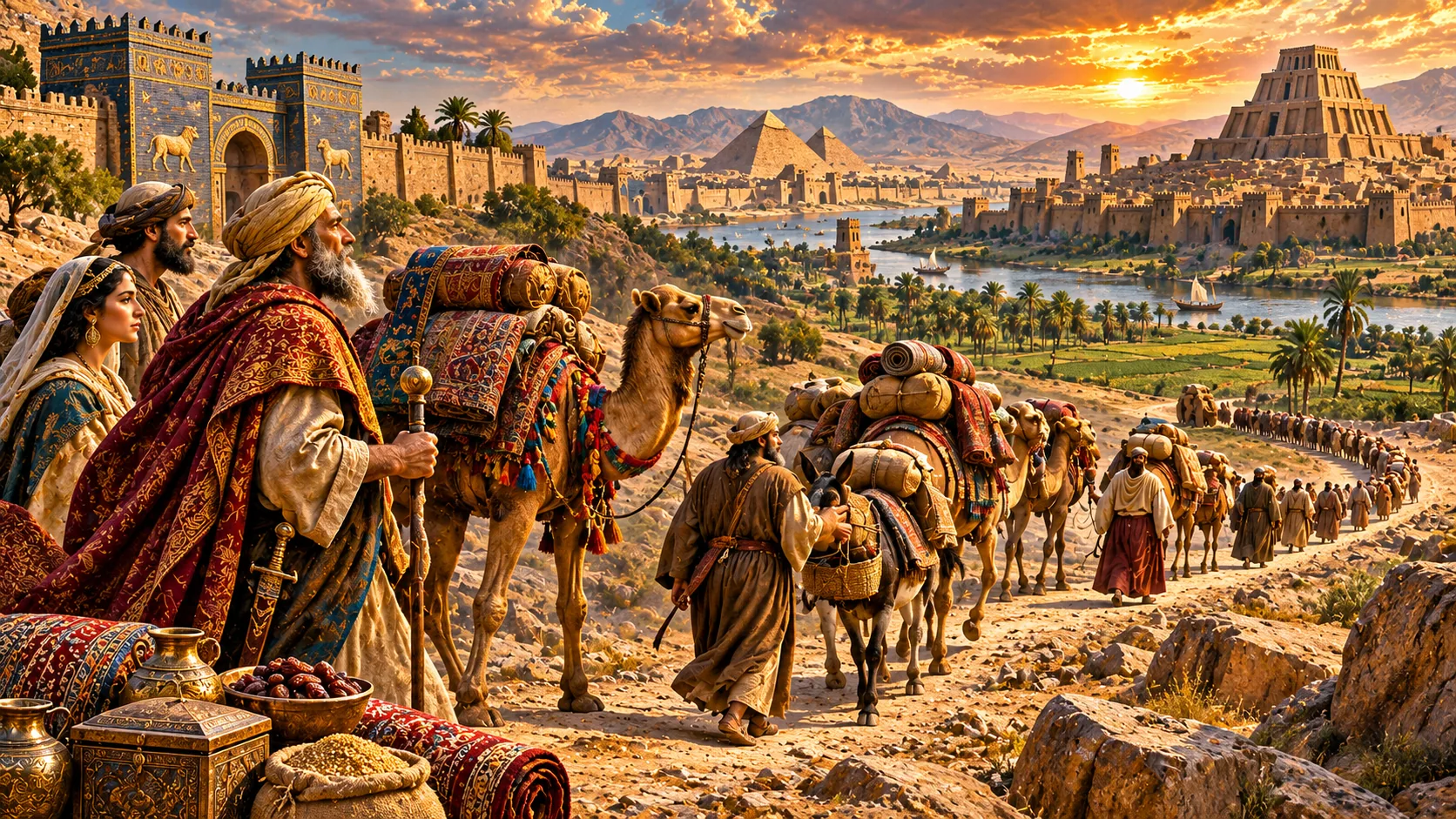
From the seventh century onward, Islamic polities and societies connected regions across the Middle East, North Africa, parts of Europe, Central Asia, and South Asia. Baghdad, Cairo, Córdoba, Damascus, and many other centers supported scholarship, trade, architecture, and intellectual debate. Translation movements and original research helped transmit and develop knowledge in mathematics, astronomy, medicine, geography, and philosophy.
Claims about the exact number of books in medieval libraries—sometimes repeated as spectacular comparisons between Córdoba and all of Europe—are often difficult to substantiate. Their significance does not depend on an exaggerated count. What matters is that scholars worked across languages and traditions, including Greek, Persian, Indian, Syriac, Arabic, and Hebrew, creating new intellectual possibilities through exchange.
Civilizations have always borrowed from one another. The idea of a wholly self-made civilization is itself a historical illusion.
Why Civilizations Change
The history of civilizations includes collapse, but the word can deceive. The western Roman imperial state fragmented through multiple political, military, fiscal, and social processes; the eastern Roman Empire continued for centuries. Some Classic Maya cities were abandoned or transformed, yet Maya peoples and cultures continue today. Urban centers in the Indus region declined, but their inhabitants and descendants did not vanish into nothingness.
Environmental shifts, disease, warfare, political conflict, inequality, and economic change can interact in different ways. There is no universal formula in which injustice alone causes every civilization to fall, or technology alone makes it survive. Often what ends is a particular state or urban system, while language, knowledge, faith, and ordinary human life continue in altered forms.
The Planetary Civilization
Industrialization transformed production, transport, energy use, and urban life, but it also accelerated pollution, fossil-fuel dependence, imperial expansion, and new forms of inequality. Modern communications now allow people separated by oceans to learn, work, trade, and speak almost instantly. Yet connection is not the same as understanding.
We live in a world of shared systems: climate, supply chains, scientific networks, financial institutions, public health, and digital platforms. A drought in one region can alter prices far away; a discovery in one laboratory can change treatment across continents. Artificial intelligence may widen the possibilities of cooperation while creating new problems of power, bias, and control.
Our ancestors learned to govern villages and cities. We are still learning how to govern interdependence on a planetary scale.
What Was Civilization Born For?
Return to the earliest community. One person has food, another has knowledge, a third has an injury, a fourth remembers where the river runs in the dry season. No one possesses everything necessary for survival. Cooperation is not always gentle or fair; it can involve hierarchy, exclusion, and conflict. But it creates possibilities no individual could achieve alone.
Civilization is not proved by the height of its towers or the reach of its armies. Those things can coexist with cruelty. Its deeper measure is whether people can build institutions that preserve knowledge, settle disputes, protect the vulnerable, and make room for lives unlike their own.
Stones fall. Dynasties end. Cities change their names. But every generation faces the same unfinished question: how shall we live together?
Everything has a beginning. Civilization begins again whenever human beings choose to make a common world.
Historical Sources and Further Reading
- Smithsonian Human Origins — Homo sapiens
- UNESCO — Göbekli Tepe
- UNESCO — Archaeological Site of Çatalhöyük
- Encyclopaedia Britannica — Uruk
- UNESCO — Archaeological Ruins at Moenjodaro
- Encyclopaedia Britannica — Indus Civilization
- UNESCO — Great Zimbabwe National Monument
- UNESCO — Historic Sanctuary of Machu Picchu
Editorial note: Ancient dates, population estimates, and disputed interpretations are presented cautiously. “Civilization” is used as a historical description of certain forms of social complexity, not as a ranking of human worth.



