

Birth Stories — Research Feature 05 | The story of humanity’s inventions, from fire to artificial intelligence
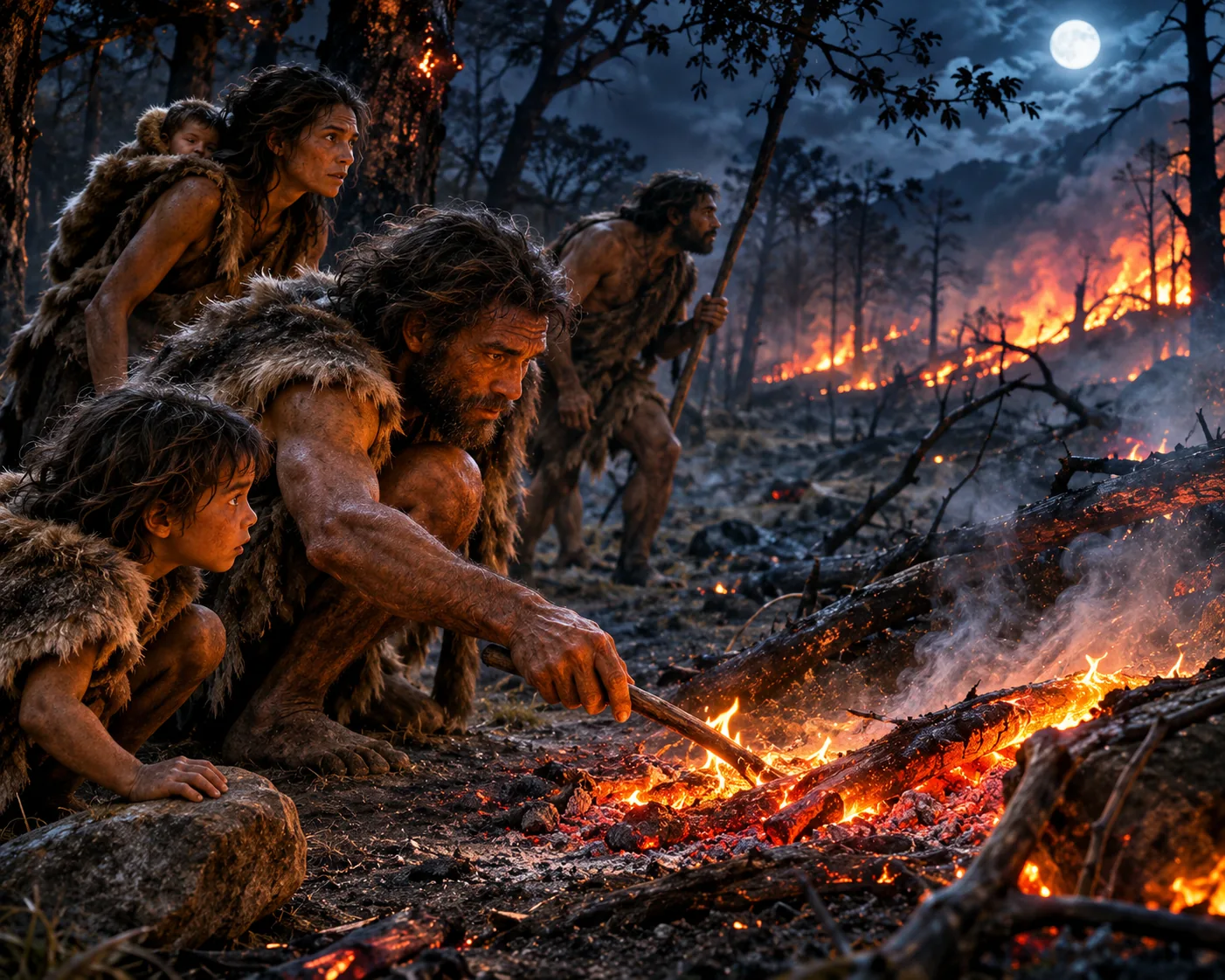
The Night the Forest Burned
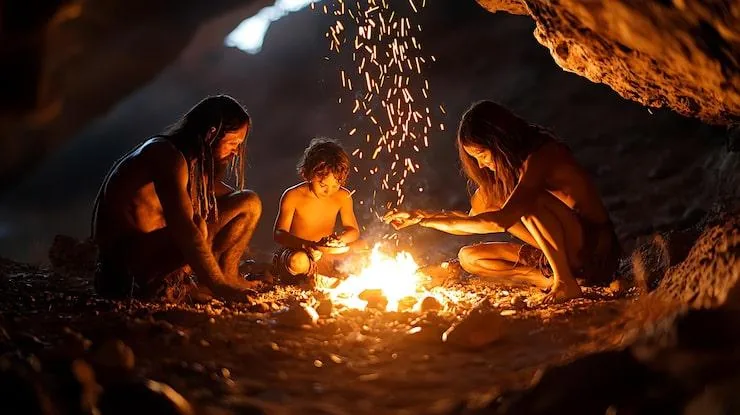
The forest was on fire. Sparks drifted into darkness as animals fled. Somewhere beyond the flames, imagine a small group of early human ancestors watching. We cannot recover such a particular scene; it is an imaginative opening to a real archaeological question. When the blaze passed, perhaps an ember remained. A creature might have approached, felt the heat and learned that a destructive force could also provide warmth, light and protection. Humans did not invent fire. They eventually learned to control a force that had existed long before them. When did an animal first deliberately make the world different?
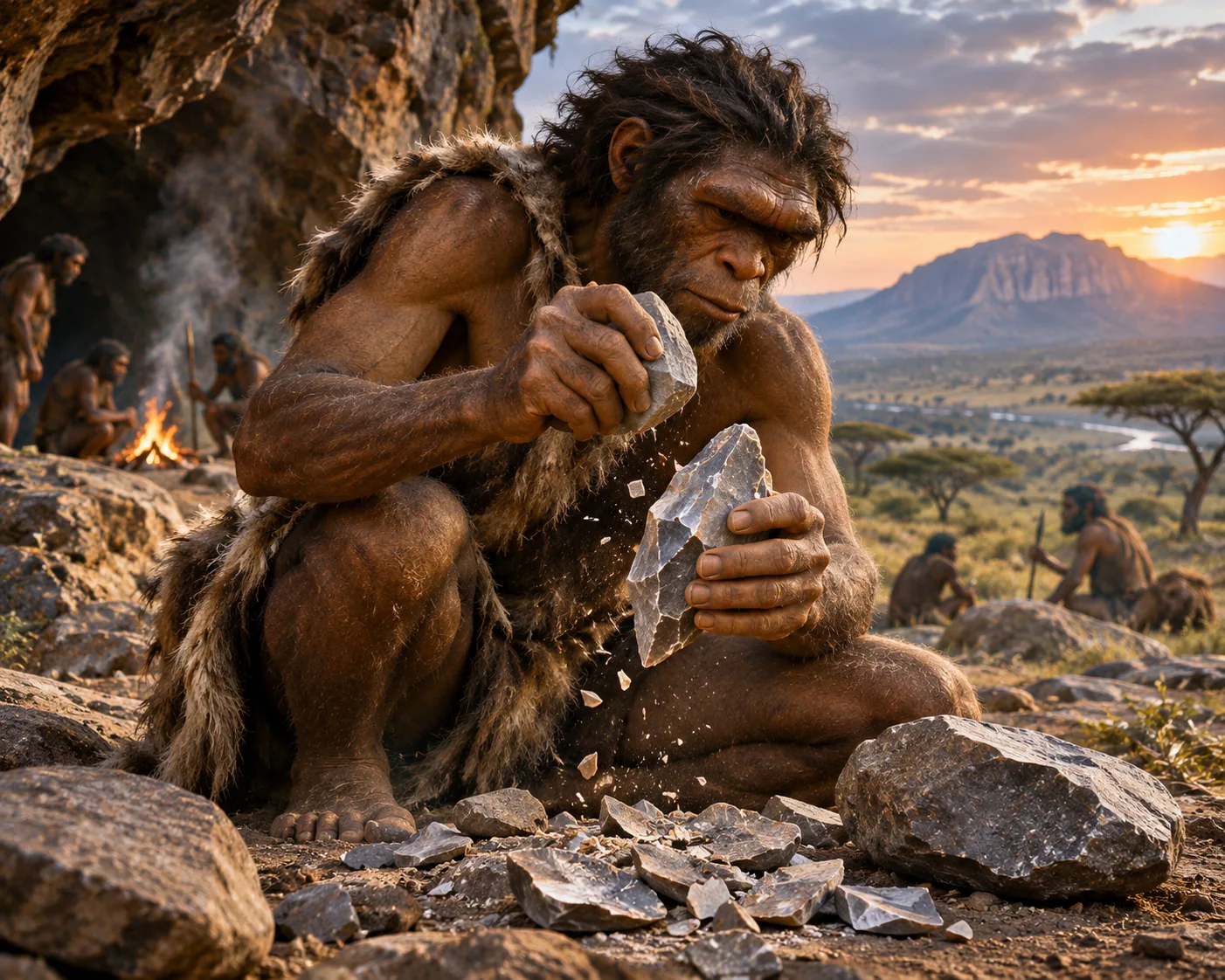
The First Inventor Had No Name
An accidental fracture can leave a stone with a sharp edge. Deliberate knapping turns that possibility into a repeatable technique. Stone artefacts from Lomekwi 3 in Kenya, dated to approximately 3.3 million years ago, are among the oldest widely discussed evidence of stone-tool manufacture. Their makers remain uncertain. Later Oldowan technologies became widespread. The archaeological record reveals actions, not private thoughts: did a maker anticipate the shape, imitate a companion or learn through repeated attempts? The first inventor may never have known that invention had occurred.
The Stone That Changed the Hand
A sharp edge can cut flesh, scrape hides, process plants and shape other materials. A hammerstone can crack hard objects. Tools extended what hands could do. Acheulean handaxes, appearing by roughly 1.76 million years ago, reveal repeated patterns of manufacture and sometimes striking symmetry. Whether that symmetry reflects aesthetic choices, function or production habits remains debated. A tool is both an object and a trace of knowledge: material, technique and purpose meeting in one gesture.
Fire: The Invention That Was Not Invented
Lightning and volcanic activity ignited fires before humans existed. The breakthrough was controlled use, and eventually the ability to produce fire reliably. Wonderwerk Cave in South Africa contains evidence interpreted as fire use about one million years ago. Gesher Benot Ya’aqov in Israel offers evidence of burning around 780,000 years ago. Distinguishing human control from natural burning requires close analysis of ash, charcoal and heated material. There is no single universally agreed birthday for controlled fire, and preserving an ember is not identical to making a spark on demand.
The First Kitchen
Imagine food held above a flame. Heat changes proteins, texture and digestibility, and can reduce certain biological hazards. Cooking may increase energy obtained from some foods, although methods and ingredients matter. Richard Wrangham has argued that cooking profoundly shaped human evolution; the chronology and strength of particular claims remain debated. The first kitchen might have been a patch of earth beside a fire. In that modest space, the environment became something humans could transform before consuming it.
When Night Became Useful
Fire supplied warmth and light, changed the risks posed by predators and potentially extended activity after sunset. Researchers have considered whether fireside gatherings influenced communication, learning and storytelling. These remain hypotheses, not documented transcripts of prehistoric evenings. Fire also demanded vigilance: fuel had to be gathered and flames could destroy shelter. One of humanity’s earliest powerful technologies was also one of its earliest hazards.
Other Animals Invent, Too
Birds build nests, beavers construct dams and some chimpanzees use sticks to obtain food. New Caledonian crows shape tools; sea otters use stones to open shellfish. Humans are not alone in modifying environments or using objects skilfully. What makes human technological history distinctive is its extraordinary cumulative scale: tools making tools, practices transmitted between generations, and innovations combined across communities. No single person understands every part of the technologies on which modern society relies.
The First Needle
Bone needles and sewing tools reveal how ancient people joined hides and fibres. Clothing can make cold and windy environments more survivable. The earliest garments are difficult to date because organic materials decay. Research on clothing lice provides another, uncertain window into the history. A tiny needle helped humans inhabit places their unprotected bodies could scarcely tolerate. Its consequences were geographical, not merely decorative.
The First Boat
Ancient crossings into Sahul—the former landmass connecting Australia and New Guinea—required journeys over water. The vessels have not survived, and researchers debate routes and navigation. Rafts and other watercraft may have preceded the oldest preserved boats by many millennia. The Mesolithic Pesse canoe from the Netherlands is among the oldest surviving examples. A boat turned a barrier into a route. Rivers and seas began to connect as well as divide.
The Wheel Arrived Surprisingly Late
People shaped stone, controlled fire, travelled by water and farmed before wheeled vehicles appeared. Evidence for wheeled transport emerges in the fourth millennium BCE across parts of Eurasia; its precise origin remains debated. A useful wheel requires an axle, appropriate materials and favourable conditions. Boats, sledges or pack animals could be more practical elsewhere. Cleverness alone does not guarantee adoption: an invention must fit a society’s environment and needs.
The Farmer as Inventor
Agriculture developed through different pathways in Southwest Asia, East Asia, the Americas and elsewhere. People selected crops, managed soil and water, stored harvests and changed the reproductive futures of plants and animals. Domestication was gradual, not one worldwide event. Farming could support larger settlements but also introduce vulnerability to drought, crop failure, disease and unequal access to land. Every solution may create new problems.
The City: A Machine Made of People
A city is more than buildings. It is a system of water, food, movement, labour, authority and exchange. Settlements such as Çatalhöyük and later urban centres in Mesopotamia, the Indus region and Egypt demonstrate different trajectories of complex communal life. Cities needed infrastructure and rules as well as walls. The invention of urban living was partly a transformation in collective organisation.
When Memory Left the Brain
Tokens, marks and seals helped people manage obligations and goods. Writing later developed in distinct settings, including Mesopotamia, Egypt, China and Mesoamerica. It was not invented worldwide by one accountant on one day. Writing allowed laws, stories, calculations and observations to survive their authors. A message could reach a person not yet born. Human memory had acquired an external form.
The Invention That Accelerated Invention
Woodblock printing and movable type developed in East Asia before Gutenberg. In fifteenth-century Europe, Gutenberg’s work with metal type, ink and presses helped transform book production. Printing did not immediately remove barriers of literacy, cost or censorship. It did, however, allow ideas and instructions to circulate more consistently and widely. Knowledge could be copied and combined at a new scale.
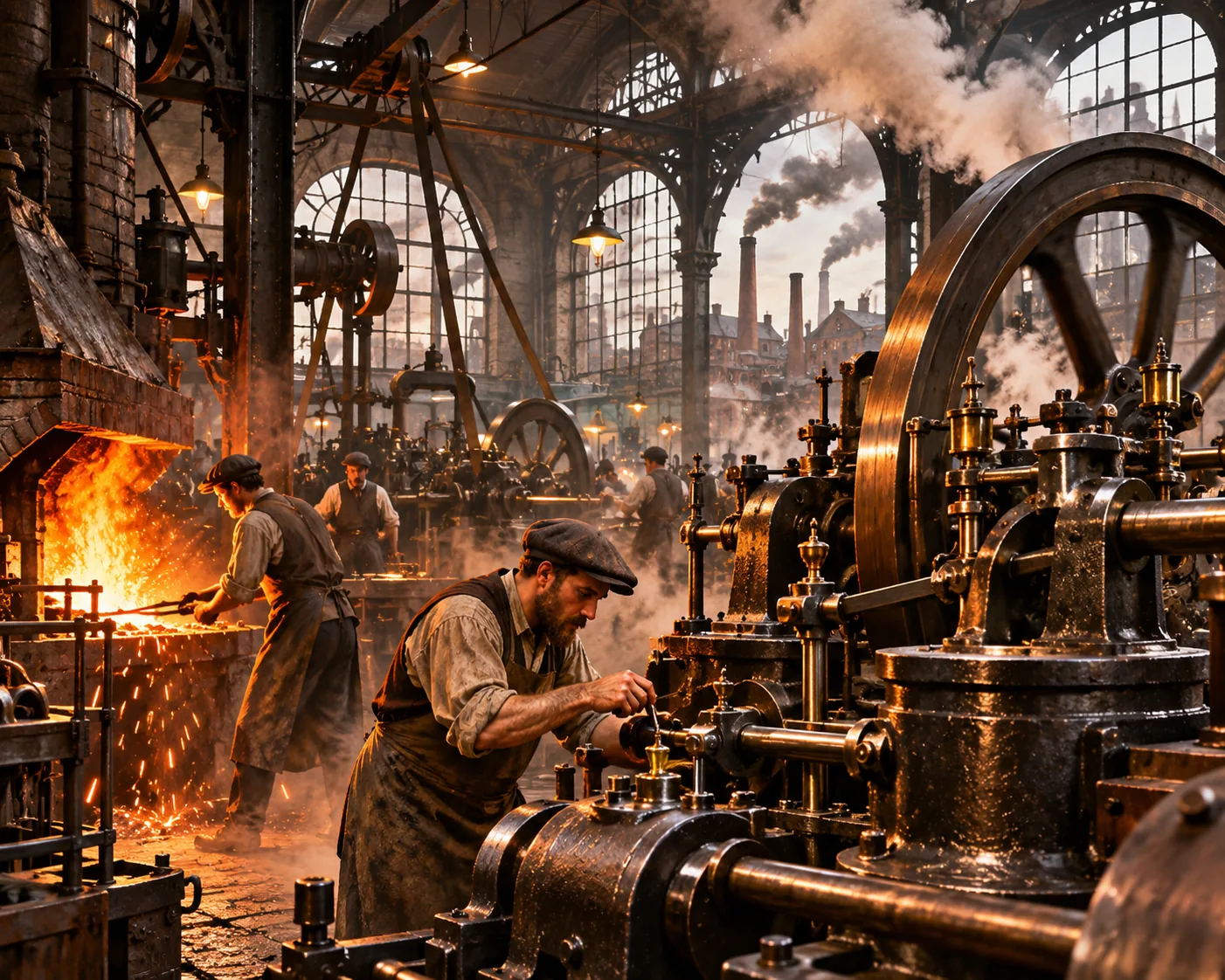
Steam and the New Meaning of Power
Early steam devices preceded practical engines. Newcomen’s eighteenth-century engine pumped water from mines; Watt’s improvements increased efficiency. Steam power reshaped manufacturing, mining and transport, but industrialisation also brought dangerous work, urban pollution and growing fossil-fuel emissions. Mechanical power multiplied human capabilities without automatically improving human judgment.
The Night Electricity Became a City
Volta, Faraday, Maxwell, Edison, Tesla and countless engineers contributed to electrical science and infrastructure. Faraday’s electromagnetic induction helped make generators possible; Maxwell’s equations unified key aspects of electricity and magnetism. Electric lighting, motors and power grids transformed factories and homes. Energy could be generated in one place and used in another. The city began to glow, supported by an intricate network few residents could fully explain.
The Message That Outran the Messenger
The telegraph let information travel electrically across distance. Submarine cables linked continents; telephones carried voices; radio enabled wireless communication. The internet emerged through decades of networking research, while the World Wide Web developed from Tim Berners-Lee’s work at CERN beginning in 1989. The web is not identical to the internet. Faster communication did not guarantee better understanding, but it changed what coordination could mean.
Machines That Calculate
Babbage imagined programmable mechanical computing machinery; Ada Lovelace saw possibilities beyond arithmetic. Turing helped establish theoretical foundations of computation. Electronic computers, transistors and integrated circuits transformed the speed and scale of calculation. The modern computer is not one miraculous device invented in a single afternoon. It is a convergence of mathematics, engineering, materials and generations of accumulated work.

Artificial Intelligence and the Unfinished Future
Machine-learning systems can recognise patterns, translate, generate text and images, and assist research. These capabilities do not by themselves establish subjective experience. AI raises questions about reliability, bias, labour, creativity and power. Meanwhile researchers explore batteries, medicines, cleaner industry, robotics and space technologies. Some ambitious inventions will fail; modest ones may transform lives. The future is not a guaranteed march toward perfection.
The First Spark Is Still Burning
Return to the forest after the fire. An ember glows among the ashes. Perhaps an ancestor preserves it; perhaps the chance is lost. We cannot know. But a long history followed: stone tools, needles, boats, wheels, fields, cities, writing, printing, engines, electricity, computers and AI. Some inventions extended the hand; others extended memory, movement or communication. Beneath them lay a capacity to imagine that the world need not remain exactly as it was. The first inventor had no name. The last inventor has not yet been born. And every invention leaves us with one question: just because we can create something, does that mean we should?
Research Notes and References
- Harmand et al. (2015), 3.3-million-year-old stone tools from Lomekwi 3, Nature.
- Berna et al. (2012), Evidence of fire at Wonderwerk Cave, PNAS.
- Richard Wrangham (2009), Catching Fire (an influential, debated hypothesis).
- Smithsonian Human Origins Program.
- British Museum — Collections and Research.
- Science Museum Group.
- Computer History Museum.
- CERN — The Birth of the Web.
Editorial principle: Archaeological evidence is distinguished from imagined scenes. Many inventions emerged cumulatively, without one identifiable inventor or date. Interpretations will be revised when stronger evidence emerges.
Dark Page — Wonder & Curiosity | Everything Has a Beginning. Every Beginning Has a Story.



