

Birth Stories — Research Feature 03 | An investigation of fear, love, memory, grief and consciousness

The Creature That Heard Something in the Dark
The forest was not silent. Insects moved beneath the leaves; branches rubbed against each other; somewhere a small animal searched for food. Then a sound came from the undergrowth. The creature froze. Its muscles prepared for danger. It fled. This is an imagined scene, not a recovered event from prehistory. But it opens a genuine scientific mystery: was the animal afraid, or did it merely perform a defensive response? We can reconstruct behaviour and nervous systems; we cannot directly enter an ancient creature’s experience. The distinction between reacting and feeling is the doorway to the birth of emotions.
Before There Were Feelings
For much of Earth’s history, life consisted of microorganisms. Bacteria can sense chemical gradients and move toward nutrients or away from harmful conditions. Such responses are impressive but do not establish conscious wanting or suffering. A thermostat also responds to its surroundings; responsiveness alone is not sentience. To study the origins of emotion, scientists must distinguish detection, adaptive behaviour and subjective experience. They may be related, but they are not interchangeable.
The First Nervous Systems
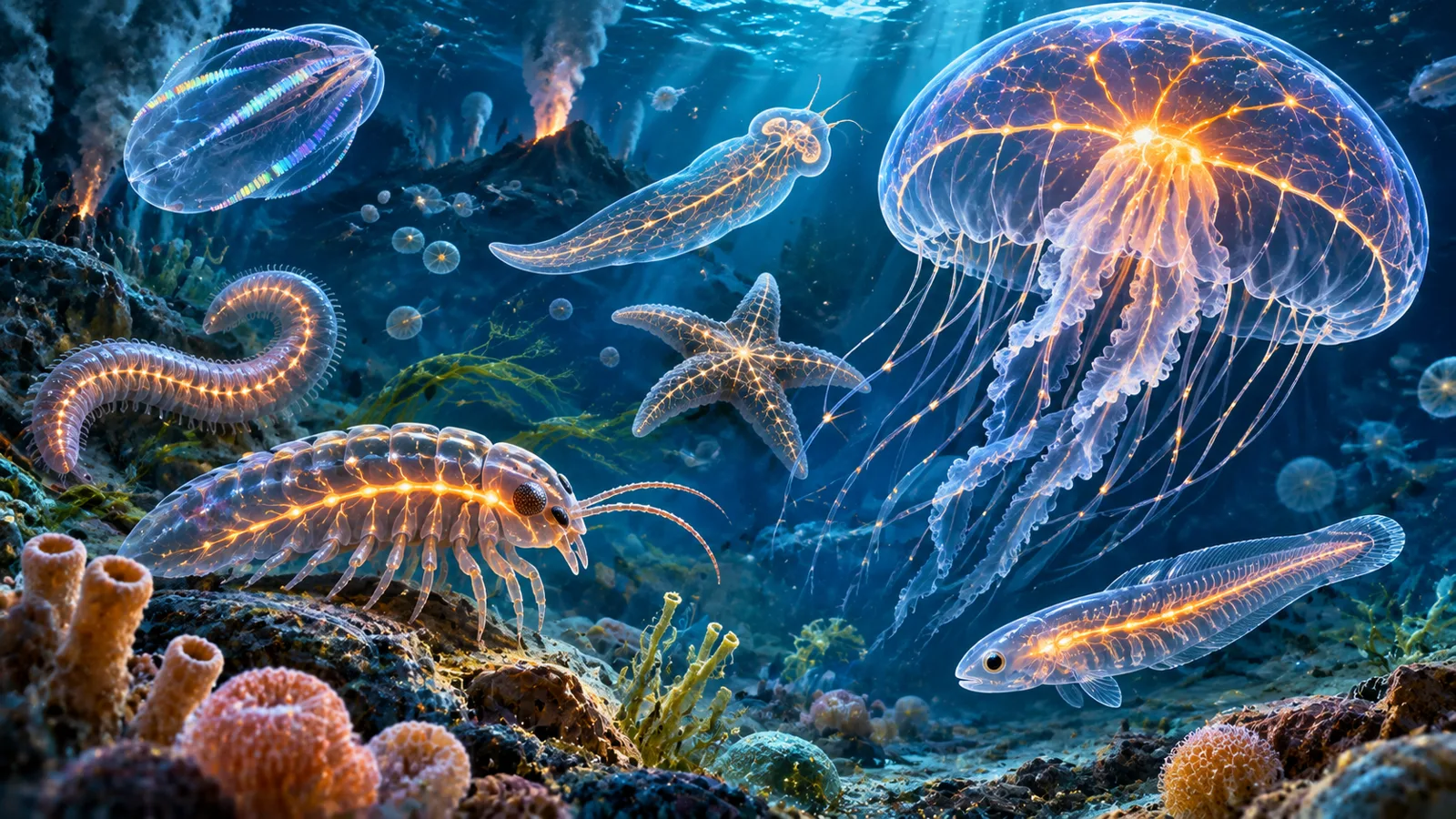
Multicellular animals faced a coordination problem: how could cells organise movement, feeding and defence? Neurons and neural networks provided powerful solutions. Jellyfish and their relatives have nerve nets rather than brains like ours; other early animal groups display different architectures. Researchers still debate the evolutionary sequence of the earliest animal lineages and nervous systems. Neurons make flexible behaviour possible, but the first neuron does not identify the first conscious feeling. A nervous system can be observed; an experience must be inferred with care.
Fear: The Ancient Guardian
Predators and hazards existed long before humans. Selection could favour organisms that rapidly detected threats. In mammals, the amygdala participates in threat learning alongside the hypothalamus, brainstem and wider brain networks. But it is not a single fear container. Neuroscientist Joseph LeDoux has argued that defensive survival circuits and the conscious feeling of fear should be distinguished. Other affective-neuroscience perspectives emphasise ancient emotional continuities among mammals. The disagreement is important: freezing in an experiment is measurable, but it does not by itself disclose what the animal feels. Perhaps fear emerged gradually as sensing, bodily preparation, memory and experience became more closely integrated.
The Creature That Remembered Yesterday
A small animal survives an attack. Days later it returns to the same place, smells something familiar and hesitates. Learning has changed its future. Even relatively simple nervous systems support lasting behavioural change; sea-slug research has helped reveal cellular mechanisms of memory. Birds remember food caches, and social mammals recognise individuals. Yet memory need not involve an autobiographical narrative. A creature may carry traces of yesterday without remembering it as a human remembers a childhood afternoon.
When Staying Close Became a Matter of Survival
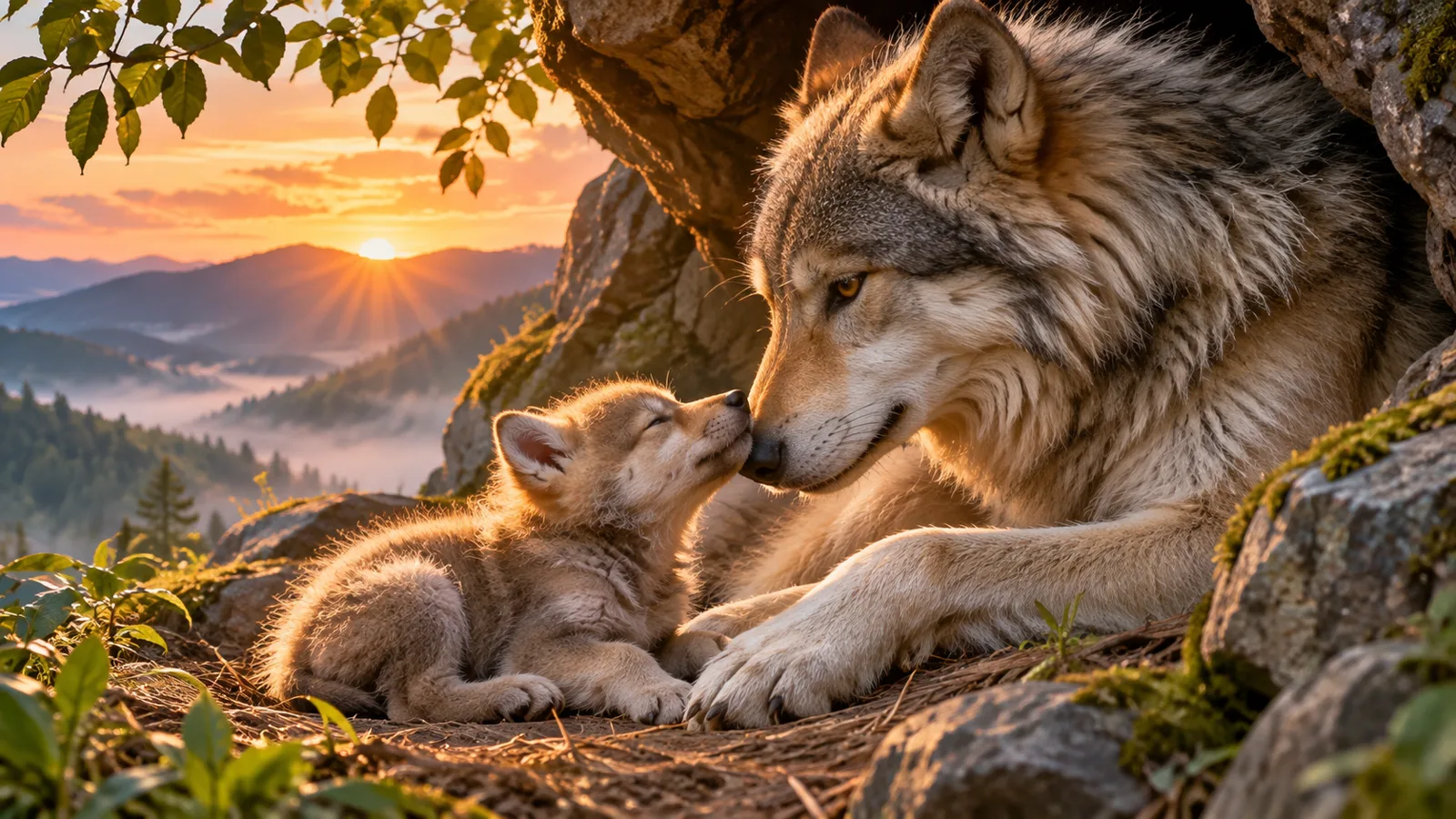
A newborn calls. A parent approaches. Warmth, feeding and protection can determine survival. In many lineages, parental care and social bonds evolved under particular ecological pressures. Oxytocin and other signalling systems contribute to social behaviour in some mammals, but there is no universal chemical that simply equals love. Pair bonding, parental attachment and human romantic love are related topics, not one identical phenomenon. Fossils preserve bones and nests; they do not preserve longing. We cannot identify the first creature that loved, but the evolutionary foundations of attachment are deep.
The First Grief
Elephants investigate remains; some primate mothers have been observed carrying dead infants; social animals sometimes alter behaviour after loss. These observations deserve attention without automatic translation into human mourning. Human grief can include an understanding of death, shared memories and imagined futures. Animals may respond deeply without possessing those same concepts. Dismissing their responses as meaningless instinct is premature; treating every response as proof of human-like sorrow is equally unwarranted. The private life of another creature remains difficult to know.
Anger, Compassion and the Social World
Aggression is not identical to anger. Defensive attack, territorial competition and human outrage at injustice involve different mechanisms and interpretations. Empathy is similarly complex. Researchers distinguish emotional contagion, concern for another’s welfare and perspective-taking. Some components appear in nonhuman animals, but their extent and meaning remain debated. Human empathy can encourage cooperation, yet it is often uneven: people may care deeply for neighbours while ignoring distant suffering. Biology provides capacities; culture and moral reflection shape how they are used.
Dreams: Worlds Behind Closed Eyes
A sleeping person can visit an impossible city, meet someone long dead or experience terror without an external threat. Dreams occur especially during REM sleep but are not exclusive to it. Many animals exhibit distinctive sleep states, although the contents of any animal’s dreams are difficult to establish. Ancient Mesopotamian, Greek and religious traditions often treated dreams as meaningful; modern sleep science studies neural activity, memory and reported experience. These approaches ask different questions. The laboratory can investigate sleep, but cannot automatically determine the spiritual meaning a dream holds for its dreamer.
The Animal in the Mirror
A mirror reflects an animal’s face. Does it recognise itself? Mirror self-recognition studies have yielded intriguing findings in some species, but passing such a test is not proof of every kind of self-awareness, and failing it is not proof of unconsciousness. An animal that depends primarily on smell may not respond to a visual reflection as a human does. Bodily self-detection, remembering one’s past and imagining one’s future may be separable abilities. The self may not be a single evolutionary invention.
What Is Consciousness?
Being awake and responsive is not the same as having a subjective experience. Consciousness researchers study perception, attention, neural activity and reports of awareness. Global neuronal workspace theories, integrated information theory, recurrent-processing approaches and other accounts propose different explanations. None has universal acceptance. Why should physical activity feel like anything from the inside? How might we identify unfamiliar forms of experience in other animals? The questions remain open, and experimental evidence must be separated from philosophical assumptions.
The Octopus and the Stranger’s Mind
Octopuses explore, learn and solve problems with nervous systems strikingly different from ours, including substantial neural processing associated with their arms. Such evidence has strengthened concern for cephalopod welfare, but intelligence and consciousness should not be equated. Nor should lack of human speech be mistaken for lack of feeling. Researchers compare behavioural, physiological and neural evidence. The living world may contain forms of experience that our language describes poorly.
When Feelings Became Stories
Human emotional communication long predates writing. Gestures, calls, touch and expressions helped organise social life. Language later made it possible to name feelings, narrate loss, debate duty and turn longing into poetry. The Epic of Gilgamesh explores friendship and mortality. Greek tragedy examines passion and responsibility. South Asian theories of rasa study the aesthetic evocation of emotional states. Arabic, Persian and Urdu poetry developed rich languages of separation and devotion. These are not evolutionary experiments; they are records of how people have interpreted inner life. Science examines mechanisms. Literature explores meaning.
The Soul, the Heart and the Inner Life
Islamic intellectual traditions have discussed nafs, qalb, ruh, intellect and perception through scripture, theology, philosophy and spirituality. Hindu and Buddhist traditions contain diverse and sometimes sharply different accounts of consciousness and selfhood. Western philosophy has debated materialism, dualism and idealism. None should be flattened into a simple scientific prediction. Neuroscience can investigate the brain without automatically resolving metaphysical questions; sacred traditions should be represented accurately in their own contexts rather than made to substitute for empirical tests.
Could a Machine Ever Feel?
Artificial intelligence can now produce fluent descriptions of happiness, sorrow and affection. But persuasive emotional language is not proof of subjective experience. There is no universally accepted scientific test that conclusively establishes machine consciousness. Researchers disagree about which computational or physical features might be necessary. We should avoid declaring that a machine is conscious because it talks as if it is, and avoid pretending that every possible future system has already been ruled out. Observable capability and experienced feeling are different claims.
The Universe That Learned to Care
Return to the imagined forest. A creature hears a sound and escapes. We cannot know whether it felt fear. Millions of years later, a person holds a loved one’s hand beside a hospital bed. A parent waits for a child. A poet remembers someone who will never return. The atoms in their brains belong to the same physical universe as stars, mountains and dust, yet living systems have developed the capacity—at least in humans—for memory, imagination, suffering and love. We may never find a fossil of the first feeling. The beginning may have been gradual, or stranger than our theories allow. But one question remains extraordinary: when did the universe begin to feel? We do not know. And our ability to ask reveals something remarkable about what the universe has become.
Research Notes and References
- Charles Darwin (1872), The Expression of the Emotions in Man and Animals.
- Joseph LeDoux (2012), Rethinking the Emotional Brain, Neuron.
- LeDoux and Pine (2016), A Two-System Framework for Fear and Anxiety.
- Jaak Panksepp (1998), Affective Neuroscience.
- Frans de Waal and Stephanie Preston (2017), Mammalian Empathy.
- Stanislas Dehaene and Jean-Pierre Changeux (2011), Experimental and Theoretical Approaches to Conscious Processing.
- Anil Seth and Tim Bayne (2022), Theories of Consciousness.
- The New York Declaration on Animal Consciousness (2024).
Editorial note: Behavioural responses are not automatically evidence of subjective experience. Scientific interpretations remain provisional. Historical and religious traditions are discussed as distinct forms of understanding. We may be wrong; when stronger evidence emerges, we will revise.



