

Birth Stories — Research Feature 01 | Science, history, tradition and the questions still unanswered
The future has already entered the room
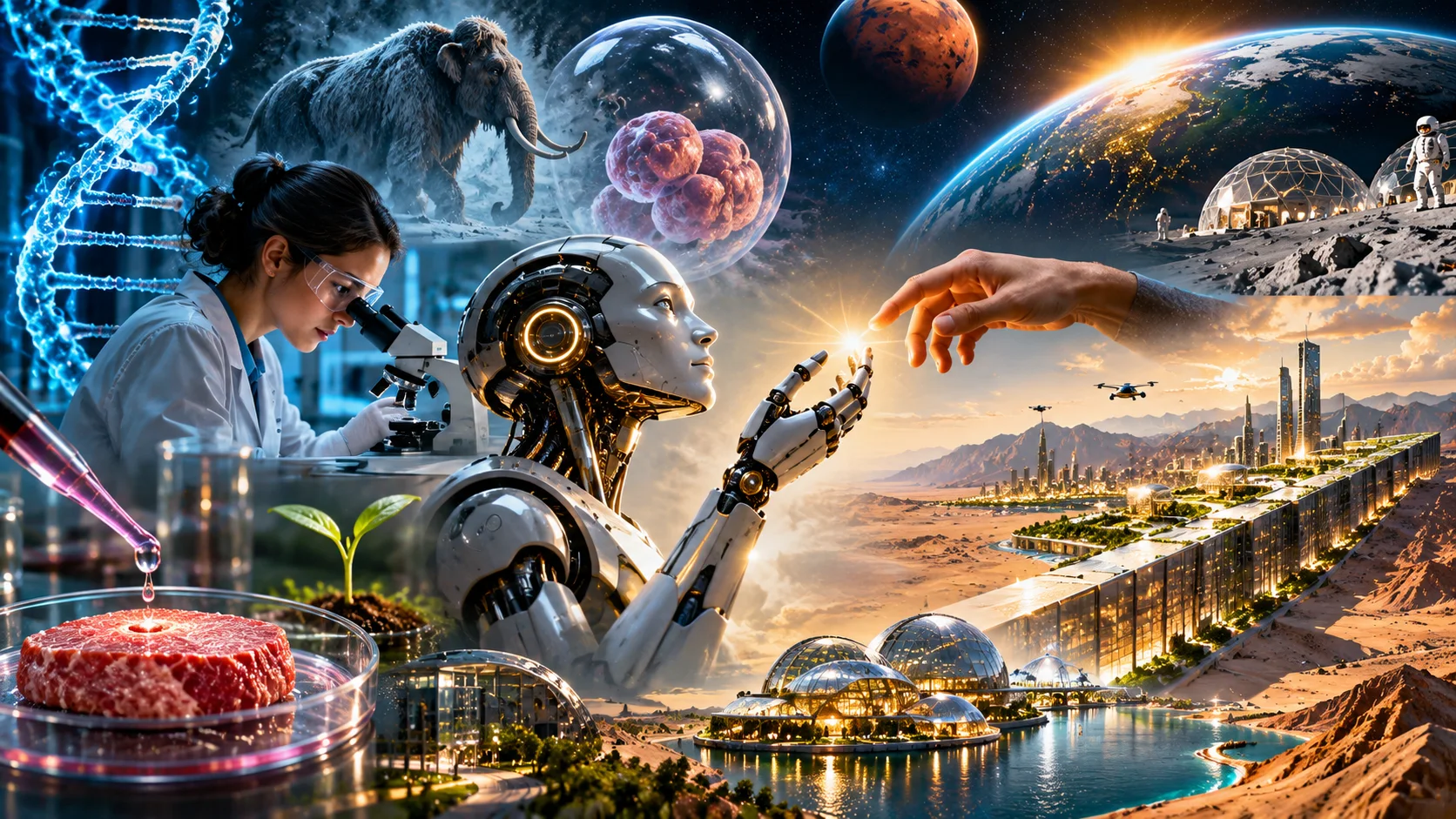
The future used to arrive in stories. It came riding on mechanical horses, speaking through mirrors, or living in cities suspended above the clouds. Today it arrives in a laboratory freezer, a computer screen, a bioreactor, or a planning document for a city that does not yet exist. Some of these inventions work. Others remain prototypes, aspirations, or expensive promises. The difference matters.
Imagine a child born today. During that child’s lifetime, food might be grown from animal cells, inherited diseases might become treatable through precisely targeted genetic changes, and machines might perform tasks once thought inseparable from human judgment. Yet no scientific result guarantees that these technologies will be affordable, fair, safe, or widely adopted. The future is not a destination waiting for us. It is a contested collection of decisions being made now.
To understand this new world, we must begin with evidence—and then ask the older questions that evidence alone cannot settle: What should humans make? Who gets to decide? And who lives with the consequences?
1. Rewriting the instructions of life
For millennia, people changed living things without seeing a gene. Farmers saved seeds from plants with desirable characteristics. Herders bred animals for temperament, milk, strength, or endurance. The results could be extraordinary, but change usually took generations. Molecular biology eventually revealed a more direct route: DNA carries instructions used by living cells, and those instructions can sometimes be changed deliberately.
CRISPR-based genome editing uses molecular machinery to target particular stretches of DNA. It is powerful, but not magical. Changes can have unexpected effects; delivering the editing tools to the right cells can be difficult; and complex characteristics rarely depend on one gene. Still, the first regulatory approvals of CRISPR-based therapies for certain patients with sickle-cell disease marked a remarkable transition from laboratory technique to clinical medicine.
That achievement does not mean all genetic diseases can now be cured. A therapy developed for one condition cannot simply be applied to another, and questions about long-term safety, access, and cost remain. Editing cells in an existing patient also raises different ethical issues from editing embryos in ways future generations could inherit.
Ancient stories often imagined transformations of living beings and the pursuit of immortality. Such traditions reveal enduring human desires, not evidence that ancient storytellers anticipated CRISPR. The modern question is more immediate: when an intervention becomes possible, who should determine whether it is wise?
2. Can an extinct animal truly return?
The woolly mammoth remains one of the most haunting images of a lost world: enormous, furred, and adapted to cold landscapes that have since changed. Advances in ancient DNA analysis and genome engineering have encouraged proposals to produce elephants with some mammoth-like traits. Other projects have invoked the dodo and the dire wolf.
But the phrase “bringing back an extinct species” conceals a difficult scientific problem. An organism’s identity is not a handful of selected genes. It also involves a genome, development, behavior, reproduction, ecology, and relationships with other members of its species. A genetically modified living relative may resemble an extinct animal without being the same species restored.
Researchers disagree about how to describe such animals, and the ecological claims are even harder to establish. Would an engineered mammoth-like elephant thrive? Would introducing it help restore a landscape—or create new problems? If conservation resources are scarce, should they protect species still alive rather than reconstruct those already lost?
The deeper mystery is not whether science can make something impressive. It is whether resemblance amounts to resurrection.
3. Organisms designed for unfamiliar jobs
Synthetic biology extends the story beyond editing individual genes. Researchers can design genetic circuits, modify microorganisms to manufacture useful substances, and construct simplified experimental systems to study what life requires. Engineered microbes are being investigated for applications in medicine, materials, manufacturing, and environmental remediation.
Some achievements are well established, including the long use of genetically engineered microorganisms to produce medicines such as insulin. Others—microbes that reliably clean up pollution in open environments or produce fuels at transformative scale—face substantial technical, ecological, and economic obstacles.
Living systems evolve, interact, and spread. That makes biological design different from assembling a machine whose parts stay where they are put. Containment, ecological testing, oversight, and public accountability are not optional footnotes. They are part of the invention itself.
4. A piece of meat that never belonged to a slaughtered animal
A small sample of animal cells can be cultivated in a controlled environment, supplied with nutrients, and encouraged to multiply. With appropriate techniques, those cells can become the material of cultivated meat. This is real biological tissue, not a vegetable imitation, although producing familiar textures and complex cuts remains challenging.
The process also has a history of bold claims. Some cultivated-meat products have received regulatory authorization in particular markets, but widespread commercial adoption remains limited. Production facilities are expensive, growth media and energy requirements matter, and scaling from a demonstration to affordable mass production is difficult.
Supporters hope the technology could reduce slaughter and, under suitable conditions, certain environmental impacts. Critics note that climate outcomes depend heavily on energy sources, production methods, and the type of conventional meat being compared. No single environmental benefit should be treated as guaranteed.
Food is never merely chemistry. It is memory, livelihood, ritual, identity, and religion. Muslim scholars and certification bodies must consider questions about the source of the cells, growth media, production methods, and the conditions of halal certification. Different interpretations may arise. Farmers and rural communities have their own concerns: what happens when a food system changes faster than the people who depend on it?
We may soon learn that growing meat is easier than agreeing on what it means.
5. The machines that learned to answer
A machine that speaks fluently can create the impression that someone is speaking from inside it. Modern artificial-intelligence systems can generate text, analyze images, write software, help scientists explore data, and assist with a growing range of tasks. Their achievements are measurable, but their mistakes can be persuasive, and fluent language does not prove human-like understanding or consciousness.
Today’s AI grew from decades of mathematical work, computing, statistics, neural networks, and engineering. Its progress is neither a single sudden awakening nor an inevitable march toward a particular destiny. Capabilities differ across systems; benchmark performance does not automatically translate into reliability in a hospital, courtroom, classroom, or public institution.
Robots add bodies to some of these systems. Industrial robots have operated for decades; surgical robotic platforms are used under human clinical control; experimental systems can navigate unfamiliar spaces and manipulate objects. Yet a general-purpose robot that can safely and affordably perform every household or caregiving task remains far from ordinary reality.
Greek mythology tells of Talos, a bronze guardian; Jewish folklore includes the golem; medieval engineers built ingenious automata. These stories and inventions do not predict contemporary AI. They show that the idea of an artificial helper—and the fear that a creation may escape its maker’s intentions—has deep roots.
We should ask two questions separately: What can the machine do? And what authority should we give it? The second may prove harder.
6. Will machines invent their own language?
Human language is not static. Printing, broadcasting, migration, and the internet have all reshaped how people speak and write. Emojis, memes, abbreviations, and online communities can transmit humor or emotion with astonishing speed. But an emoji is not necessarily a universal language: its meaning changes with culture, context, and generation.
In research settings, artificial agents trained to cooperate can develop compact signaling conventions. This phenomenon, often called emergent communication, is scientifically interesting. It should not be confused with proof that AI systems have spontaneously created a secret, autonomous civilization of language beyond human comprehension. The systems, objectives, and communication channels are typically defined by researchers, even when the resulting signals are not immediately intuitive.
Translation tools may reduce language barriers, but language learning is more than converting sentences. It offers access to humor, history, intimacy, and ways of thinking that automated translation may only partially convey. The question is not simply whether machines can translate us. It is whether we will still make the effort to understand one another.
7. Cities designed before their inhabitants arrive
Cities traditionally grow through a long negotiation between geography and human need. Rivers offer water and trade; roads attract markets; markets attract houses; houses eventually become neighborhoods, governments, and memories. Contemporary planners sometimes reverse the sequence: design the entire city first, then invite people to inhabit it.
Saudi Arabia’s NEOM and its proposed linear city, The Line, are among the most visible examples of this ambition. Their architectural images are arresting, but renderings are not evidence that a completed city exists. The project’s scope, financing, engineering demands, environmental consequences, and timelines must be evaluated against verified construction progress rather than promotional imagery.
Smart-city technologies promise more efficient transport, energy, and public services. They also introduce questions about surveillance, data ownership, resilience, accessibility, and democratic control. A city can be technologically advanced yet socially inhospitable. It can be green on a screen while consuming enormous resources in construction.
What makes a city alive? Not merely its buildings, but the unplanned encounters, disagreements, traditions, and ordinary routines that its residents create. Can those be designed from above?
8. Can an online community become a country?
A country is not simply a group of people who agree to call themselves one. International law and political practice involve questions of territory, permanent population, effective government, sovereignty, and recognition. The precise legal tests and their application are contested, but buying property or declaring independence on a website does not automatically create a recognized state.
Advocates of “network states” imagine online communities developing shared institutions and eventually acquiring physical territory. Seasteading projects envision settlements on water, sometimes with aspirations for greater autonomy. Both raise serious questions about infrastructure, citizenship, labor rights, environmental protection, maritime jurisdiction, and relations with existing states.
There is an older echo here. Utopian communities have repeatedly attempted to build societies from a plan. Some endured; many failed; almost all discovered that governance is more difficult than drawing a blueprint. A new flag is easy to design. A just society is not.
9. The settlement beyond Earth
The Moon and Mars invite the most dramatic form of future settlement: humans living where human life cannot survive unaided. Astronauts have visited the Moon; robotic missions continue to investigate Mars. But neither world currently hosts a self-sustaining human city. Radiation, life support, energy, food, medical care, low gravity, and transport make the problem far harder than cinematic depictions suggest.
Space law adds another layer. The Outer Space Treaty places important limits on national appropriation of celestial bodies, while questions about resource use and future settlements remain subjects of legal and political debate. Even if humans build a habitat beyond Earth, it will not automatically become a sovereign nation.
And if we carry our old inequalities into a new world, will distance from Earth make us any different?
10. The future’s oldest argument
Science can describe what a technology does, test its performance, and investigate its consequences. It cannot, by itself, decide whose interests should come first. Religious traditions, moral philosophy, political institutions, and lived human experience all enter that discussion. They may disagree profoundly, and their claims should not be presented as interchangeable forms of experimental evidence.
Some religious thinkers interpret human ingenuity through ideas of stewardship, responsibility, or the limits of human power. Others focus on protecting life, dignity, justice, and the natural world. These perspectives deserve accurate treatment in their own contexts, not convenient quotations attached to technological headlines.
There is also a duty to revise. A celebrated innovation may prove harmful; a dismissed idea may acquire evidence; an apparently certain prediction may fail. The responsible writer neither worships scientific authority nor pretends that all opinions carry equal evidential weight. We follow the strongest available evidence, state what remains uncertain, and correct ourselves when better evidence arrives.
Perhaps the most astonishing thing about the future is not that we are beginning to create it. Human beings have always done that. The astonishing thing is that our creations may change the meaning of being human. We can edit the instructions of life, grow food from cells, build machines that answer questions, and imagine cities where no city has stood before. Yet one question remains beyond every laboratory and every computer: If we are becoming powerful enough to reshape the world, are we becoming wise enough to decide what it should become?
Research Notes and Further Reading
This feature distinguishes demonstrated results from proposed technologies and speculative futures. The following primary institutional and research sources provide starting points for further verification; their findings do not imply that every prediction in this essay will occur.
- US FDA: First gene therapies for sickle-cell disease, including a CRISPR-based treatment.
- WHO: Human genome editing and governance.
- Food Standards Australia New Zealand: Cell-cultured foods.
- US FDA: Human food made with cultured animal cells.
- COLING 2025: Research on emergent communication in language models.
- UN Office for Outer Space Affairs: Outer Space Treaty.
- NASA: Human space exploration.
Editorial note: The interpretations offered here are provisional. We may be wrong; when stronger evidence emerges, this article should change with it.



