

On 18 November 2026, a machine launched nearly half a century ago reached a distance so immense that a message from Earth takes a full day to arrive. The remarkable part is not only how far Voyager 1 has travelled. It is that humanity can still listen.
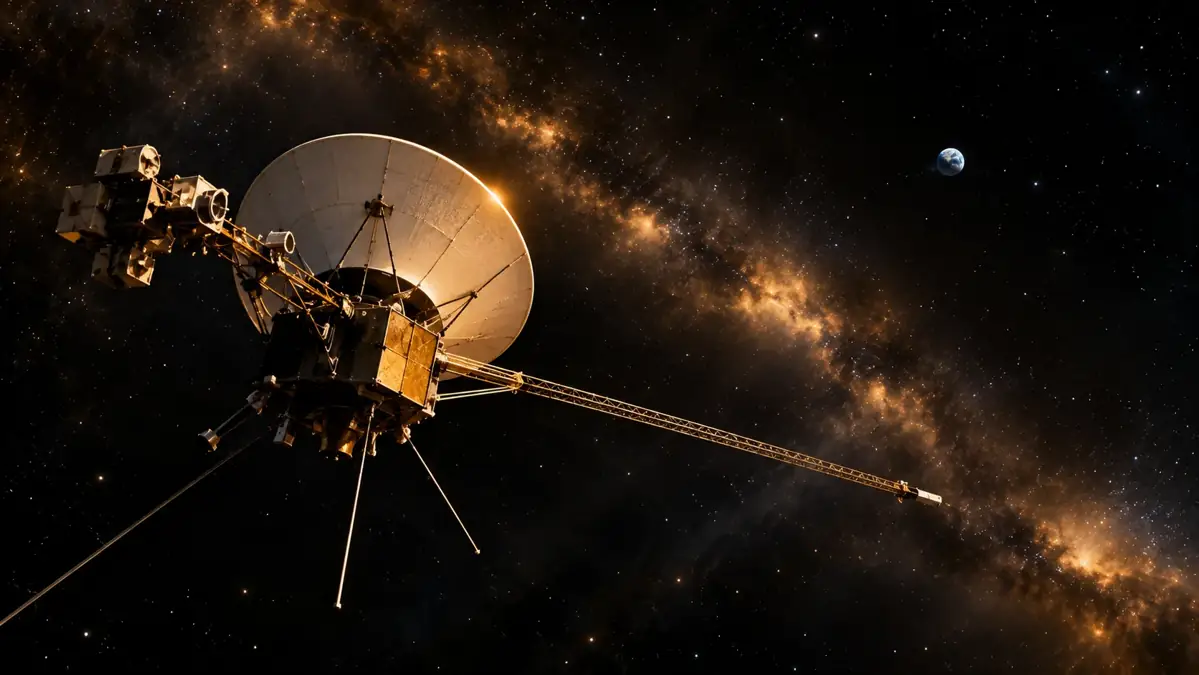
A day between a question and an answer
NASA’s Voyager 1, launched in September 1977, has reached approximately one light-day from Earth: roughly 26 billion kilometres, subject to the changing distance between Earth and the spacecraft. A radio instruction sent from Earth now takes around 24 hours to reach the probe. A reply requires another 24 hours to return. Even a simple exchange becomes a two-day conversation.
According to reporting on 18 November, the predicted milestone was reached that morning; the arrival of the corresponding signal provides the operational confirmation. These are travel-time calculations based on radio waves moving at the speed of light, not evidence that the spacecraft has suddenly accelerated.
Beyond the Sun’s bubble, but not beyond its influence
Voyager 1 crossed the heliopause into interstellar space in 2012. The heliopause is the boundary where the solar wind gives way to the surrounding interstellar medium. Crossing it does not mean leaving the solar system in every sense: the Sun’s gravitational influence extends vastly farther, and the distant Oort Cloud lies well ahead on a journey measured in centuries.
The spacecraft continues to measure conditions that telescopes near Earth cannot sample directly. Magnetic fields and energetic particles help scientists examine the environment between the stars and the unexpectedly complex boundary of the Sun’s influence.
The silence engineers must manage
Voyager’s radioactive power source gradually weakens. Engineers have switched off equipment to conserve energy and extend the mission. Each decision must account for the long delay, aging electronics and a spacecraft operating far beyond its original planetary-tour design life.
Voyager carries a Golden Record containing selected sounds and images of Earth. Its more immediate message, however, is scientific: an instrument built in the 1970s still reports on a place no human has visited.
The question beyond the milestone
How much longer can we maintain a conversation with a spacecraft that is drifting farther away every second? And what will we learn about interstellar space before the final signal fades? One light-day is not the end of Voyager’s journey. It is a measure of how patient scientific curiosity has become.



